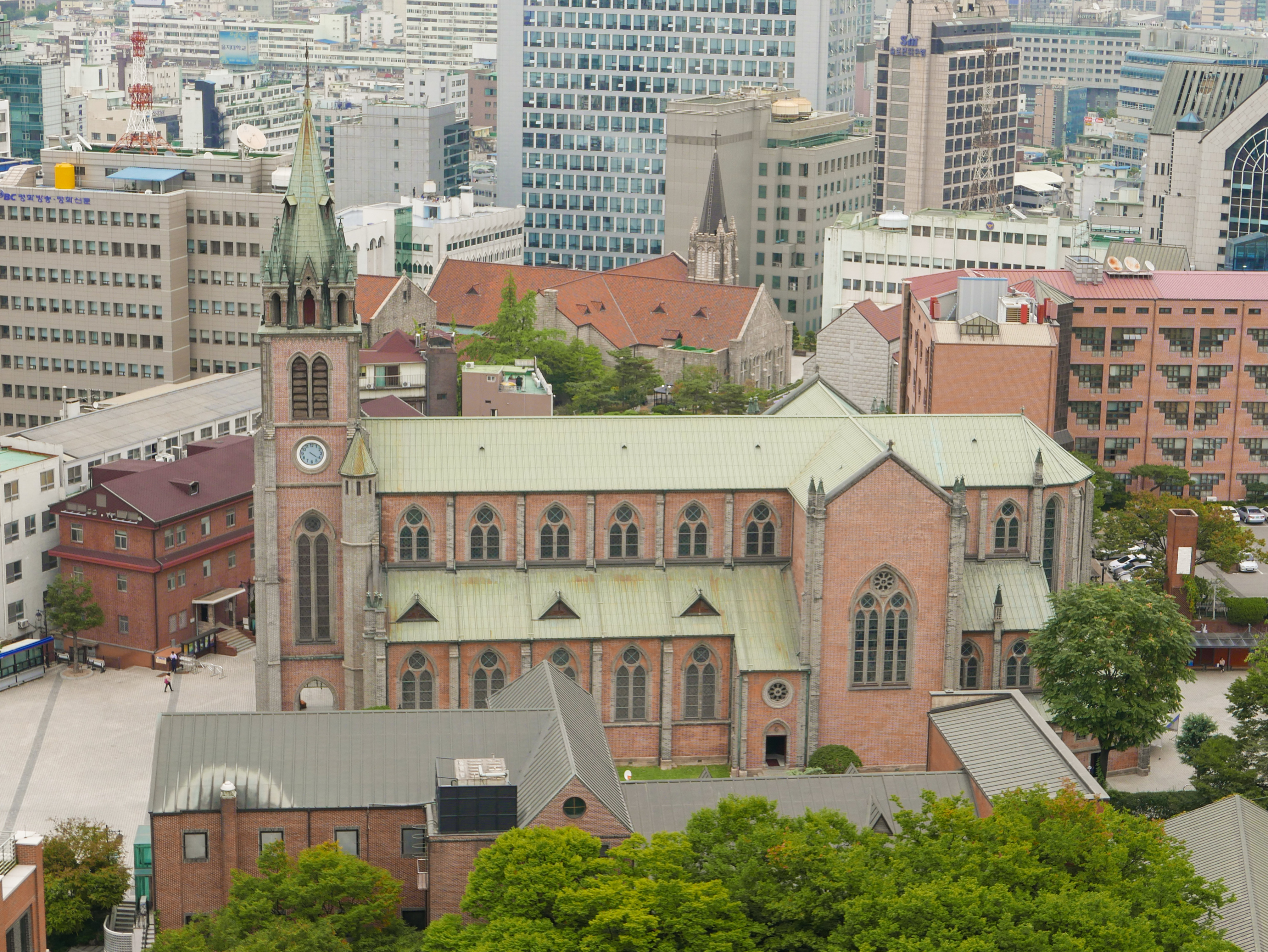
Myeongdong Cathedral
The land was available because everyone else was afraid of it. In the 1880s, when the French Apostolic Vicar of Korea needed a site for a mission, he found a vacant lot on Jonghyeon, meaning Bell Hill, in central Seoul. Koreans had avoided building there because of its proximity to a Confucian temple. Under the Korean name Kim Gamilo, Bishop Marie-Jean-Gustave Blanc acquired the parcel. By 1898, the cathedral that rose on it was the largest building in Seoul, its red and gray brick neo-Gothic spire towering over a city of tile roofs and wooden walls. More than a century later, Myeongdong Cathedral still stands in the heart of the capital, national cathedral of the Archdiocese of Seoul and a symbol of something larger than any single faith: the stubborn persistence of conscience in the face of power.
Faith Under Persecution
Christianity arrived in Korea not through missionaries but through books. Members of the Silhak school, intellectuals drawn to practical learning and egalitarian values, encountered Catholic texts as academic curiosities in the 18th century. Belief followed scholarship, and by the 19th century, French missionaries were actively converting Koreans. The Joseon court responded with waves of persecution. Missionaries were executed, and Korean converts faced imprisonment and death. The persecution of French clergy provoked France's punitive naval expedition against Korea in 1866. It was against this backdrop of danger that Bishop Blanc bought the land on Bell Hill, and French priest Eugene Jean George Coste supervised construction of the cathedral beginning in 1887, after a diplomatic trade treaty between Korea and France provided enough political cover to proceed.
Sanctuary for Dissent
Myeongdong Cathedral earned its most distinctive role not through worship but through protest. For decades, an unwritten understanding held that South Korean authorities would not arrest demonstrators inside church property. The cathedral became, in the words of many, the Mecca of pro-democracy activism. In 1976, future president Kim Dae-jung held a rally at the cathedral demanding the resignation of President Park Chung Hee. In 1987, after the torture and death of university student Park Jong-chol by police sparked national outrage, some 600 student-led protesters staged a hunger strike inside the cathedral. The government's reluctance to violate the sanctity of church grounds gave the movement breathing room at critical moments. In 2000, the cathedral finally attempted to formalize rules, banning unauthorized protests after a telecommunications union demonstration resulted in assaults on churchgoers and vandalism of church property.
Relics Beneath the Altar
The cathedral's crypt lies directly beneath the main altar, a quiet space that holds the relics of nine Korean Church martyrs. Two remain unidentified. The known five include Bishop Laurent-Joseph-Marius Imbert, the second bishop of the Church in Korea, along with Father Maubant, Father Chastan, Kim Sung-woo Antonio, and Choi Gunghwan Francesco. A special pilgrimage mass takes place in the Crypt Chapel every weekday morning. Above, the interior is richly decorated: stained glass windows depict the Nativity, the Adoration of the Magi, Jesus with the Twelve Apostles, and the Fifteen Mysteries of the Rosary. The windows were restored to their original condition in 1982 by artist Lee Nam-gyu. A side chapel honors Andrew Kim Taegon, the first Korean-born Catholic priest, who was martyred in 1846 at the age of 25.
Names Lost and Recovered
Like many Korean institutions, the cathedral's name tells a story of occupation and liberation. It was originally called Jonghyeon Cathedral during the reign of Emperor Gojong. Under Japanese colonial rule, its formal title was stripped away, and it was referred to simply as The Catholic Church. After Korea's liberation in 1945, the formal name was restored as the Cathedral Church of the Virgin Mary of the Immaculate Conception, though congregants and visitors came to know it by the neighborhood that embraced it: Myeongdong. On August 18, 2014, Pope Francis presided over Holy Mass at the cathedral, attended by President Park Geun-hye and seven surviving comfort women who had endured sexual enslavement during the Japanese occupation, a congregation that embodied the cathedral's role as a meeting point between spiritual devotion and historical witness.
A Grotto Facing North
Behind the cathedral, a French statue of Our Lady of Lourdes was erected in 1948 to mark the 50th anniversary of the church's consecration. Twelve years later, on August 27, 1960, Archbishop Paul Roh Ki-nam consecrated the grotto and dedicated it toward Korean reunification, a politically charged act at a time when the Korean War was barely a decade old. The dedication caused controversy then and resonates now. Every Tuesday evening at 7 p.m. since 1997, a special mass offers the plenary indulgence of the Archbishop of Seoul for Korean reunification. It is a quiet, persistent act of hope, repeated weekly in a cathedral that has never been content to remain merely a house of prayer.
From the Air
Located at 37.563N, 126.987E in the Myeongdong shopping district of Seoul's Jung District. The Gothic spire is a distinctive landmark amid the surrounding commercial buildings. Nearest airport is Gimpo International (RKSS), approximately 18 km west. Incheon International (RKSI) is about 53 km west. Namdaemun Gate and Seoul Station are nearby visual reference points.