Myklebust Burial Mound
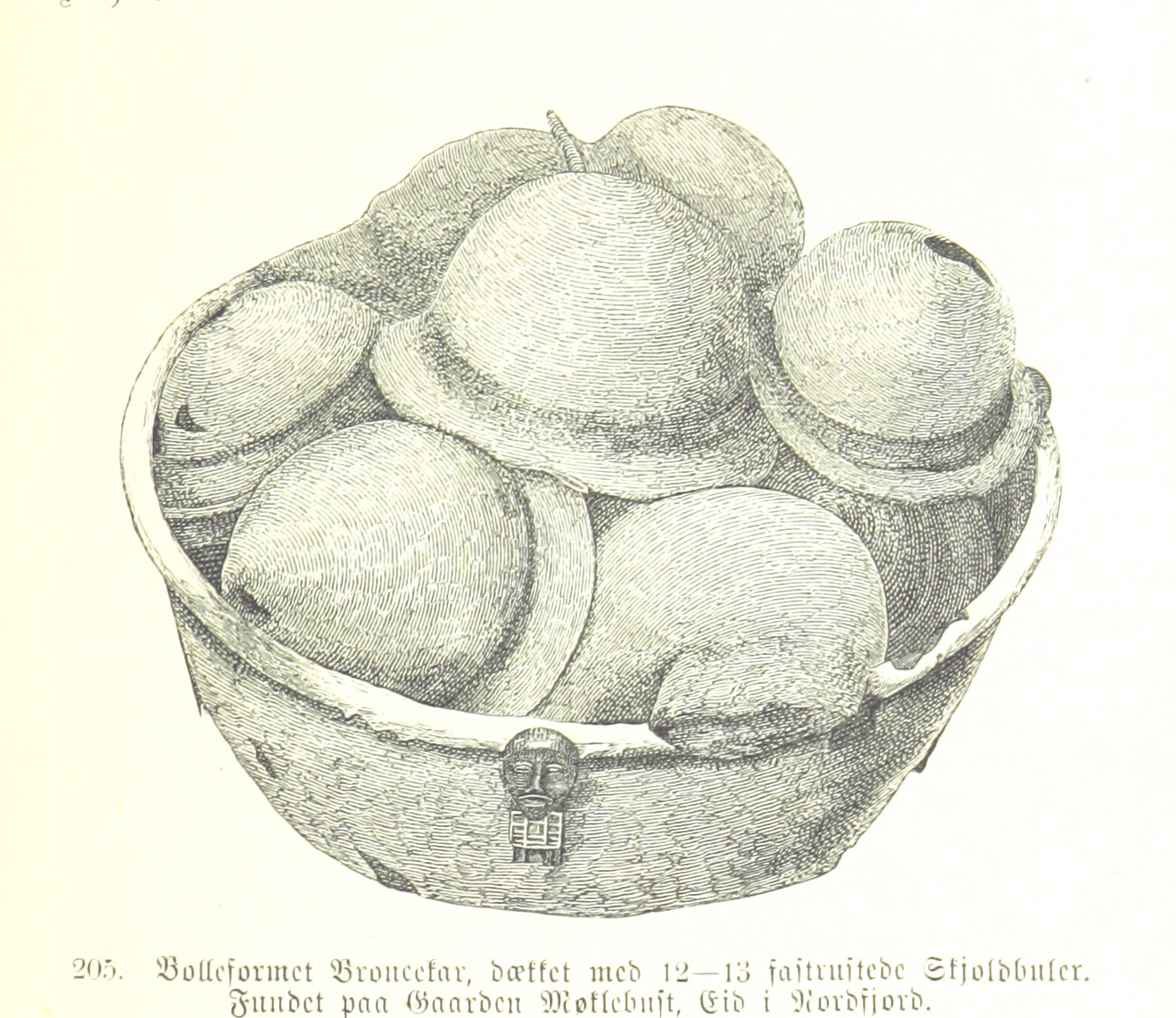
In 1874, an archaeologist named Anders Lorange dug into a mound at the center of Nordfjordeid, a small town on Norway's western coast. What he found was ash. Layers of it, thick and black, the residue of an enormous ship that had been set ablaze more than a thousand years earlier. Mixed into that carbon were roughly 750 iron rivets, 44 shield bosses, swords, spears, glass beads, combs, and the skeleton of a man between 30 and 35 years of age, placed inside an enamelled bronze vessel and covered with twelve additional shield bosses. When Lorange finished, he refilled the mound and left it as close to its original form as possible. He also left something the excavators of 2024 did not expect to find: a glass bottle containing a letter addressed to the future.
The Largest Farm, the Greatest Ship
The name Myklebust derives from Old Norse: mikill meaning large and bolstadr meaning farm. Across Norway, the name appears wherever the biggest farm in a district once stood, and the Myklebust farm in Nordfjordeid was the largest in the Nordfjord region, likely the seat of local power. The mound that Lorange opened, roughly 30 meters in diameter and nearly 4 meters tall with a wide moat around it, was one of five burial mounds on the property. Only two survive today. Inside, the length of the iron rivets told Lorange that the burned ship was formidable, larger than the Gokstad ship found in 1880 and the Oseberg ship excavated in 1904. Because the Myklebust ship had been cremated during the burial ritual rather than preserved intact, it was overshadowed by those later discoveries. But in scale, it may have been the largest Viking ship ever built.
A King in the Ashes
The 44 shield bosses suggest the ship carried at least that many rowers, and the twelve additional bosses covering the bronze vessel are believed to have belonged to the king's hird, his personal retinue. The richness of the grave goods, among the most lavish ever found in Norway, points to someone of extraordinary status. The leading candidate is King Audbjorn of Firda, who ruled from Nordfjordeid during the mid-ninth century. Snorri Sturluson mentions him in the saga of Harald Fairhair, recording that Audbjorn fell at the second battle of Solskjel in 870. The dating of the artifacts aligns with this period, and no other named figure of sufficient rank is connected to the Myklebust farm. The burial customs mirror those described by Ahmad ibn Fadlan in the tenth century among the Volga Vikings: a ship cremation reserved for the most powerful.
A Letter Across 150 Years
Lorange was the first archaeologist at the University of Bergen, methodical enough to refill the mound after his work and, it turns out, sentimental enough to leave a message for those who would follow. When archaeologists from the University of Bergen and the University of Stavanger reopened the mound in October 2024, exactly 150 years after Lorange's excavation, they found his glass bottle with its letter still intact. The 2024 dig was the first opening of a ship burial in Norway in over a century, prompted by a proposal to place the country's Viking Age burial mounds on UNESCO's tentative World Heritage list. Following Lorange's original trench but surveying a slightly larger area, the team discovered an additional 600 ship rivets, four more shield bosses, and a bronze ring of Celtic origin, further confirming the grave's scale and its connections beyond Scandinavia.
What Still Lies Beneath
Before the 2024 excavation, ground-penetrating radar scanned the surrounding field and revealed the outlines of a Viking-age village directly north of the mound, with multiple structures and production sites. Metal detector surveys suggested potentially upward of 8,000 unique artifacts remain in the soil. After just one week of work, the archaeologists closed the mound and restored it to its original form, leaving most of what lies beneath for future investigation. The Myklebust burial mound sits in the center of Nordfjordeid today, approximately 250 meters from the Sagastad Viking Center, which houses a full-scale reconstruction of the ship that once burned here. Walkers pass it on the way to the shops along Eidsgata street, a quiet hillock in the middle of town that contains a king, a ship, and, quite possibly, a few more messages from those who came before.
From the Air
Located at 61.91N, 5.99E in Nordfjordeid, at the head of the Eidsfjord in western Norway. The mound is in the town center, near the waterfront Sagastad Viking Center. Best viewed below 3,000 ft. Nearest airport: ENSD (Sandane Airport, Anda, approximately 15 nm northeast). The fjord and surrounding mountain terrain create variable winds. In clear conditions, the town layout and waterfront are visible from above.