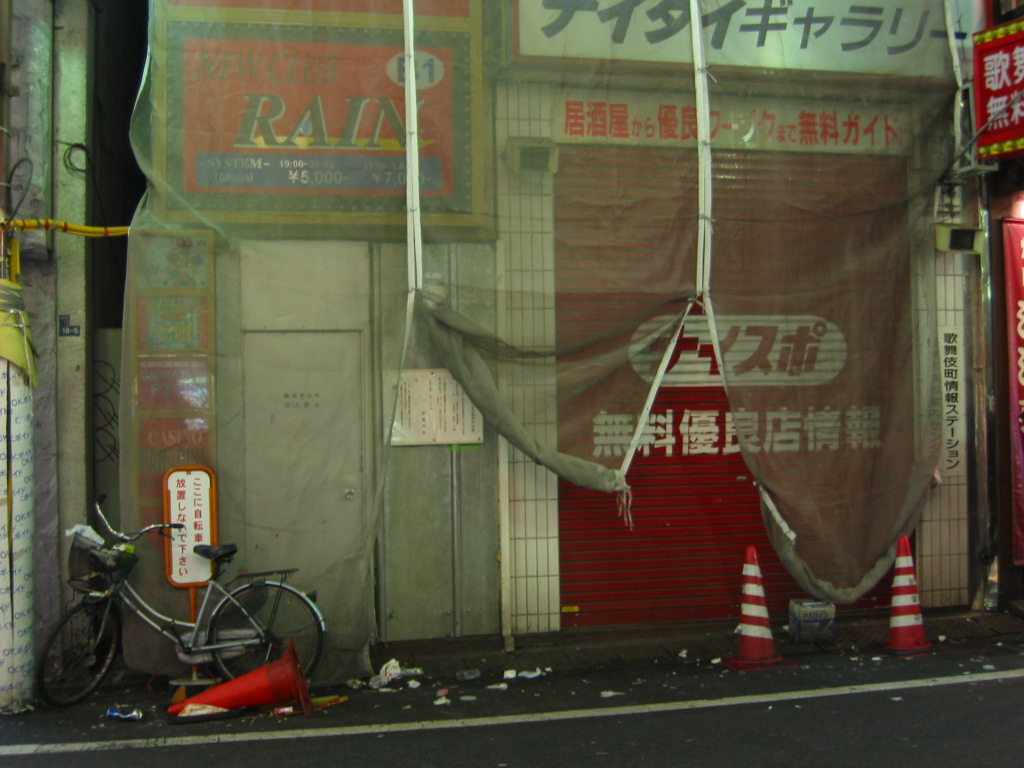
Myojo 56 Building Fire
Ten days before the September 11 attacks redrew the world's attention, a different inferno burned through the night in Tokyo's most notorious entertainment district. At 1:00 a.m. on September 1, 2001, fire erupted on the third floor of the Myojo 56 building, a narrow, four-story commercial structure wedged into the neon-drenched blocks of Kabukicho in Shinjuku. Inside were patrons and staff of a video mahjong parlor and a hostess bar. The fire burned for five hours. Forty-four people died. Three employees survived by jumping from third-floor windows. The building that killed them stood barely wider than a city bus.
Neon and Narrow Stairs
Kabukicho is one of the largest red-light and entertainment districts in Asia, a labyrinth of karaoke bars, pachinko parlors, restaurants, and nightclubs packed into tight blocks just east of Shinjuku Station. The Myojo 56 building was typical of the district's architecture: a slender multi-story structure maximizing every square meter of floor space. When the fire broke out, 19 people were on the third floor and 28 on the fourth. The building's stairwells, their only viable route to safety, were jammed with lockers and storage. Fire doors were blocked. Emergency ladders on the upper floors were absent. Advertising signs had been bolted over windows, sealing off escape routes that might have saved lives. A 1999 fire inspection had flagged these violations. Nothing was corrected.
Five Hours of Smoke
Three employees on the third floor made a desperate choice and leaped from the windows, suffering injuries but surviving. Witnesses on the street who saw them jump called an ambulance. When emergency responders arrived to treat the jumpers, they discovered the building was ablaze. Firefighters entered and began evacuation efforts. Some occupants managed to reach the roof and were rescued from above. But for the majority trapped inside, the stairwells were impassable. The fire itself was not the primary killer. Autopsies determined that carbon monoxide poisoning was the main cause of death, the invisible gas spreading faster than the flames through the sealed, airless floors. Firefighters recovered 32 men and 12 women from the interior. Not one of the 44 who remained inside survived.
A Crime Without a Conviction
By July 2008, Tokyo Metropolitan Police had officially concluded that the fire was arson. But no suspect was ever arrested. The investigation revealed a building deeply entangled with organized crime. The mahjong parlor on the third floor was reportedly an illegal gambling operation generating daily revenues of approximately eight million yen. Reports in Japan Today quoted Tokyo police linking the establishment to both Chinese organized crime groups and yakuza syndicates, noting that illegal gambling dens routinely pay protection money to criminal networks. Six people were eventually arrested -- not for starting the fire, but for the negligence that made it lethal. Two executives of the Myojo Kosan Group, which owned the building, and four commercial tenants were charged with professional negligence resulting in death. In July 2008, the Tokyo District Court convicted five of the six defendants. The question of who lit the match remains open.
Erased and Remembered
The Myojo 56 building was demolished in May 2006, replaced with a single-story restaurant. The streetscape of Kabukicho absorbed the change without a ripple; new signs and new storefronts fill gaps quickly in this district. But the fire left a lasting mark on Japanese fire safety regulation. Media coverage at the time was intense, though it was eclipsed just ten days later by the September 11 attacks in the United States. The disaster joined a grim lineage of building fires in Japan -- alongside the 1972 Sennichi Department Store fire in Osaka that killed 118, and later tragedies like the 2019 Kyoto Animation arson and the 2021 Osaka clinic fire. Each exposed the same vulnerabilities: narrow buildings, blocked exits, inadequate codes enforcement. In Kabukicho, where the nightlife still pulses past dawn, the Myojo 56 fire is a reminder that the neon glow conceals real dangers behind those tightly packed walls.
From the Air
Located at 35.695N, 139.701E in the Kabukicho entertainment district of Shinjuku, central Tokyo. The site is identifiable from the air by the dense commercial blocks immediately east of the massive Shinjuku Station rail complex. Nearest airports: Tokyo Haneda International (RJTT) approximately 12nm south, Chofu Airport (RJTF) approximately 12nm west. Narita International (RJAA) lies approximately 35nm east. Expect congested airspace; Tokyo's Class B airspace restricts low-altitude overflights. Best observed during evening hours when Kabukicho's distinctive neon signage illuminates the district.