Every Name This Stage Has Known
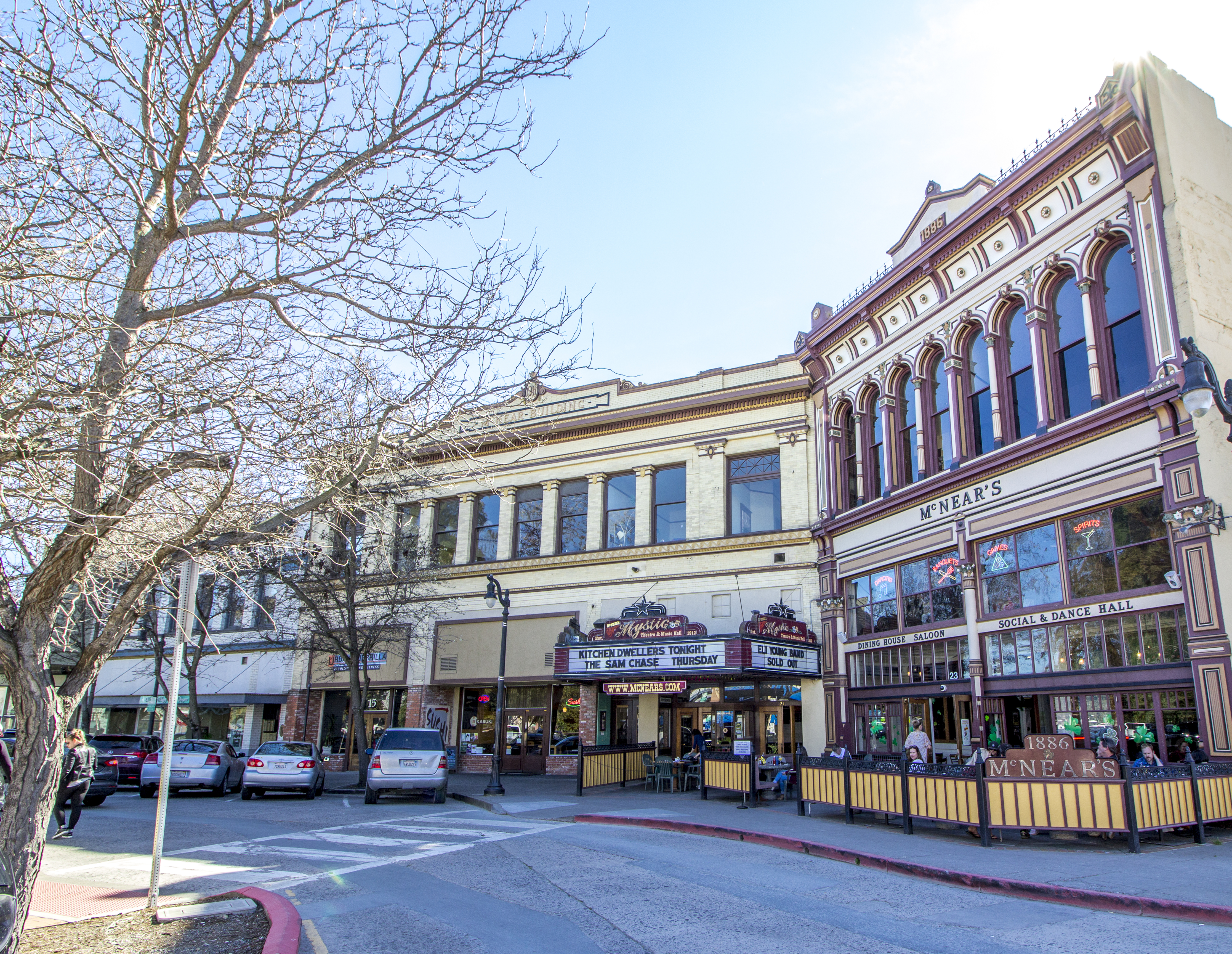
The marquee has said a lot of things. State Theater. Plaza Theater. Palace Theater. Each name belonged to a different era, a different owner, a different idea about what the people of Petaluma, California wanted to see on a Friday night. The building at 23 Petaluma Boulevard North has been standing since 1911, and for most of that time it has been reinventing itself -- vaudeville house, movie palace, live music venue -- as if the walls themselves refused to settle on a single identity. Today the sign reads Mystic Theatre, the latest and perhaps most enduring name for a room that has outlived every trend it has hosted.
When Vaudeville Came to the River Town
Petaluma in 1911 was a prosperous agricultural town on the banks of the Petaluma River, connected to San Francisco by steamship and defined by its egg industry. The building that would become the Mystic Theatre opened in this context as a vaudeville house, part of a nationwide circuit that brought live variety acts to small-town America. Vaudeville was the dominant form of popular entertainment in the early twentieth century -- comedy, music, acrobatics, and dramatic sketches rolled into marathon evenings that served as both spectacle and social gathering. The theater's location along what is now the Petaluma Historic Commercial District placed it at the commercial heart of town, surrounded by the saloons, shops, and hotels that made downtown Petaluma a destination. The district would eventually be listed on the National Register of Historic Places on March 31, 1995, recognizing the architectural and historical significance of the entire block.
The Long Intermission
By the 1920s, vaudeville was dying. Motion pictures had arrived, and theaters across the country scrambled to adapt or close. The Petaluma house chose adaptation, converting to a movie theater and beginning the cycle of name changes that would mark its middle decades. As the State Theater, the Plaza Theater, and the Palace Theater, the building screened films through the golden age of Hollywood and into the era of television-driven decline. Each rebranding suggested a new owner or a new ambition, but the fundamental challenge remained the same: keeping a single-screen theater alive in a world that was inventing multiplexes and home video. The building survived where many of its contemporaries did not, its sturdy 1911 construction and prime downtown location working in its favor even when the business model wobbled.
The Room Where Legends Played Small
The transformation into a live music venue gave the building its most compelling chapter. Rechristened as McNear's Mystic Theatre, the room became one of the Bay Area's most beloved small concert halls, a place where the intimacy of the space created experiences that arena shows could never replicate. The list of performers who have stood on its stage reads like a curated argument for why small venues matter: Van Morrison, Carlos Santana, Warren Zevon, Snoop Dogg, Iris DeMent, Stephen Marley. The band Train booked one of their earliest shows here in the late 1990s, before radio play and Grammy Awards made them too large for a room this size. For artists, a venue like the Mystic offers something arenas strip away -- the ability to see faces in the crowd, to feel the room respond, to play as if every seat is the front row.
McNear's Next Door
The Mystic Theatre does not stand alone. Adjoined to the theater is McNear's Saloon and Dining House, a restaurant and bar that shares a wall and a name with its louder neighbor. The McNear family was among Petaluma's founding commercial dynasties; John Augustus McNear arrived in the mid-nineteenth century and built a business empire that included grain warehouses, real estate, and shipping. The saloon carries that legacy into the present tense, offering food and drink in a space that feels continuous with the theater's history rather than tacked onto it. On show nights, the saloon fills with concertgoers before and after performances, blurring the line between restaurant and lobby. Together, the two spaces function as a single cultural anchor for downtown Petaluma -- one side feeding the body, the other feeding whatever it is that live music feeds.
Still Standing, Still Changing
More than a century after its construction, the Mystic Theatre remains what it has always been: a bet that people will leave their homes to sit together in the dark and watch something happen on a stage. The Petaluma Historic Commercial District designation protects the building's exterior, preserving the architectural character of a downtown that has resisted the strip-mall sprawl consuming other California towns. Inside, the room continues to book acts that range from nationally touring headliners to regional artists building audiences one show at a time. The theater survived vaudeville's death, cinema's decline, and the pandemic shutdowns that threatened to silence small venues permanently. Each crisis produced a new name, a new format, a new reason to keep the lights on. The building at 23 Petaluma Boulevard North has proven, over and over, that the best way to last a century is to never stop becoming something else.
From the Air
Located at 38.23N, 122.64W in downtown Petaluma, Sonoma County, along the Petaluma River corridor. From the air, downtown Petaluma's historic commercial district is visible as a compact grid of older buildings along the river's west bank. Nearest airports: Petaluma Municipal (O69) approximately 3 nm east, Gnoss Field (KDVO) approximately 10 nm south. Santa Rosa's Charles M. Schulz-Sonoma County Airport (KSTS) is 20 nm north. Best viewed at 1,500-2,000 ft AGL to appreciate the river town layout and surrounding dairy farmland.