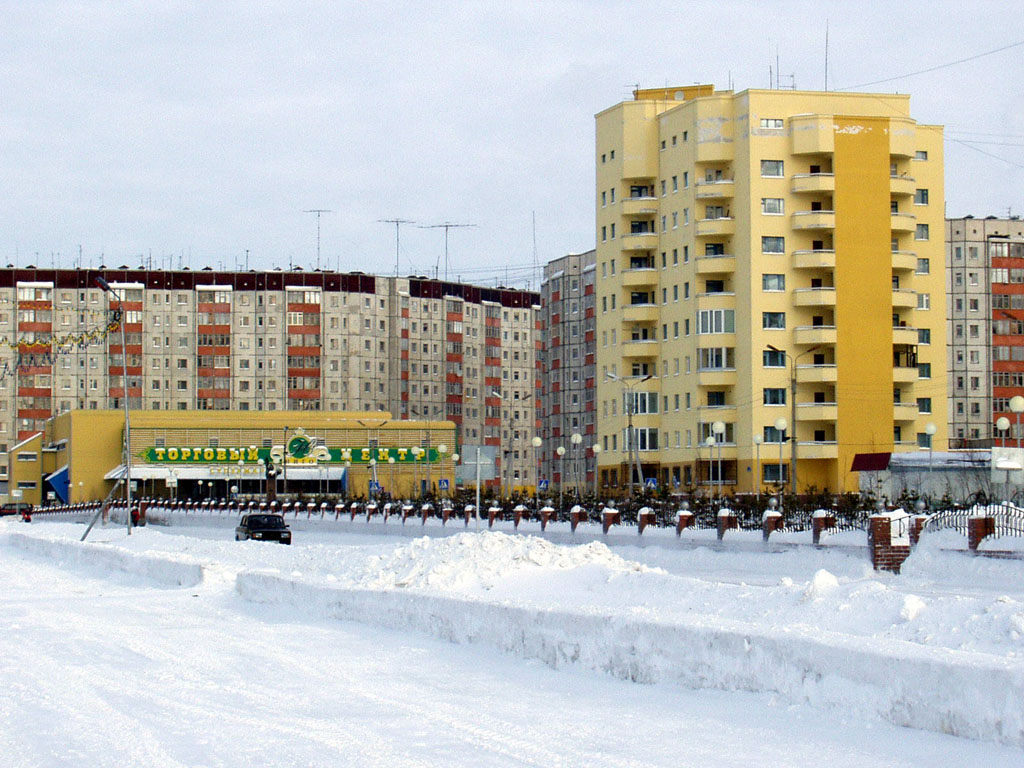
Nadym
Three Nenets words compete to explain the name. "Nyadey ya" means mossy place. "Ngede ya" means dry, grassy hill. "Nyada yam" means land of the Nyadong family. All three sound right for a settlement on the Nadym River in the Yamalo-Nenets Autonomous Okrug, where moss and grass and family claims have been layered over by something the Nenets never anticipated: one of the largest natural gas operations on Earth. Nadym exists because of gas, was built for gas, and runs on the logic of gas extraction, yet the name itself reaches back centuries before anyone knew what lay beneath the permafrost.
A Name Older Than Its Maps
The first mention of Nadym dates to the late sixteenth century. By the end of the seventeenth century, the name appeared on Russian maps, and the river itself was documented in the "Drawing Book of Siberia" by Semyon Remezov and his sons between 1699 and 1701. On an 1802 map of Tobolsk province, Nadym was already marked as a place of significant population. The modern settlement sits 32 kilometers from the river's mouth, on what locals call Nadym mound. In 1929, a reindeer farm named Nadym was established on the right bank, but by 1934 it had been disbanded and converted to a factory. For decades, the place remained small and remote, known to few beyond the indigenous communities and fur traders who passed through.
Gas Changes Everything
In the fall of 1967, geologists chose the area around Nadym as the base for developing a regional gas deposit. The village sat on elevated, dry ground surrounded by lakes, which made it suitable for a runway. By the 1950s and 1960s, locals had begun calling the growing settlement "New Nadym." The transformation accelerated with the development of the Medvezhye gas field, one of the largest in Western Siberia. In August 1971, Nadym held a groundbreaking ceremony for its first major building. On March 9, 1972, Soviet authorities officially incorporated Nadym as an urban settlement. The town's main enterprise, Nadymgazprom, is a branch of Gazprom and accounts for approximately 11 percent of all gas produced in Russia. NOVATEK, the country's largest independent gas producer, also operates from the Yurkharovskoye field nearby. The city exists in Gazprom's orbit the way a moon exists in a planet's gravity well.
The Dead Road Passes Through
Nadym's transportation story is tangled with one of the Soviet Union's grimmer engineering projects. The unfinished Salekhard-Igarka Railway, known as the Transpolar Mainline or simply "The Dead Road," passes through Nadym between Novy Urengoy and Salekhard. Built with gulag labor under Stalin, the railway was never completed, and its abandoned sections became landmarks of a different kind of ambition. Today, the only functional rail construction in the area is the Salekhard-Nadym line. Most roads crossing the Nadym River opened in September 2015, when the automobile portion of a 1,300-meter bridge was completed. The Nadym Airport sits on the west bank of the river, connecting the town to the wider world through flights that operate when weather permits in a climate classified as subarctic.
Life at Minus Fifty
Nadym's subarctic climate, classified Dfc under the Koppen system, defines daily existence. Winters are long and brutal, with temperatures that can plunge far below minus 40 degrees Celsius. Average annual precipitation is a modest 496 millimeters, heavier in summer than winter. The cold shapes infrastructure, schedules, and psychology. The city maintains nine schools, two art schools, a college, and branches of four Russian universities including Tyumen State University and the Tomsk State University of Control Systems and Radio Electronics. One cultural institution stands out: the Museum of Tanya Savicheva, housed in School Number 2. Savicheva was a young girl from Leningrad who kept a diary during the Nazi siege, recording the deaths of her family members one by one. That her memorial sits in an Arctic gas town thousands of kilometers from St. Petersburg speaks to how the Soviet experience scattered memory and meaning across improbable distances.
Between Worlds
Nadym once had a twin city arrangement with Tromso, Norway, a connection severed by Norwegian authorities in October 2022 for reasons rooted in geopolitics. The broken partnership captures something about Nadym's position: it is Arctic but not Scandinavian, industrial but not self-sufficient, Russian but shaped by forces far from Moscow. The population has fluctuated over decades, rising and falling with the fortunes of gas extraction. Construction companies like Arktikneftegazstroy and Severgazstroi built the infrastructure; Severtruboprovodstroy went bankrupt in 2011. The city's rhythm follows extraction cycles, pipeline schedules, and the slow warming of permafrost that threatens everything built upon it. Nadym is a place where the ancient Nenets name for a mossy riverbank now labels a gas-powered Arctic outpost, a town that grew from the earth's surface and the earth's depths simultaneously.
From the Air
Located at 65.53°N, 72.52°E on the Nadym River in Yamalo-Nenets Autonomous Okrug. Nadym Airport (USMM) is on the west bank of the river. The 1,300-meter Nadym River bridge is visible from altitude. The town appears as a compact urban area amid flat tundra with numerous surrounding lakes. Novy Urengoy (USMU) is approximately 200 km to the east. Expect subarctic conditions with limited visibility in winter. Recommended viewing altitude: 3,000-6,000 feet AGL.