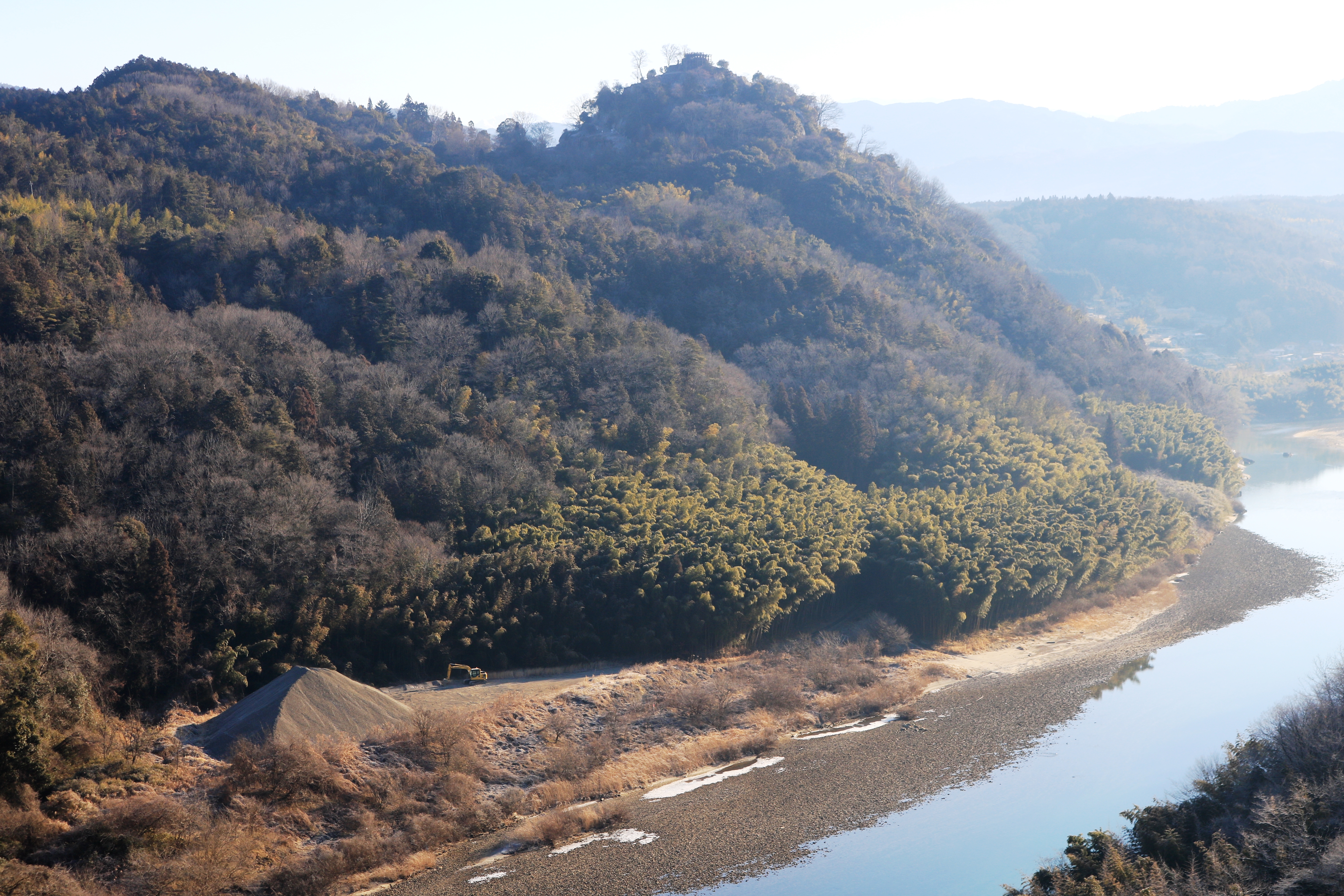
Naegi Castle
Most Japanese castles wore white plaster walls, a choice that made them gleam against mountain backdrops and project an image of refinement. Naegi Castle chose a different color entirely. Built with the reddish clay of its mountaintop site in what is now Nakatsugawa, Gifu Prefecture, the fortress earned the nickname Akakabe -- "red walls" -- and stood as the administrative heart of the Toyama clan's domain for over three centuries. The ruins, designated a National Historic Site since 1981, perch above the Kiso River on a craggy summit where massive boulders jut from the earth like the bones of the mountain itself. A restored framework of the main keep now serves as a lookout, offering panoramic views across Nakatsugawa and the river valley below.
Born of Ambition and Alliance
The Toyama clan had ruled southeastern Mino Province since at least the Kamakura period, but Naegi Castle itself dates to 1532. Toyama Naokado, the second son of Toyama Kagetomo, lord of nearby Iwamura Castle, built the fortress on a strategic mountaintop overlooking the Kiso River. The family was deeply entangled in the politics of the age. Kagetomo had married Otsuya no Kata, the sister of Oda Nobunaga, Japan's most ambitious warlord. In an effort to prevent Takeda clan expansion into Mino, Nobunaga arranged for Naokado's daughter to be adopted and married to Takeda Katsuyori. The diplomatic marriage failed to hold. When Iwamura Castle fell to the Takeda, Nobunaga turned his strategic attention to Naegi, declaring it the most important fortification defending Mino against the Takeda advance.
Caught Between Warlords
The assassination of Oda Nobunaga at the Honnoji Incident in 1582 threw Japan into turmoil and Naegi Castle changed hands. Mori Nagayoshi, a general serving Toyotomi Hideyoshi, seized the fortress and installed Kawajiri Hidenaga as its castellan. The Toyama clan, dispossessed of their ancestral stronghold, fled south to Hamamatsu and entered the service of Tokugawa Ieyasu. They would wait eighteen years for their chance to return. That chance came at the Battle of Sekigahara in 1600, the decisive conflict that determined Japan's future. Kawajiri Hidenaga chose the losing side, joining the Western Army under Ishida Mitsunari. He was killed in battle. Ieyasu dispatched Toyama Tomomasa, the son of Naegi's former castellan, to reclaim the castle. Tomomasa succeeded, and Ieyasu confirmed the Toyama clan as daimyo over their ancestral holdings, establishing Naegi Domain under the new Tokugawa shogunate.
Twelve Generations on the Mountain
From 1600 until the Meiji Restoration in 1868, the Toyama clan held Naegi Castle through twelve unbroken generations. The domain was small by the standards of the era, but its mountain fortress was formidable. The castle exploited the natural terrain with ruthless efficiency, incorporating enormous natural boulders into its stone walls and defensive structures. The reddish clay that gave the castle its Akakabe nickname was a practical choice dictated by local geology, but it made Naegi visually distinctive among Japan's hundreds of castles. By the time the feudal system was abolished in 1871, the domain had accumulated massive debts. The castle was dismantled and its timbers and furnishings auctioned off to help pay creditors. What the auctioneers could not sell -- the stone walls, the massive boulders, the mountaintop itself -- remained, and it is these bones of the old fortress that visitors explore today.
Climbing the Ruins
The castle ruins sit about seventeen minutes by car from Nakatsugawa Station on the Chuo Main Line. The approach winds up through forest to a parking area, from which a walking trail ascends to the summit. Along the way, stone walls emerge from the hillside at unexpected angles, their courses interrupted by boulders too large to move. The Sannomaru, or third enclosure, opens onto views of the surrounding mountains. Higher up, the restored strut-work of the main keep crowns the summit like a skeletal frame, offering unobstructed views of Nakatsugawa city, the Kiso River snaking through its valley, and on clear days the peaks of the Central Alps beyond. The adjacent Toyama Historical Museum provides context for the castle's long history. The site rewards those who appreciate the spare beauty of ruins -- there are no rebuilt towers or painted walls here, only weathered stone and mountain air and the sense of standing where twelve generations of a single family watched over their domain.
From the Air
Naegi Castle is located at 35.513N, 137.485E on a mountaintop overlooking the Kiso River in Nakatsugawa, Gifu Prefecture. From the air, look for the exposed rocky summit with visible stone wall remnants and the restored keep framework rising above the tree canopy, situated on the south bank of the Kiso River. The city of Nakatsugawa spreads along the river valley below. Mount Ena (2,191m) rises prominently to the southeast. Nearest airports: Chubu Centrair International (RJGG) approximately 140km southwest, Matsumoto Airport (RJAF) approximately 85km north, Nagoya Airfield (RJNA) approximately 100km west. Mountainous terrain; clear weather recommended for viewing the castle site amid the forested ridgeline.