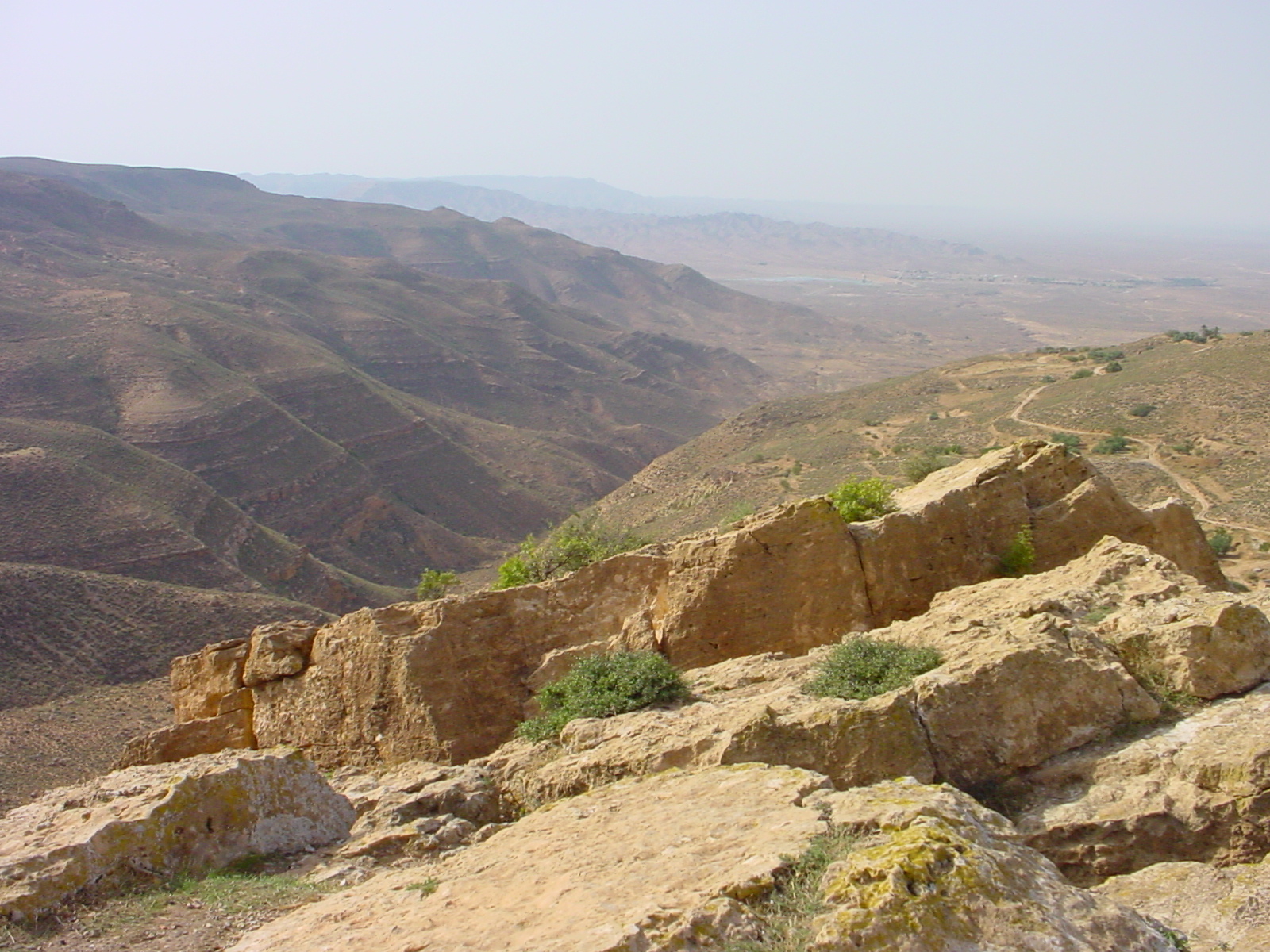
Nafusa Mountains
In 757, warriors descended from these mountains and captured Tripoli. In 2011, warriors descended again and helped topple a dictator. The Nafusa Mountains have spent more than a millennium doing the same thing: sheltering people the lowlands tried to break. This rugged escarpment in northwestern Libya, where the Tripolitanian Plateau drops abruptly toward the Mediterranean coastal plain, is not especially high or especially vast. What it is, persistently, is unconquerable.
Where the Plateau Breaks
The Nafusa range is technically an escarpment rather than a conventional mountain chain. The beds of the Tripolitanian Plateau tilt upward as they approach the coast, then end abruptly in a series of cliff faces with significant topographic prominence. Deep valleys cut northward into the escarpment, draining toward the flat Jefara plain below. The effect from the air is dramatic: a wall of rough terrain rising from a featureless coastal lowland. This geography has dictated military and cultural history for centuries. Mechanized forces struggle on the narrow, winding mountain roads, while defenders who know the terrain can hold ground against far larger armies. The Nafusa's strategic value has never been abstract.
The Ibadi Republic
After the great Berber Revolt of the 8th century, Ibadi missionaries fleeing the Umayyad Caliphate found refuge in the Nafusa Mountains. They converted the native Nafusa people and organized them into a formidable fighting force. Under Imam Abu al-Khattab al-Ma'afari, Nafusa fighters captured Tripoli in 757 and Kairouan in 758, briefly conquering the crumbling Fihrid emirate of Ifriqiya. The Abbasid governor of Egypt needed three separate armies before defeating them at Tawergha in 761. Even then, the mountains themselves remained unconquered. Throughout the 9th century, while the Aghlabids ruled the lowlands, an independent Ibadi republic persisted in the highlands. Allied with the Rustamid dynasty in Tiaret, the mountain Ibadis were thorns on both flanks of the Aghlabid state, communicating across the back highlands of North Africa.
Victories That Did Not Last
The pattern repeated with punishing regularity. In 880, the Nafusa destroyed a Tulunid Egyptian army that had seized Tripoli. By 897, the Aghlabid emir Ibrahim II had recovered Tripolitania and crushed the Nafusa in a great battle at Manu, south of Gabes. Ibrahim executed all his Nafusa prisoners and proclaimed the end of their imamate. The Rustamid capital at Tahert fell shortly after, in 911. On paper, the independent Berber states were finished. In practice, Ibadi Islam survived as a clandestine faith among the mountain Berbers for centuries, down to the present day. The orthodox Sunni majority in the rest of Libya has viewed the Nafusa with suspicion ever since, a tension that never fully dissolved.
Under the Boot, Then Free
Under Muammar Gaddafi's four-decade rule, the Nafusa Berbers faced systematic cultural suppression. Speaking and writing Tamazight carried severe punishment. Berber names were forbidden in official records. The distinct identity that had survived Abbasid armies and Aghlabid emperors was now targeted by a 20th-century police state. When the Libyan Civil War erupted in 2011, the Nafusa Mountains became a major front. The escarpment's terrain, which had always favored local defenders, once again constrained loyalist armor while rebel fighters used their knowledge of every valley and switchback. Over 45,000 refugees fled to the Tunisian region of Tataouine, where many had relatives from ancient cross-border ties.
Language in the Open Air
As towns were liberated in the summer of 2011, even while fighting continued in neighboring valleys, something extraordinary happened. Berber exhibitions and workshops sprang up across the mountains. People began teaching Tamazight openly for the first time in decades, sharing the culture and writing system that had been driven underground. The Nafusa Mountains had done what they have always done: provided enough shelter, enough high ground, enough geographic stubbornness to keep something alive that powerful forces wanted dead. Whether that something was an 8th-century Ibadi imamate or a 21st-century Berber cultural revival, the mountains did not much care about the era. They simply held.
From the Air
The Nafusa Mountains escarpment at 31.86N, 11.79E is strikingly visible from altitude, forming a sharp boundary between the flat Jefara coastal plain to the north and the elevated Tripolitanian Plateau to the south. Deep valleys cut into the escarpment face. Nearest major airport is Tripoli International (HLLT), approximately 130 km northeast. Towns of Zintan, Nalut, Jadu, and Yefren are scattered along the highland. Recommended altitude 10,000-15,000 ft for full terrain appreciation.