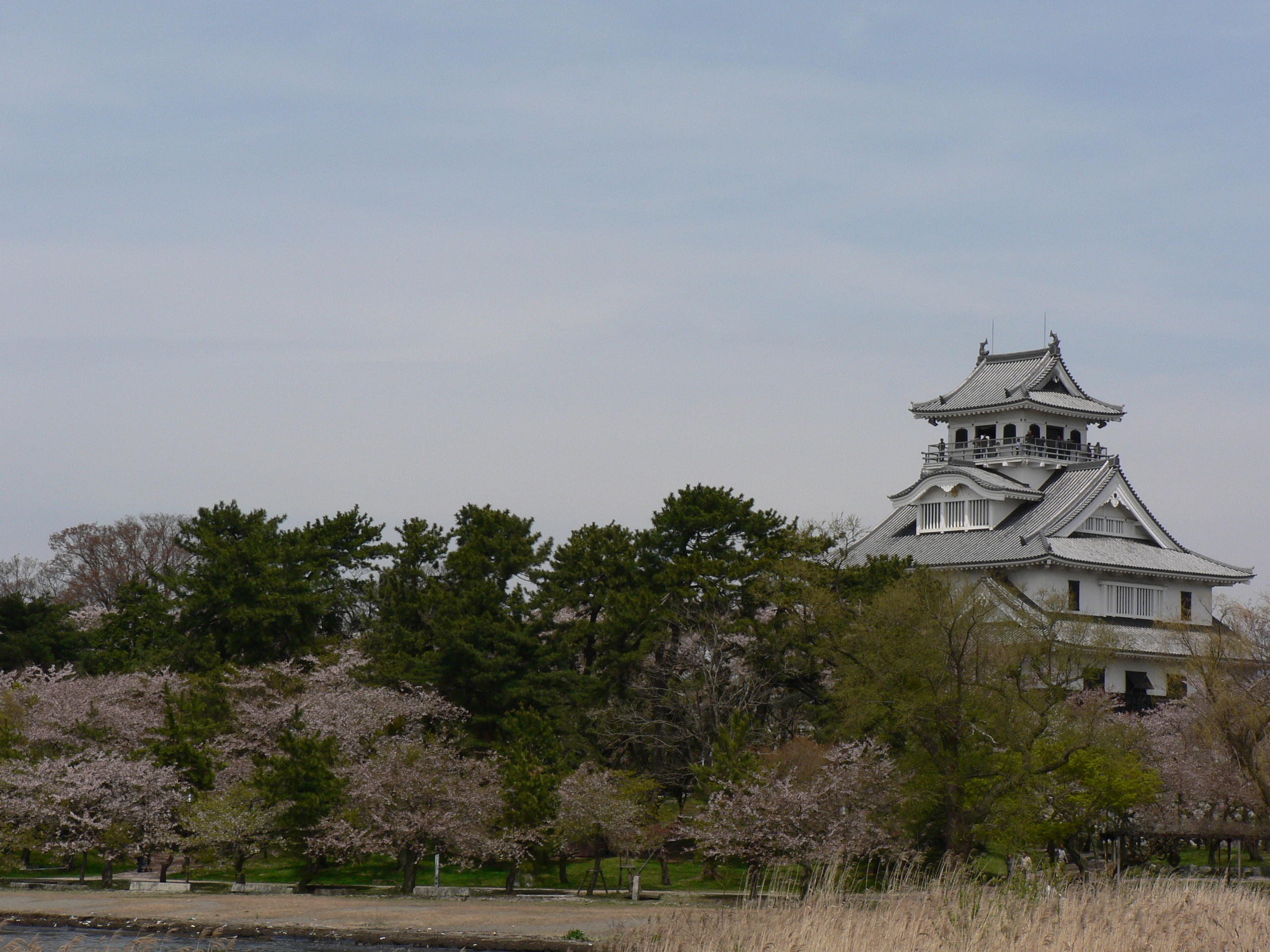
Nagahama Castle
Before he unified Japan, before he became the most powerful man in the country, Toyotomi Hideyoshi was a young general who had just proven himself in battle and needed a castle to match his ambitions. In 1575, freshly rewarded by Oda Nobunaga for his role in conquering northern Omi Province, the man then known as Hashiba Hideyoshi looked out over the eastern shore of Lake Biwa and chose this spot -- a flat plain where a fishing village called Imahama sat at the water's edge. He renamed the village Nagahama, built a castle on the plain, and began his ascent from warlord to ruler of all Japan.
A Castle Born from Conquest
Nagahama Castle rose between 1575 and 1576 as what the Japanese call a hirashiro -- a castle built on flat ground rather than a mountaintop. This was a deliberate choice. Hideyoshi had been governing from Odani Castle, the mountain fortress of the defeated Azai clan perched high on the ridges above. A yamashiro like Odani was superb for defense but miserable for administration. Hideyoshi wanted a castle that could serve as a seat of government, a trading hub, and a statement of authority on the shores of Japan's largest lake. He dismantled parts of Odani Castle itself, hauling its stones and timbers downhill to build something new on the plain below.
Three Lords and a Demolition
The castle's life as a seat of power lasted only forty years and passed through three rulers. Hideyoshi governed from Nagahama until his star rose higher and he moved on to grander strongholds. Yamanouchi Kazutoyo took over after the 1583 Battle of Shizugatake, another clash in the convulsive wars that defined the era. Then came the battle that settled everything: Sekigahara, in 1600, after which Naito Nobunari replaced Kazutoyo as lord of Nagahama. But the Tokugawa shogunate that emerged from Sekigahara had its own plans for the region. In 1615, the authorities ordered Nagahama Castle demolished. Its stone walls and structural timbers were carted away to build Hikone Castle, fifteen kilometers to the south -- a fortress the Tokugawa intended to dominate northern Lake Biwa for centuries.
Concrete Memory
The castle grounds sat empty for over three hundred years, slowly reverting to parkland above the lakeshore. Then, in 1983, the city of Nagahama rebuilt the tenshu -- the main keep -- in concrete, a common practice in postwar Japan where communities reconstruct their lost castles as museums and landmarks. The reconstruction makes no pretense of authenticity in its materials, but its silhouette against Lake Biwa recalls the fortress Hideyoshi raised here four centuries ago. Inside, the keep houses a museum dedicated to the history of Nagahama, tracing the city's journey from fishing village to castle town to the modern community that grew up around the old foundations.
Hideyoshi's Launching Pad
What makes Nagahama Castle remarkable is not the structure itself but what it represents in the arc of Japanese history. This was the first castle Hideyoshi ever built as a lord in his own right. The peasant-born soldier who had risen through Nobunaga's ranks by sheer cunning and battlefield brilliance chose this lakeshore as the place to declare himself a ruler, not merely a retainer. From Nagahama, he would go on to build Osaka Castle, conquer Kyushu and Shikoku, and attempt the invasion of Korea. Every subsequent chapter of his extraordinary life traces back to this spot on Lake Biwa where a renamed village received a brand-new castle and a warlord first tasted sovereignty.
From the Air
Located at 35.378N, 136.261E on the northeastern shore of Lake Biwa, Japan's largest freshwater lake. The reconstructed keep is visible as a small structure near the waterfront in the city of Nagahama. Lake Biwa itself is an unmistakable landmark stretching roughly 64 kilometers north to south. Nearest airport: Chubu Centrair International (RJGG) approximately 110km southeast. Approach from over the lake for the best view of the castle's relationship to the shoreline. Hikone Castle, which inherited Nagahama's original stones, is visible 15km to the south along the same shore.