Nagaoka Castle
There is a train station in Nagaoka, Niigata Prefecture, where commuters board bullet trains on ground that once formed the central bailey of a feudal fortress. Nagaoka Station was built in 1898 directly atop the Honmaru of Nagaoka Castle, and today almost nothing visible remains of the fortification that anchored this stretch of the Shinano River for over 250 years. But the castle's story -- of ambitious lords, devastating fires, catastrophic floods, and a final battle that erased it from the landscape -- is written into the bones of this city even if the walls are gone.
The Hori Legacy and the Move West
Nagaoka Castle began as a practical decision about water. Hori Naoyori, a retainer rewarded with 60,000 koku of land for his service to Toyotomi Hideyoshi, originally governed from Zaodo on the east bank of the Shinano River. When the Tokugawa shogunate granted him an additional 20,000 koku from the disgraced Matsudaira Tadateru's holdings in 1616, Naoyori moved his seat to higher ground on the west bank. The Shinano is Japan's longest river, and its periodic floods made the east bank treacherous for a permanent seat of power. Naoyori began construction, but was transferred to Murakami Domain in 1618 before he could finish. The castle was completed by Makino Tadanari, whose clan would hold it for the next two and a half centuries until the Meiji Restoration upended feudal Japan.
Fires, Floods, and Earthquakes
Nagaoka Castle endured an almost comically relentless series of disasters. Most of the complex burned down in March 1728, and it took 26 years to restore it -- not until 1754 were the structures rebuilt. Another fire in 1844 destroyed two gates and part of the daimyo's palace. Flooding struck repeatedly in 1671, 1674, 1781, and 1789, a reminder that proximity to the Shinano River was both the castle's strategic advantage and its chronic vulnerability. Then the Sanjo earthquake of 1829 leveled most of what remained. The castle was essentially rebuilt multiple times over its existence, each version a little more battered by the forces that define life in Niigata Prefecture: water from below, tremors from beneath, and fire from within.
The Boshin War and the Castle's End
The final chapter of Nagaoka Castle was written in blood. During the Boshin War of 1868-1869, Japan's last great civil conflict between the old Tokugawa shogunate loyalists and the forces of the new Meiji government, representatives of Nagaoka Domain met with delegates of the Satcho Alliance at a nearby temple to negotiate. The talks collapsed. What followed was a siege. Meiji government forces attacked and destroyed the castle, ending centuries of Makino clan rule. In the aftermath, the moats were filled in and portions of the site sold to private owners. The castle that had survived fire, flood, and earthquake could not survive the political earthquake of modernization. By the end of the 19th century, a railroad station occupied its heart.
A Castle Without a Keep
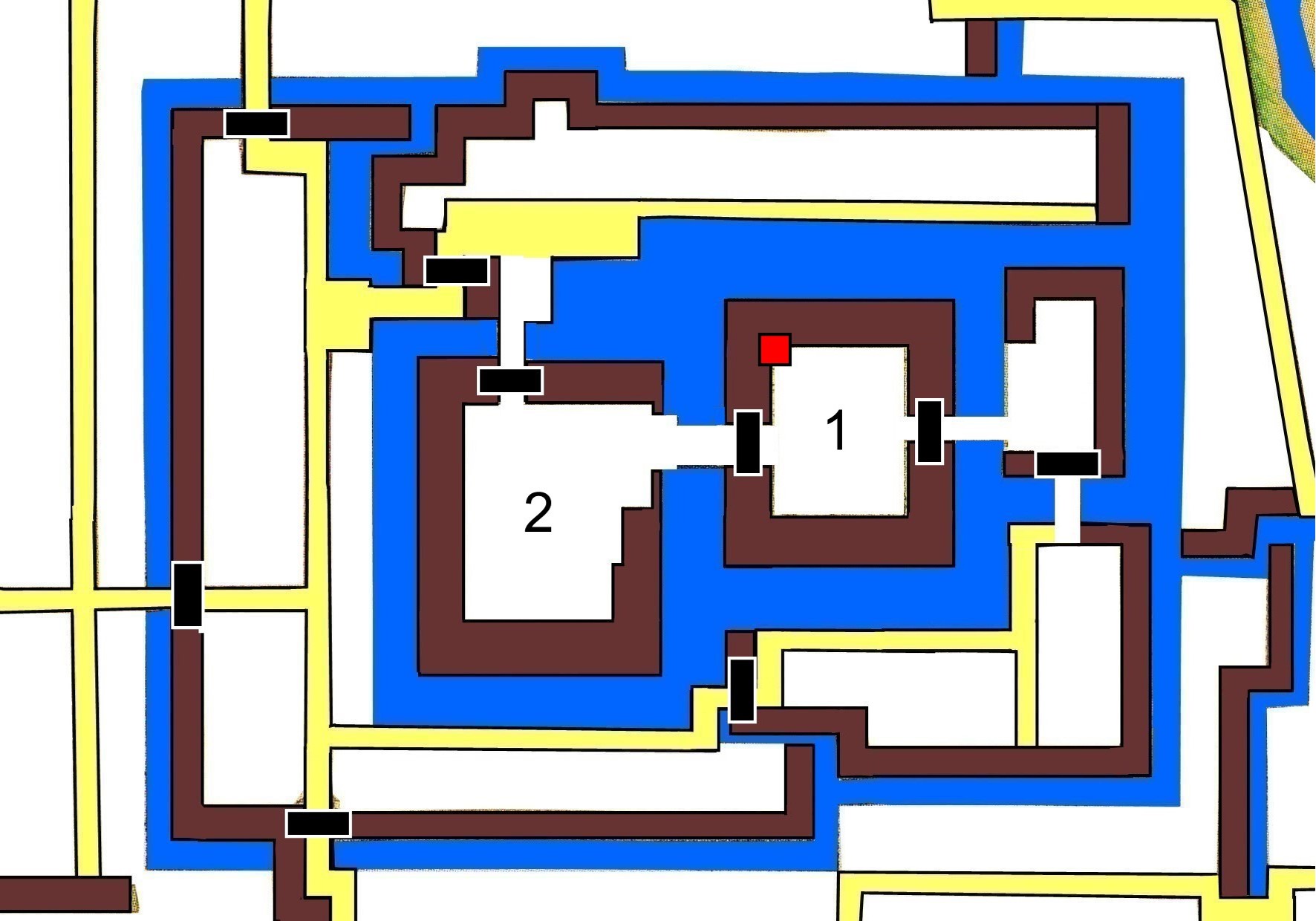
Even at its peak, Nagaoka Castle was never a showpiece. It was a flatland-style fortress -- a hirajiro -- with no soaring donjon tower like those at Himeji or Matsumoto. Its defenses relied on concentric rings of moats and earthen ramparts rather than stone walls. The layout followed classical Japanese castle design: the Honmaru and Ni-no-Maru central baileys were wrapped by the San-no-Maru and Tsume-no-Maru outer baileys, with the Minami-Kuruwa and Nishi-Kuruwa forecourts completing the perimeter. Yagura watchtowers stood at strategic points along the ramparts. It was a functional military installation rather than a symbol of lordly grandeur, designed for the practical realities of controlling territory along a major river in a region defined by harsh winters and unpredictable geology.
From the Air
Located at 37.447N, 138.853E in central Nagaoka, Niigata Prefecture. The castle site is now occupied by Nagaoka Station and Nagaoka City Hall, making it virtually invisible from the air. The Shinano River runs nearby to the east. The nearest airport is Niigata Airport (RJSN), about 55 km to the north-northeast. The surrounding area is flat rice country typical of the Echigo Plain, with the mountains of central Niigata visible to the east and south.