Nagashima Castle
Where children now play at recess, twenty thousand people once burned alive. Nagashima Castle sits -- or rather, sat -- on an alluvial island wedged between the Nagara and Kiso rivers at the head of Ise Bay, in what is now the city of Kuwana, Mie Prefecture. Today the castle grounds hold the Nagashima Chubu Elementary School and Nagashima Junior High School, and almost nothing visible remains of the fortress that witnessed nearly eight centuries of power struggles, religious uprisings, and one of the most devastating massacres in Japanese feudal history. But the ground remembers what the buildings cannot.
An Island Between Rivers
Nagashima's strategic value was written in water. The alluvial island, formed where two of the Kiso Three Rivers meet before emptying into Ise Bay, was a natural fortress -- approachable only by boat or narrow land bridges, surrounded by channels that could swallow invading armies. In 1245, the regent Kujo Michiie built the first fortification here to protect his extensive estates in the region. It was a hirashiro, a flatland castle that relied on rivers and moats rather than mountain terrain for defense. For more than two centuries, control of this island meant control of the river delta and the trade routes feeding into Ise Bay.
Defiance and Fire
In 1482, Ito Shigeharu -- head of one of the 48 samurai clans of northern Ise Province -- rebuilt the castle. But the Ito clan's hold was short-lived. Shoi, the chief priest of Gansho-ji temple, expelled the samurai and turned Nagashima into a stronghold of the Ikko-ikki, the militant Buddhist uprising that challenged warlords across central Japan. The fortress became the nerve center of a network of river island defenses surrounding the Gansho-ji monastery. Oda Nobunaga, the ruthless unifier of Japan, laid siege to the complex three times -- in 1571, 1573, and finally in 1574. In that last campaign, a naval blockade led by Kuki Yoshitaka cut off all supplies. When fire arrows and strong winds engulfed the wooden fortifications, the 20,000 Ikko-ikki defenders -- soldiers, women, and children -- were trapped. Those who did not burn charged into the swords of Nobunaga's vastly superior forces. None survived.
Rebuilding from Ashes
After the massacre, Nagashima Castle was rebuilt by Takigawa Kazumasu and later assigned to Oda Nobukatsu, Nobunaga's son. A major earthquake in 1586 collapsed the tenshu -- the castle's main tower -- and Nobukatsu abandoned the site for Kiyosu Castle. It was the Battle of Sekigahara in 1600 that gave Nagashima new life. Under the Tokugawa Shogunate, the Suganuma clan rebuilt the castle as the administrative seat of Nagashima Domain, a 20,000 koku territory, and laid out a proper castle town around it. In 1702, the Masuyama clan -- relatives of the Shogun Tokugawa Ietsuna -- took over and ruled from Nagashima through the end of the Edo period. The castle was renovated and expanded under the Masuyama, though a tenshu was never rebuilt. When the Meiji government ordered the dismantling of feudal fortifications in 1872, Nagashima Castle was pulled apart for the last time.
What the Ground Remembers
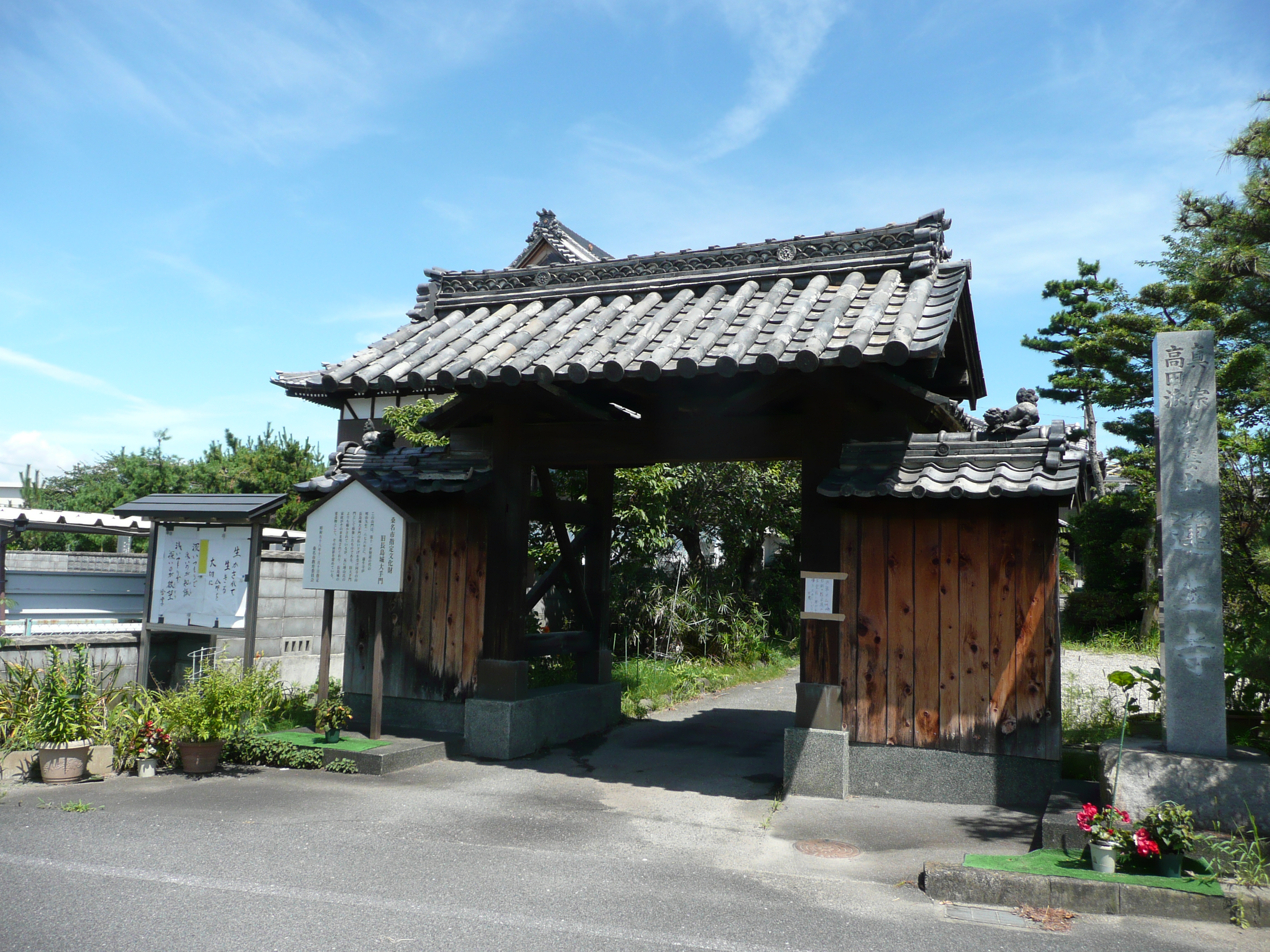
Walk the streets of Nagashima-cho today and the castle is gone but not entirely erased. Stone walls and moat fragments survive along the eastern edge of the school grounds. The former Otemon gate -- the castle's grand main entrance -- was relocated to the temple of Rensei-ji, where it still stands as a Registered Tangible Cultural Property of Kuwana City. The Okushoin, once an inner reception hall, found refuge at the temple of Fukagyo-ji nearby. And in the southwest corner of what was once the main enclosure, now within the elementary school grounds, a massive Japanese black pine estimated to be more than 300 years old spreads its branches -- protected as a Natural Monument of Kuwana City. It is the oldest living witness to the castle's final centuries, rooted in the same soil that absorbed so much history.
From the Air
Nagashima Castle (35.093N, 136.698E) occupied an alluvial island in the river delta where the Nagara and Kiso rivers meet before flowing into Ise Bay. From the air, the braided river system and island geography that made the site strategic are clearly visible. The castle site is now occupied by school buildings in Nagashima-cho, Kuwana. Nearest airports: RJGG (Chubu Centrair International, 35 km south) and RJNA (Nagoya Airfield, 30 km northeast). Nearby Nagashima Spa Land's roller coasters provide a modern visual landmark just south of the historic site.