Nagashino Castle
Five hundred men against fifteen thousand. In May 1575, the garrison of Nagashino Castle watched a Takeda army thirty times their number surround the clifftop fortress and begin to dig in. What followed -- the desperate defense, the lone messenger who swam downriver through enemy lines to summon help, and the battle that redefined Japanese warfare -- made this small castle in what is now Shinshiro, Aichi Prefecture, one of the most consequential military sites in Japan. When it was over, the samurai cavalry charge that had dominated battlefields for centuries was broken against wooden stockades and coordinated gunfire. The ruins were designated a National Historic Site in 1929, the first time any former castle site in Japan had received such recognition.
The Crossroads Fortress
Nagashino Castle sits on a cliff above the confluence of the Kansagawa River and the Uregawa River, in the northeastern reaches of modern Shinshiro. The position was not accidental. This spot commanded the crossing where the road from eastern Mikawa Province to southern Shinano Province intersected the route connecting Totomi Province with eastern Mino Province. Whoever held Nagashino controlled a junction of four provincial roads. In 1508, Imagawa Ujichika, ruler of Suruga and Totomi, recognized the strategic value and ordered his vassal Suganuma Motonari to build a castle here. Today, only remnants of moats and scattered stonework remain, but the rivers still converge below the cliff in the same pattern that made this ground worth fighting over.
Loyalty Bought and Sold
The decades before the famous battle were a study in the fragility of feudal allegiance. After the Imagawa clan collapsed at the Battle of Okehazama in 1560, the local Suganuma clan pledged loyalty to Tokugawa Ieyasu. But when Takeda Shingen swept down from Shinano Province and threatened northern Mikawa, the Suganuma switched sides to the Takeda. When Shingen died in 1573, Ieyasu retook Nagashino and dispossessed the Suganuma entirely. In their place, he installed Okudaira Nobumasa as castellan -- a man who had himself defected from the Takeda to the Tokugawa, at a terrible price. The Takeda executed Okudaira's wife and brother, who had been held as hostages to prevent exactly such a betrayal. Nobumasa now defended the castle with the personal fury of a man who had already paid for his loyalty in blood.
The Siege and the Swimmer
In May 1575, Takeda Katsuyori arrived at Nagashino with 15,000 troops. Okudaira Nobumasa had only 500 men behind the castle walls. The Takeda laid siege, and the outcome seemed inevitable. But Okudaira managed to send a messenger -- accounts describe the man swimming downriver through Takeda lines under cover of darkness -- to reach Tokugawa Ieyasu with a plea for reinforcement. Ieyasu responded, and not alone. He brought Oda Nobunaga and their combined army of 38,000 men to relieve the siege. The stage was set for a confrontation that would change the nature of war in Japan.
Gunfire Against the Cavalry
Oda Nobunaga understood that the Takeda cavalry was the most feared striking force in Japan. Rather than meet the charge in the open, he built wooden stockades and positioned his arquebusiers behind them. When the Takeda horsemen thundered forward, they met coordinated volleys of gunfire from protected positions. The result was devastating. By mid-afternoon, the Takeda army broke and fled. Among the dead were eight of the legendary Twenty-Four Generals that Katsuyori had inherited from his father, Takeda Shingen. The Battle of Nagashino marked a turning point: the mounted samurai charge, the defining tactic of Japanese warfare for generations, had been defeated by firearms and field fortifications. It was the beginning of the end for the Takeda clan and the dawn of a new military era.
What the Cliff Still Holds
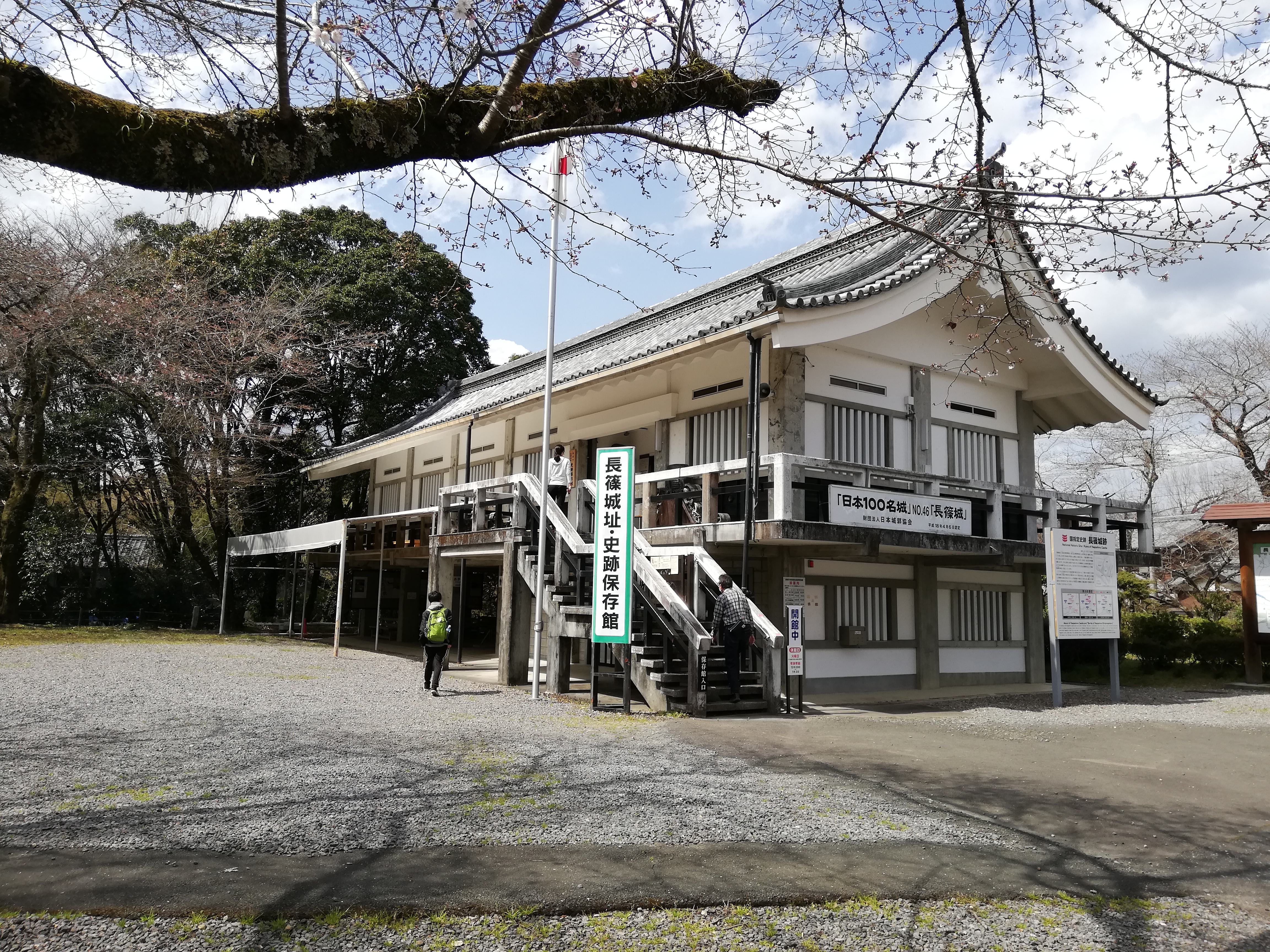
The castle was never rebuilt as a grand fortress. Its strategic importance faded as the Tokugawa consolidated power and Japan moved toward unification. Today, the ruins stand quiet above the river confluence -- remnants of moats, traces of stonework, and the steep cliff that once made the position nearly impregnable. A small museum, the Nagashino Castle Ruins Museum, occupies the site of the main bailey and interprets the events of 1575 for visitors. But the most powerful exhibit is the landscape itself: the rivers still meeting below the bluff, the roads still converging at the same junction, the terrain still explaining why 500 men could hold this ground long enough to change the course of Japanese history.
From the Air
Nagashino Castle sits at 34.923N, 137.560E on a cliff at the confluence of the Kansagawa (Toyokawa) and Uregawa rivers near Shinshiro, Aichi Prefecture. The river confluence is the key visual landmark -- look for two waterways merging in a forested valley. The castle ruins occupy the bluff at the junction. Best viewed at 2,000-4,000 feet AGL. The nearest airport is RJNN (Nagoya Chubu Centrair International), approximately 55 nm to the southwest. The terrain is mountainous with narrow river valleys providing visual corridors. Clear weather recommended for sightseeing in this area.