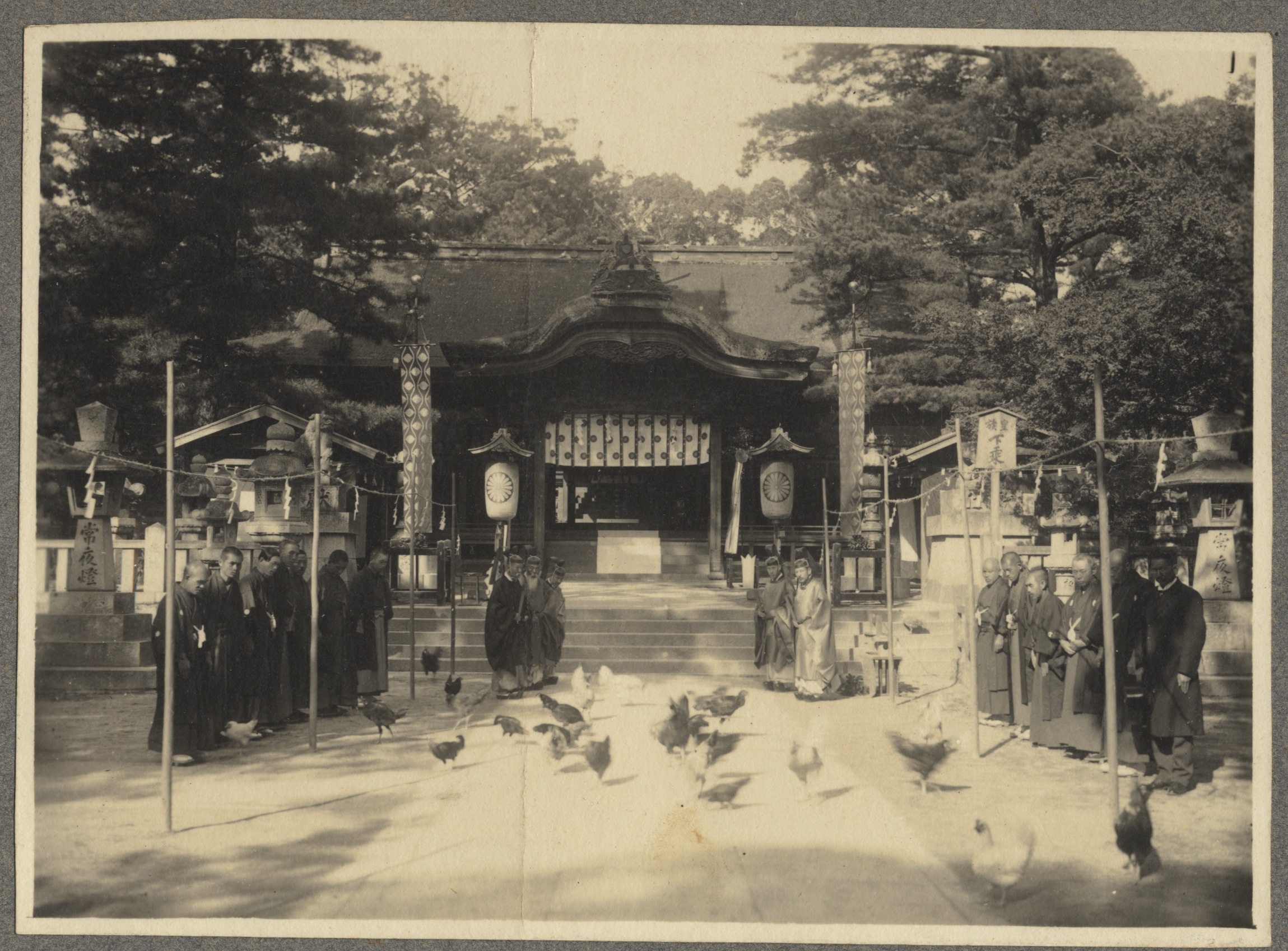
Nagata Shrine
The ground shook at 5:46 a.m. on January 17, 1995. The Great Hanshin earthquake tore through Kobe with a magnitude of 7.3, killing 6,434 people and destroying entire neighborhoods. Nagata-ku, the ward where this shrine stands, lost twenty percent of its buildings in the disaster. Yet when the dust settled, the main hall of Nagata Shrine was still standing. The structure had endured, just as it had endured for over eighteen centuries -- through wars, typhoons, firebombing, and the slow erosion of imperial power. In 2001, the shrine celebrated 1,800 years of continuous history, a span that reaches back to when Japan's chronicles say an empress heard a divine command and planted sacred ground on this spot.
An Empress Hears the Sun Goddess
According to the Nihon Shoki, Japan's oldest official chronicle, Nagata Shrine was founded by Empress Jingu at the beginning of the third century. The story claims that Amaterasu, the sun goddess at the center of Shinto cosmology, told the empress that a shrine was wanted at Nagata. Empress Jingu complied, establishing Nagata Shrine alongside Hirota Shrine in what is now Hyogo Prefecture. The deity enshrined at Nagata is Kotoshironushi-no-Okami, a kami associated with commerce, industry, and good fortune. Over the centuries, the shrine rose through Japan's hierarchical system of ranked Shinto shrines, reaching the second tier of government-supported institutions especially venerated by the imperial family. That rank placed Nagata among the most prestigious sacred sites in western Japan.
Torches Against Misfortune
Every February, during the setsubun season that marks the boundary between winter and spring, Nagata Shrine hosts the Tsuina-shiki Shinji -- a Shinto purification ceremony roughly 650 years old, dating to the Muromachi period. The ritual engages hopes for safety in the home and the averting of misfortune. Participants seek the ashes of torches held by ceremonial ogres, believed to purify spiritual defilement. Hyogo Prefecture has designated the Tsuina-shiki an Important Intangible Folk Cultural Property, recognizing its deep roots in regional religious practice. The ceremony draws crowds from across the Kansai region, filling the shrine precincts with the smell of incense and the solemn rhythms of a ritual that has outlasted dynasties, earthquakes, and the modern world's indifference to old traditions.
Three Shrines, One City
Nagata is one of Kobe's three great shrines, a grouping known locally as the Kobe Sanja. Together with Ikuta Shrine in the bustling Sannomiya district and Minatogawa Shrine to the east, Nagata forms a sacred triangle across the city. Many Kobe residents make it a tradition to visit all three during hatsumode, the New Year's shrine pilgrimage that draws millions of Japanese to sacred sites in the first days of January. Each shrine carries its own identity: Ikuta is known for matchmaking blessings, Minatogawa draws over a million hatsumode visitors annually, and Nagata specializes in commerce and protection from misfortune. An autumn matsuri in October further marks the shrine's calendar as a special day dedicated to Kotoshironushi, the guardian kami, drawing devotees who seek blessings for their businesses and households.
Standing Through the Shaking
The 1995 earthquake devastated the Nagata-ku neighborhood around the shrine. Fires burned unchecked through narrow streets, and the ward became one of the most iconic images of the disaster's aftermath. But the main hall of Nagata Shrine survived, and the reconstruction of the surrounding grounds became part of the wider rebuilding of a community that had lost so much. Today, Nagata Shrine stands fully restored in a neighborhood that has itself been reborn. The shrine's persistence through the earthquake resonates with its founding story -- a place commanded into existence by a goddess, sustained by devotion across nearly two millennia, and rebuilt by a community that refused to abandon its spiritual center. Visitors who walk through the torii gate today step into a space where deep time and modern resilience overlap, where the old rituals continue and the ground beneath still holds.
From the Air
Nagata Shrine is located at 34.67N, 135.15E in Nagata-ku, western Kobe. The shrine compound is not individually distinguishable from altitude but sits within the dense urban fabric of Nagata ward, near the waterfront. Kobe Airport (RJBE) lies approximately 8 nm to the southeast on a reclaimed island. Osaka Itami Airport (RJOO) is roughly 20 nm northeast. The shrine sits beneath the southern slopes of the Rokko mountain range, and the Nagata-ku neighborhood is identifiable by its position in western Kobe between the mountains and the port.