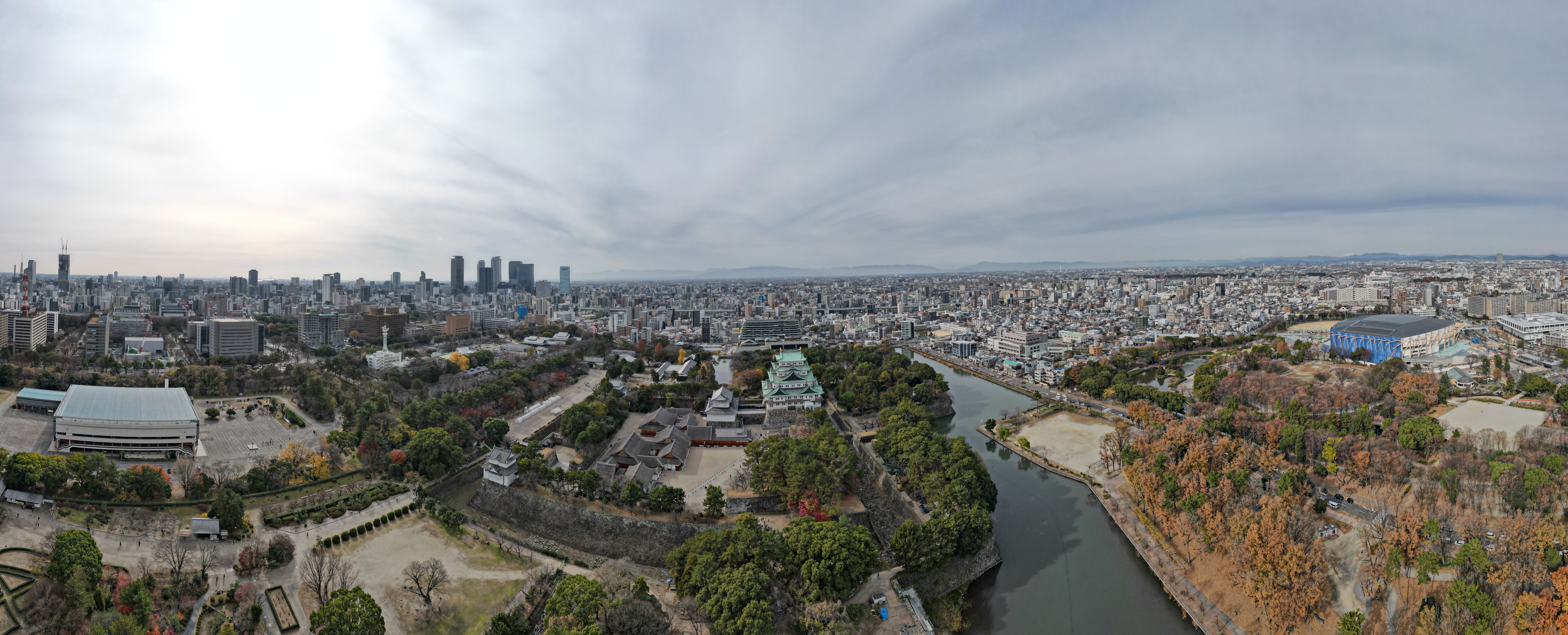
Nagoya Castle
Two golden dolphins stare down from the rooftop, their scales glinting against the Nagoya skyline. These kinshachi -- mythical fish-tiger creatures said to protect against fire -- have been recast three times, stolen by emperors, exhibited in Vienna, obliterated by American firebombs, and minted anew at the Osaka Mint. No other ornament in Japan carries such a tangled biography, and no other castle has endured quite the same cycle of splendor, destruction, and stubborn resurrection as Nagoya Castle.
Warlords and Master Builders
The site's military history predates the castle visitors see today. Between 1521 and 1528, the governor of Suruga Province built a fortification here called Yanagi-no-maru. Oda Nobuhide seized it in 1532, and his son Oda Nobunaga -- the warlord who would reshape Japan -- was reportedly born within its walls two years later. But the castle that defined Nagoya came later. In 1609, Tokugawa Ieyasu ordered a grand new fortress to serve as the seat of the Owari branch, the most senior of the three Tokugawa lineages. Twenty feudal lords were conscripted for the effort. Among them was Kato Kiyomasa, the legendary general and engineer whose "fan sloping" technique for stone walls -- curving them outward like an opening fan to balance the pressure of earth within -- remains visible today. The lords carved their crests into the stones they hauled, and those inscriptions still mark the walls four centuries later. The architect Nakai Masakiyo, who had already designed castles at Nijo, Fushimi, Edo, and Sunpu, brought all his experience to bear. By December 1612, the main keep stood complete.
Gold That Would Not Stay
The golden kinshachi became the castle's identity -- and its curse. The pair of roof-mounted dolphins, covered in gold leaf, announced the wealth of the Owari Tokugawa to anyone who looked upward. But that wealth eroded. By 1788, the Owari branch had accumulated debts of 215,000 ryo. In 1827, the shachi were melted down and recast with less gold, then covered in finer wire mesh to disguise the diminished luster. In 1846, they were melted a third time. When the Meiji Restoration ended Tokugawa rule, the golden dolphins were removed entirely in 1871, shipped to Tokyo by steamship from Atsuta port, and sent on a touring exhibition. The male appeared at the Yushima Seido Exposition in 1872; the female traveled to the Vienna World Exposition the following year. The castle itself nearly followed -- demolition was ordered, until the German minister to Japan, Max von Brandt, intervened. In 1879, the war minister Yamagata Aritomo decided to preserve it.
Fourteen Minutes in May
On the morning of May 14, 1945, American firebombs fell on Nagoya Castle. The main keep, the small keep, the golden shachi, the Honmaru Palace, the northeast turret, and dozens of other structures were destroyed. It was the worst single day of destruction in the castle's entire history. Some of the irreplaceable Honmaru Palace paintings had been moved to storage as the Pacific War intensified -- a decision that saved masterpieces by Kano Sadanobu and Kano Tan'yu, artists from the same family workshop that had decorated the palace in 1614 and 1634. The Sarumen Tea House, once designated a national treasure, had already been destroyed in an earlier January raid. Yet amid the devastation, the southwest, southeast, and northwest turrets survived, along with the Omote-Ninomon Gate. These structures were redesignated as Important Cultural Assets and became anchors for everything that followed.
A Castle Rebuilt Twice
Reconstruction began in 1957. The Osaka Mint cast second-generation golden shachi, and by October 1959 the two keeps reopened to the public. But concrete and steel were not enough for Nagoya. In 2009, Mayor Takashi Kawamura announced an ambitious two-part plan: first, to reconstruct Honmaru Palace using traditional materials and techniques, and second, something even bolder -- a full wooden reconstruction of the main tower itself, just as it had stood before the war. The palace was completed in 2018. An international fundraising campaign launched in 2017, and hinoki cypress timber began arriving from the forests of Gifu Prefecture in 2019. The ambition is remarkable -- not merely to rebuild, but to return to the original construction methods that Nakai Masakiyo perfected over four hundred years ago.
Living Grounds
Beyond the keeps and turrets, the castle grounds hold quieter stories. A 600-year-old Kaya tree near the Nishinomaru gate predates the castle itself -- the only government-designated natural monument in Nagoya. It survived the 1945 firebombing, sprouting new growth from its charred trunk. Nearby, a Palace Camellia that was thought destroyed in the same raids also regenerated from its scorched stump; a grafted descendant blooms white flowers each spring. The Ninomaru garden, built between 1615 and 1623, was converted to a dry landscape garden in 1716 and still contains its original rock arrangements. Sika deer graze in the dry summer moats, and the castle grounds bloom in seasonal rotation: cherry and wisteria in spring, iris and hydrangea in summer, and wintersweet and Japanese plum through the cold months. Every autumn, one of Japan's largest chrysanthemum exhibitions fills the grounds with cultivated flowers, bonsai arrangements, and miniature landscapes.
From the Air
Nagoya Castle sits at 35.186N, 136.899E in central Nagoya. From the air, the castle's five enceintes and concentric moat system are clearly visible. The reconstructed main keep with its gold kinshachi roof ornaments catches sunlight. Nearest airport is Chubu Centrair International Airport (RJGG), approximately 35 km to the south. Nagoya Airfield (RJNA/Komaki) is closer at roughly 10 km north. Best viewed at 2,000-3,000 feet. The castle complex is surrounded by Meijo Park to the north and government buildings of the former Sannomaru enceinte to the south and east.