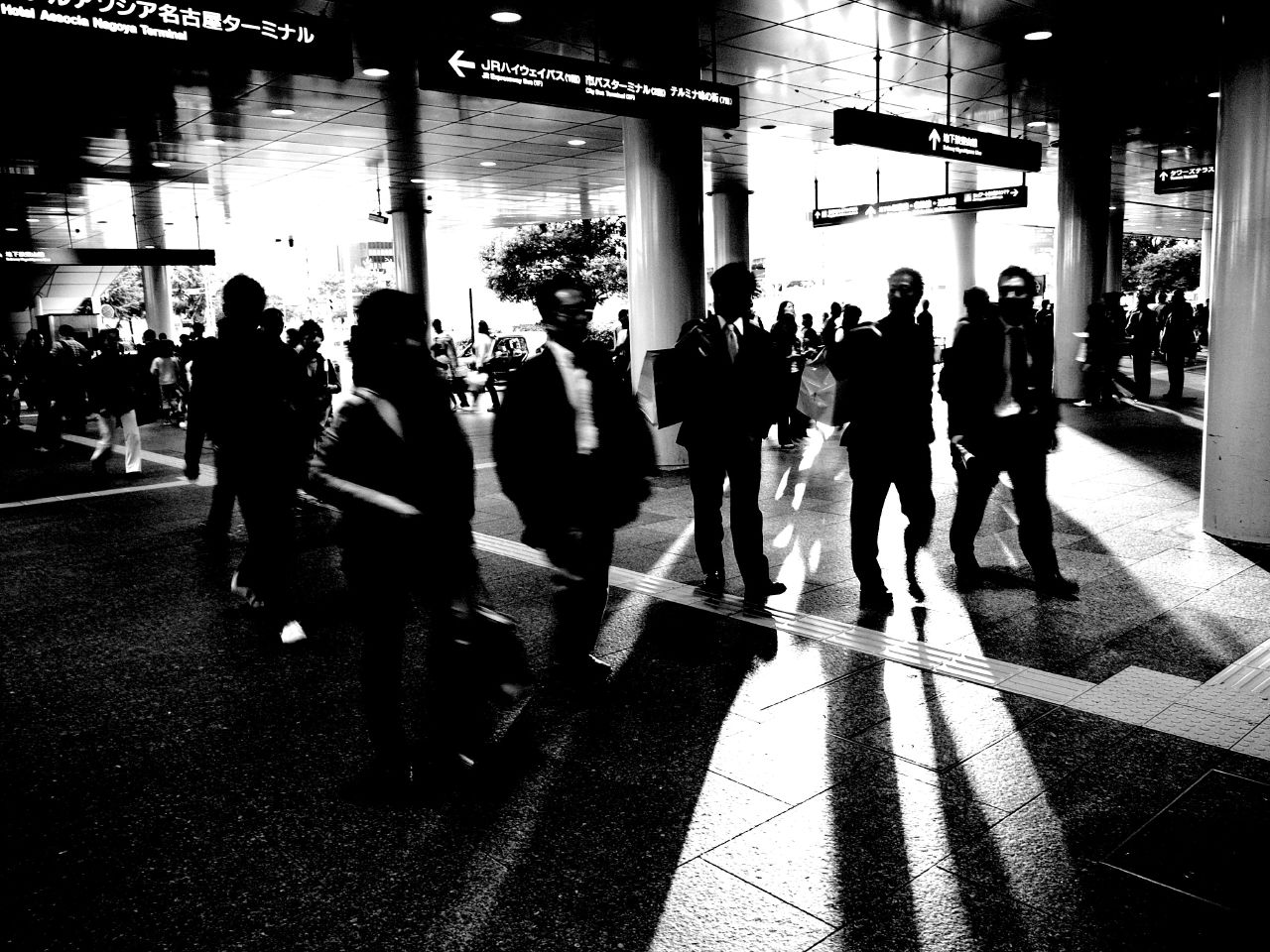
Nagoya Station
Every platform at Nagoya Station serves kishimen. The flat, slippery wheat noodles arrive in a steaming broth, slurped standing at counters wedged between tracks, and the ritual has played out here for decades. It is a small, persistent tradition inside what was once certified by Guinness World Records as the largest station building on Earth. That tension between intimate daily habit and staggering scale defines Nagoya Station, a place where 420,000 square meters of floor space somehow still feel like a neighborhood gathering point for Japan's fourth-largest city.
A Branch Line's Lucky Break
When Nagoya Station opened on May 1, 1886, it sat among rice paddies on what was supposed to be a forgettable branch line. The Japanese government had planned the main Tokyo-to-Osaka trunk railway along the inland Nakasendo route through the mountains, bypassing Nagoya entirely. Military planners preferred the mountain corridor because coastal tracks would be exposed to foreign naval gunfire. Nagoya was to receive only a short spur from Gifu to Taketoyo for hauling construction materials. City officials protested, arguing the plan would choke their modernization. Their lobbying worked. On July 19, 1886, barely two months after the station opened, the government reversed course and rerouted the trunk line along the coastal Tokaido, turning Nagoya's small wooden station into a stop on the most important railway in the country. That first building stood about two hundred meters south of the present site, near today's Sasashima-raibu Station, with just two side platforms and two tracks.
Shaken, Burned, Rebuilt
The original wooden station collapsed in the devastating 1891 Mino-Owari earthquake, one of the most powerful seismic events in Japanese history. A replacement went up a year later, twice the size but still wooden. The station kept growing through the twentieth century, absorbing the Nagoya Municipal Subway connection in 1957 and the Tokaido Shinkansen in 1964, when bullet trains began their iconic Tokyo-Osaka run. Each generation of the building reflected the ambitions of its era. By the 1990s, those ambitions had grown enormous. JR Central demolished the aging third station building and replaced it with the JR Central Towers, a pair of skyscrapers rising 51 and 53 floors directly above the platforms. Completed in 1999 and opened in May 2000 at a cost of roughly 200 billion yen, the complex earned a Guinness World Record in 2002 for the world's largest station building, with 420,000 square meters of floor space housing offices, hotels, department stores, and restaurants.
The Noodle Platforms
Amid all this vertical ambition, the platforms retain a wonderfully human scale. Platforms 1 through 10 each host a kishimen stand operated by Japan Travel Service, continuing a tradition stretching back to the early 1960s. Travelers waiting for limited express trains to the mountain towns of Takayama or the coast of Mie Prefecture stand elbow-to-elbow with Shinkansen passengers, chopsticks poised over broad noodles in bonito broth. Platform 1, occasionally taken out of regular service for construction, has hosted pop-up events including a two-month stint by the Sekai no Yamachan chicken wing chain in 2023. These small details give the station its character, the sense that it belongs to the people who pass through it daily rather than to the gleaming towers overhead.
Gateway to Everywhere
Nagoya Station is not one station but several stitched together. The main JR Central complex holds eight island platforms serving sixteen tracks for Shinkansen bullet trains and conventional lines. Adjacent to it stand the Meitetsu Nagoya and Kintetsu Nagoya terminals, each operated by a different private railway company. Underground, two Nagoya Municipal Subway lines cross on separate platforms. To the west, the Aonami Line, converted from a freight-only branch in 2004, connects to the port district. Four named limited express services fan out from the station: the Shinano toward Nagano, the Hida toward the Japanese Alps, the Nanki toward the Kii Peninsula coast, and the Shirasagi toward the Sea of Japan. A city bus terminal with 22 routes and highway bus services complete the web. The surrounding Meieki district takes its very name from the station and competes with Sakae and Kanayama for the title of Nagoya's commercial heart.
Digging Toward the Future
Since December 2014, workers have been excavating 30 to 40 meters beneath the station to build two underground island platforms and four tracks for the Chuo Shinkansen, a superconducting maglev line that will eventually link Tokyo and Osaka at speeds exceeding 500 kilometers per hour. Nagoya Station will serve as the western terminus of the first operating section. The project represents the next chapter in a story that began with a wooden depot in the rice fields, a station that was never meant to be important but refused to stay small. Above ground, Meitetsu is leading a massive redevelopment stretching 400 meters along the station's frontage, anchored by two new high-rise towers. One hundred and forty years after a branch line's lucky break, Nagoya Station is still reinventing itself.
From the Air
Nagoya Station sits at 35.17N, 136.88E in the heart of Nagoya's Nakamura ward. The twin JR Central Towers are visible from altitude as the tallest structures in the immediate station district. Chubu Centrair International Airport (RJGG) lies approximately 35 km to the south across Ise Bay. Nagoya Airfield / Komaki (RJNA) is about 11 km to the north. Approach from the east for the best view of the towers against the Meieki skyline.