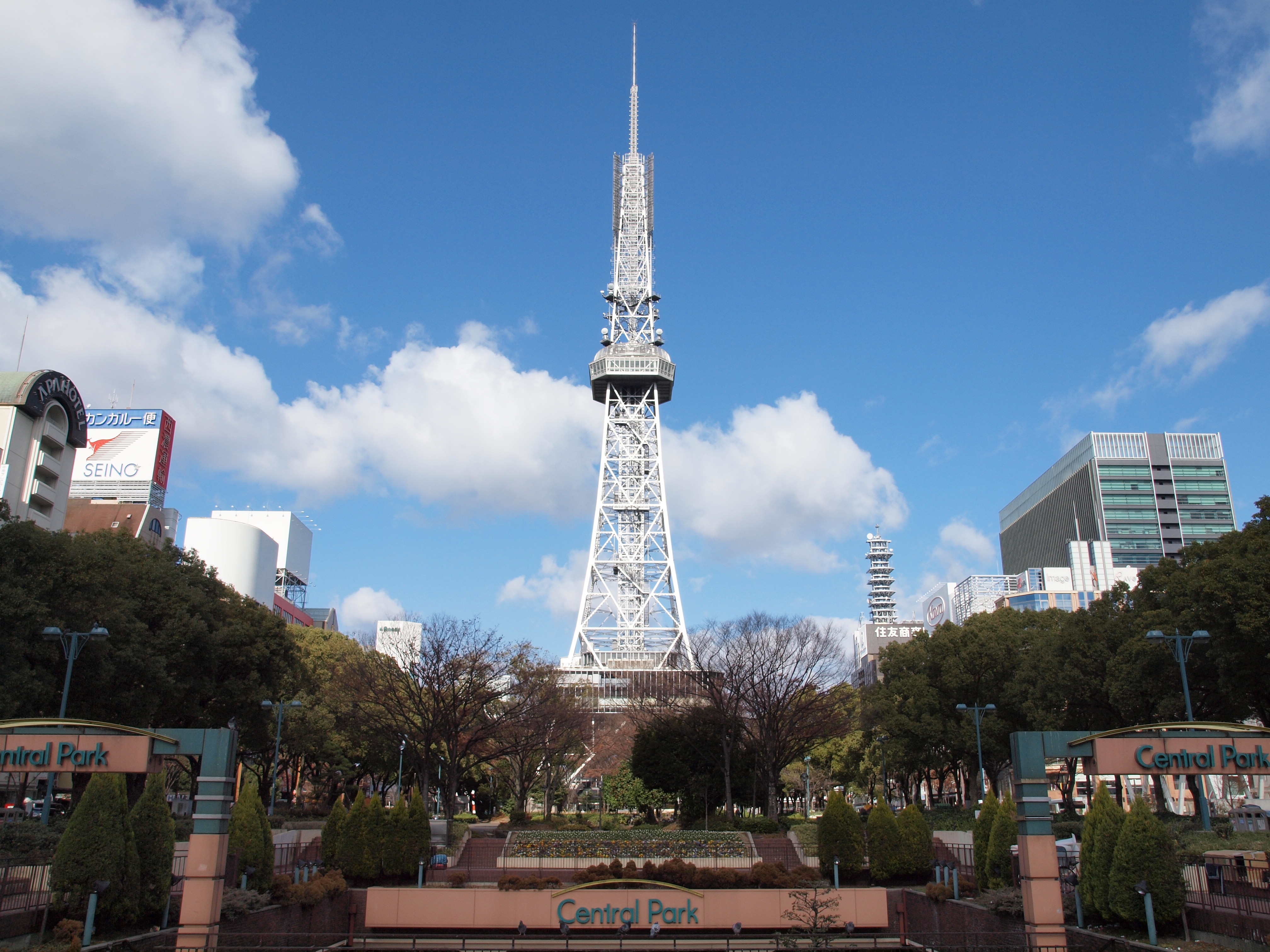
Nagoya TV Tower
Godzilla has destroyed the Nagoya TV Tower twice. In 1964's Mothra vs. Godzilla, the King of the Monsters ripped through the lattice steel on his rampage across Aichi Prefecture. In the 1992 remake, the creature Battra finished the job. The tower, of course, still stands, its 180-meter frame rising from the green corridor of Hisaya Odori Park like a steel exclamation point at the center of Nagoya. The real tower has proven harder to kill than its cinematic double. Completed in 1954 as the first television broadcasting tower in Japan, it has outlasted every structure that followed its blueprint and earned recognition as an Important Cultural Property, the first tower in the country to receive that honor.
The Tower Doctor's First Masterpiece
The man behind the Nagoya TV Tower was Tachu Naito, a structural engineer so prolific in vertical construction that he earned the nickname 'the Tower Doctor.' Naito had already proven his mastery of earthquake-resistant design with buildings that survived the catastrophic 1923 Great Kanto earthquake. When Japan needed broadcasting infrastructure for the new medium of television in the early 1950s, Naito was the natural choice. Construction began on September 19, 1953, with groundbreaking in the center of Hisaya Odori Park, a broad green boulevard that runs through Nagoya's Sakae district. Just nine months later, on June 19, 1954, the 180-meter tower was complete. It was the tallest structure in Japan at the time. Naito went on to design a string of towers across the country, including the Tsutenkaku in Osaka in 1956, the Sapporo TV Tower in 1957, and his crowning achievement, Tokyo Tower, in 1958. But Nagoya came first.
Steel Bones, Parisian Echoes
The tower's lattice steel frame draws immediate comparisons to the Eiffel Tower, and the resemblance is not accidental. Naito studied Gustave Eiffel's work closely, adapting the principles of open steelwork to Japanese conditions where typhoons and earthquakes demanded flexibility as well as strength. The result is a structure that tapers elegantly from a broad base to a slender antenna mast, painted in a warm red-orange that catches the light against Nagoya's skyline. Two observation platforms punctuate the ascent: the enclosed Sky Deck at 90 meters and the open-air Sky Balcony at 100 meters, where wind whips across visitors standing at the railing. Below them, at 30 meters, a gallery and restaurant occupy the tower's wider midsection. The tower once even housed a bowling alley near its summit, a detail that captures the exuberant optimism of postwar Japan's embrace of leisure and modernity.
Thunder and Light
For decades, the tower served its original purpose: broadcasting television signals across the Nobi Plain. As newer, taller transmission facilities came online, the tower's role shifted. It became primarily an observation platform and a symbol of the city rather than a working piece of broadcast infrastructure. A dramatic nighttime illumination program earned it the nickname 'Thunder Tower,' with lighting sequences that transform the steel lattice into a beacon visible across the city. In May 2021, as part of a corporate naming rights agreement, the tower was officially rechristened the Chubu Electric MIRAI TOWER, with 'mirai' meaning 'future' in Japanese. Locals, however, overwhelmingly continue to call it the Nagoya TV Tower, the name that has identified the structure for seven decades. The rebranding reflects the tower's ongoing search for relevance in a city that has grown up around it, but the affection embedded in the old name suggests the tower's identity was settled long ago.
Monument Status
In December 2022, the Nagoya TV Tower received designation as an Important Cultural Property, the first tower in Japan to earn that recognition. The designation acknowledged not just the tower's architectural significance but its role as a pioneering piece of postwar infrastructure, a physical record of the moment Japan entered the television age. The tower's placement in Hisaya Odori Park amplifies its presence. The park stretches nearly two kilometers through the Sakae commercial district, lined with trees and fountains, and the tower anchors its northern section like a compass needle pointing upward. From the Sky Balcony on a clear day, the view extends to the Japanese Alps to the north and Ise Bay to the south. At street level, the base of the tower draws visitors into the park's cafes and seasonal markets, weaving the seventy-year-old structure into the daily rhythm of the neighborhood.
Godzilla's Favorite Target
The tower's appearances in Japanese monster films have given it a cultural footprint that extends well beyond Nagoya. In Mothra vs. Godzilla (1964), one of the most beloved entries in the Toho franchise, Godzilla topples the tower during his assault on the city, the structure crumpling in miniature as the monster lumbers past. Twenty-eight years later, Godzilla vs. Mothra (1992) staged a repeat destruction, this time at the claws of Battra. The anime series Seraph of the End placed characters atop the tower as a sniping perch, using its height for tactical advantage in a post-apocalyptic Nagoya. These fictional demolitions have become part of the tower's charm, a running joke about the gap between the fragile miniature and the resilient original that has stood through typhoons, earthquakes, and seven decades of Nagoya summers.
From the Air
The Nagoya TV Tower stands at 35.172N, 136.908E in the Sakae district, rising 180 meters from the center of Hisaya Odori Park. The distinctive red-orange lattice structure is a clear visual landmark from the air, especially at night when illuminated. It sits roughly 2.5 km east of Nagoya Station and its JR Central Towers. Chubu Centrair International Airport (RJGG) is approximately 35 km to the south. Nagoya Airfield / Komaki (RJNA) is about 11 km north. The long green strip of Hisaya Odori Park running north-south through the city center helps identify the tower's location from altitude.