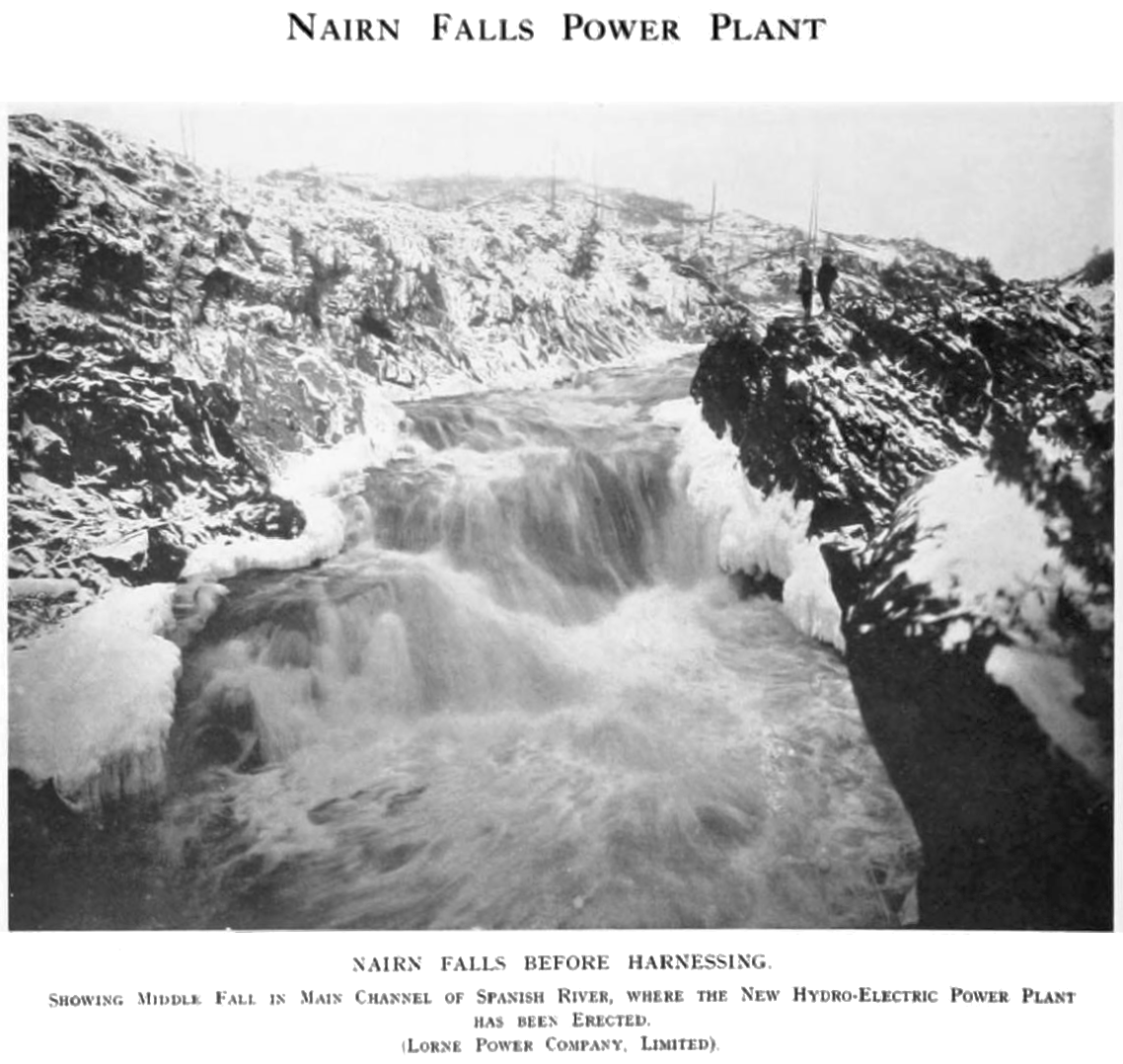
Nairn Falls Dam and Generating Plant
The powerhouse at Nairn Falls was assigned phone number 1. When the local telephone exchange opened in April 1917, the small generating station on the Spanish River was the very first subscriber -- a detail that captures something essential about this place. Before the town of Nairn had phones, before the railway workers and loggers and shopkeepers connected to the outside world by wire, the dam had a line. Power came first. It always did in the nickel country west of Sudbury, where the landscape was reshaped not by settlers seeking farmland but by mining companies seeking electricity to drive their operations underground.
Logs, Rails, and the River's New Purpose
The Spanish River had served industry long before anyone thought to dam it. Logging operations upstream sent timber floating downstream to mills at Nairn and Espanola, where the logs were processed and shipped out by rail. Two railway lines threaded through the bush country: the Algoma Eastern Railway running closer to the river on the north side, and the Canadian Pacific Railway paralleling it to the south. Both lines served a patchwork of company towns and established communities that existed because of nickel, copper, and timber. As the railways matured, loggers abandoned the river as a transportation corridor and switched to rail. This opened the door for a new use: hydroelectric power. The first dam went in at High Falls in 1904, and within a decade, the Spanish River was being reimagined as an energy source rather than a log highway.
A Nickel Baron's Wartime Gamble
The Mond Nickel Company built the Nairn Falls dam. A fierce rival of the larger International Nickel Company -- known simply as Inco -- Mond had developed mine sites and company towns west of Sudbury, connected to the outside world by both the Algoma Eastern and CPR lines. The two railways crossed each other just west of Nairn before paralleling the Spanish River, creating an industrial corridor through otherwise trackless bush. When the First World War erupted in 1914, nickel demand surged. Mond's mines and smelters were converting from steam to electric power, and the company needed generating capacity fast. Nairn Falls was the logical site: close to the Algoma Eastern line, near existing mining operations, and on a river already proven as a power source. Construction began in 1914 and was completed in 1915, obliterating the small natural waterfall in the process. The plant was managed by a Mond subsidiary called the Lorne Power Company, which also ran the Lorne Falls plant on the Vermilion River. Both facilities provided 60 Hz power to Mond operations -- a deliberate contrast to the 25 Hz system used by their rival Inco.
The Company Town That Vanished
Despite sitting only a short distance from the established railway town of Nairn, the plant had its own tiny settlement. Two three-bedroom houses and a boarding house called the "club house" -- run by a live-in cook -- formed the entire community. Four full-time workers and one relief worker kept the turbines running. The isolation deepened in 1930 when the CPR acquired the Algoma Eastern Railway and began ripping up redundant track. The section running past the plant was abandoned in 1931, cutting the generating station off from the rail network that had given it life. Over the following decades, the worker housing was abandoned as Inco -- which had absorbed Mond's operations -- switched to using roving maintenance crews instead of permanent on-site staff. The little settlement simply disappeared back into the bush.
Guarding Against Ghosts
The Second World War brought an unexpected chapter to the plant's history. Anti-German sentiment, renewed from the First World War, stoked fears of industrial sabotage across Canada. The government and industry increased security at railways, canals, harbours, and power plants. Inco responded by posting four armed guards -- two full-time and two relief -- to patrol the Spanish River dam complexes. The guards walked their rounds through the northern Ontario bush, watching for saboteurs who never came. No act of sabotage was ever attempted at Nairn Falls or any of the other Spanish River plants. The guards eventually stood down, leaving behind a footnote that says more about wartime anxiety than about any real threat to a small hydroelectric station in the Canadian wilderness.
Still Running, Still Hidden
More than a century after its turbines first turned, the Nairn Falls generating plant still operates. Now owned by Vale, the Brazilian mining giant that absorbed Inco, it supplies power both to Vale's Sudbury operations and to the Ontario Hydro grid. The surrounding landscape has changed dramatically from the logged-out terrain of 1915. Forests have regrown throughout the latter half of the twentieth century, giving the river valley a wilderness character that obscures the plant from casual view. The old Algoma Eastern Railway right-of-way has been partly reclaimed by bush, though a section serves as the plant's access road, connecting to Ferry Street in the town of Nairn. The road leads to where a ferry once carried people across the Spanish River to the area known as Headquarters. From the river itself, especially downstream, the dam and falls remain visible -- a quiet monument to the era when nickel companies reshaped northern Ontario's rivers to power their underground empires.
From the Air
Located at 46.34°N, 81.57°W on the Spanish River near the town of Nairn Centre, Ontario, west of Sudbury. The dam and generating plant sit along the river in heavily forested terrain, making them easier to spot from lower altitudes. Look for the dam structure and associated clearing along the Spanish River. The old Algoma Eastern Railway right-of-way is partially visible as a linear clearing. Nearest airports: Sudbury Airport (CYSB) approximately 30nm east; Espanola Municipal Airport (CPH9) approximately 10nm southwest. Best viewed from 1,500-3,000 ft AGL. The Spanish River corridor is scenic flying with multiple historic dam sites visible along its length.