Nakagin Capsule Tower: The Future That Never Arrived
Each capsule measured 2.3 meters by 3.8 meters -- roughly the dimensions of a shipping container, barely wider than a king-size bed. Inside, everything a single businessman needed for a night in the city: a built-in bath unit, air conditioning, a reel-to-reel tape deck, and a round porthole window framing the Ginza skyline. One hundred and forty of these prefabricated pods were bolted onto twin concrete towers in central Tokyo, each attached by just four high-tension bolts, each theoretically replaceable. Architect Kisho Kurokawa finished the Nakagin Capsule Tower in 1972 and declared it a prototype for the cities of tomorrow. Not a single capsule was ever replaced. Fifty years later, the building came down.
Metabolism's Manifesto in Concrete and Steel
The Nakagin Capsule Tower was born from the Metabolist movement, a radical architectural philosophy that emerged in postwar Japan. Metabolism imagined cities as living organisms -- growing, shedding, and regenerating their components like biological cells. Kisho Kurokawa, one of the movement's founding members, had already built capsule prototypes for Expo '70 in Osaka before tackling Ginza. The Nakagin tower was the world's first example of capsule architecture built for permanent, practical use. The two interconnected concrete shafts, eleven and thirteen stories tall, served as the organism's spine. The 140 capsules, all-welded lightweight steel-truss boxes clad in galvanized steel panels, were its living cells. Each pod was manufactured in a factory, trucked to the site, and craned into position. The entire building was completed in just two years, from 1970 to 1972, a construction speed that underscored the Metabolist promise: modular, efficient, endlessly renewable.
Life Inside a Pod
The capsules were designed for itinerant businessmen commuting to Tokyo's commercial center. Each unit came equipped with a built-in bathroom, a color television, a clock radio, and a reel-to-reel tape player -- luxury amenities for the early 1970s packed into a space smaller than most hotel rooms. The round porthole windows, set in curving white walls, gave the interiors a distinctly spacecraft-like quality. Kurokawa intended the pods to be swapped out every twenty-five years, keeping the building perpetually modern. But the replacement mechanism was never tested. The building's residents formed a co-ownership structure that made decisions about individual capsules nearly impossible. By 2012, only about thirty of the 140 capsules were still occupied as apartments. Others served as storage or office space. Some stood abandoned entirely, their porthole windows dark, their interiors slowly decaying behind locked doors.
Decay in the Shadow of Ginza
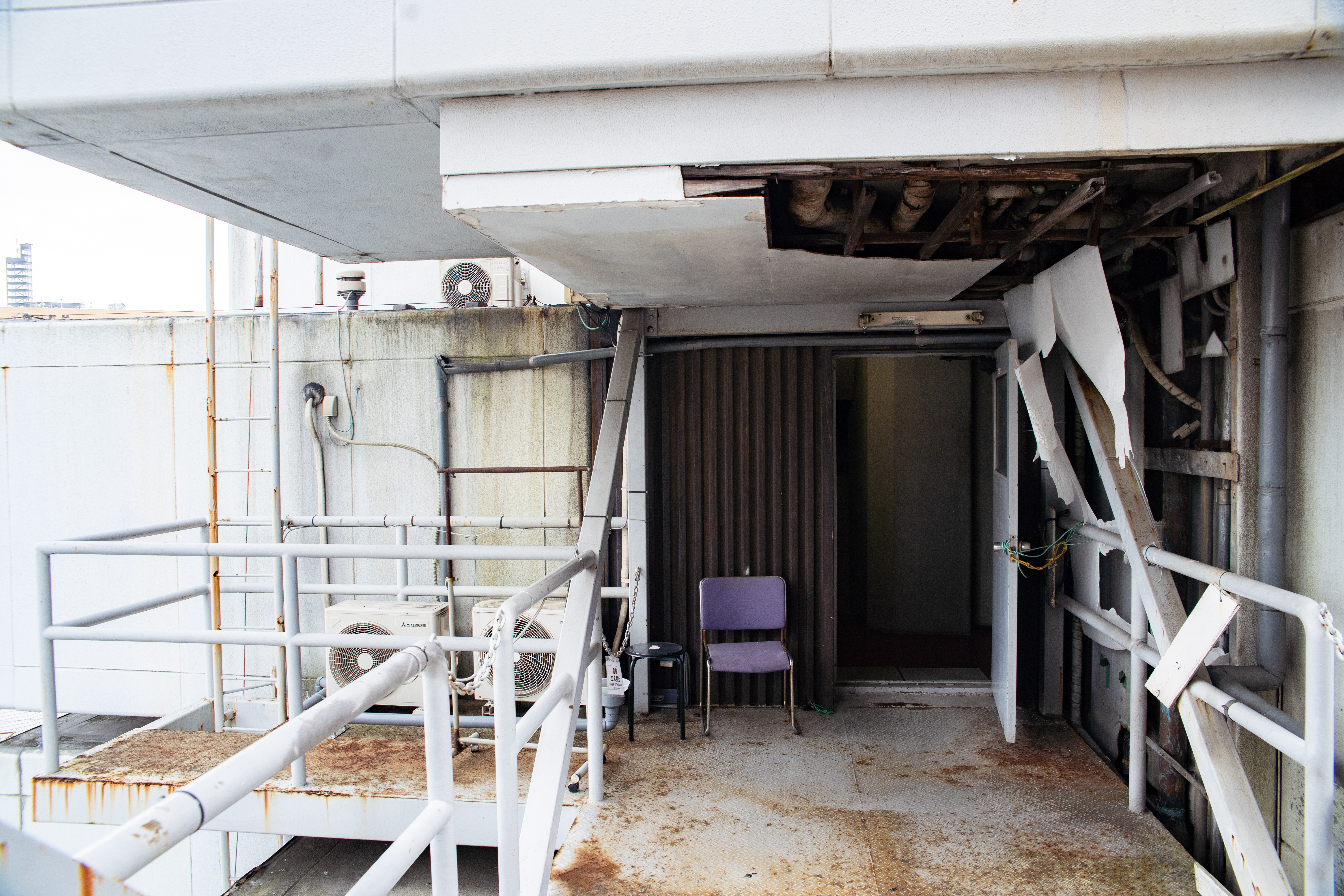
Sitting in one of Tokyo's most expensive real estate districts, the Nakagin Capsule Tower aged badly. The building's asbestos insulation posed health concerns. Its plumbing deteriorated. Water damage spread between capsules. The co-ownership structure meant that any major renovation required near-unanimous agreement from dozens of capsule owners, a consensus that never materialized. Preservation campaigns attracted international attention. Architecture enthusiasts, photographers, and design pilgrims made the tower a destination, marveling at its retro-futurist silhouette amid Ginza's polished glass facades. As recently as 2017, capsules could still be rented at surprisingly affordable rates for the Ginza neighborhood, though the waiting list was long. The Economist, the New York Times, Bloomberg, CNN, and The Guardian all published elegies. But the economics of central Tokyo real estate proved stronger than nostalgia.
Dismantlement and Afterlife
Demolition began on April 12, 2022. The capsules were detached from their concrete cores one by one, reversing the crane-and-bolt process of fifty years earlier. Former residents and preservation advocates had managed to save twenty-three capsules from destruction. A digital archiving project by the firm Gluon captured the entire building in detailed 3D scans before it vanished. The rescued capsules scattered across the globe: the San Francisco Museum of Modern Art acquired one in 2023, displaying it as a cultural artifact of postwar Japanese design. Others went to museums, private collectors, and cultural institutions. Kurokawa himself had died in 2007, fifteen years before his most famous building was taken apart. The vacant lot in Ginza where two concrete towers once bristled with 140 pods now awaits redevelopment. The future Kurokawa envisioned -- disposable, replaceable, endlessly regenerating -- turned out to be the one thing the capsules were not.
From the Air
Located at 35.666°N, 139.763°E in the Ginza district of central Tokyo. The tower site sits near the Shimbashi waterfront area, roughly 2 km southeast of the Imperial Palace. From altitude, the Ginza district is identifiable by its dense grid of commercial buildings along the Sumida River's west bank. Tokyo Haneda Airport (RJTT) lies approximately 8 nautical miles to the south. Note: the building was demolished in 2022, so the site is no longer a visible landmark. Best context is the surrounding Ginza streetscape at 2,000-3,000 feet AGL.