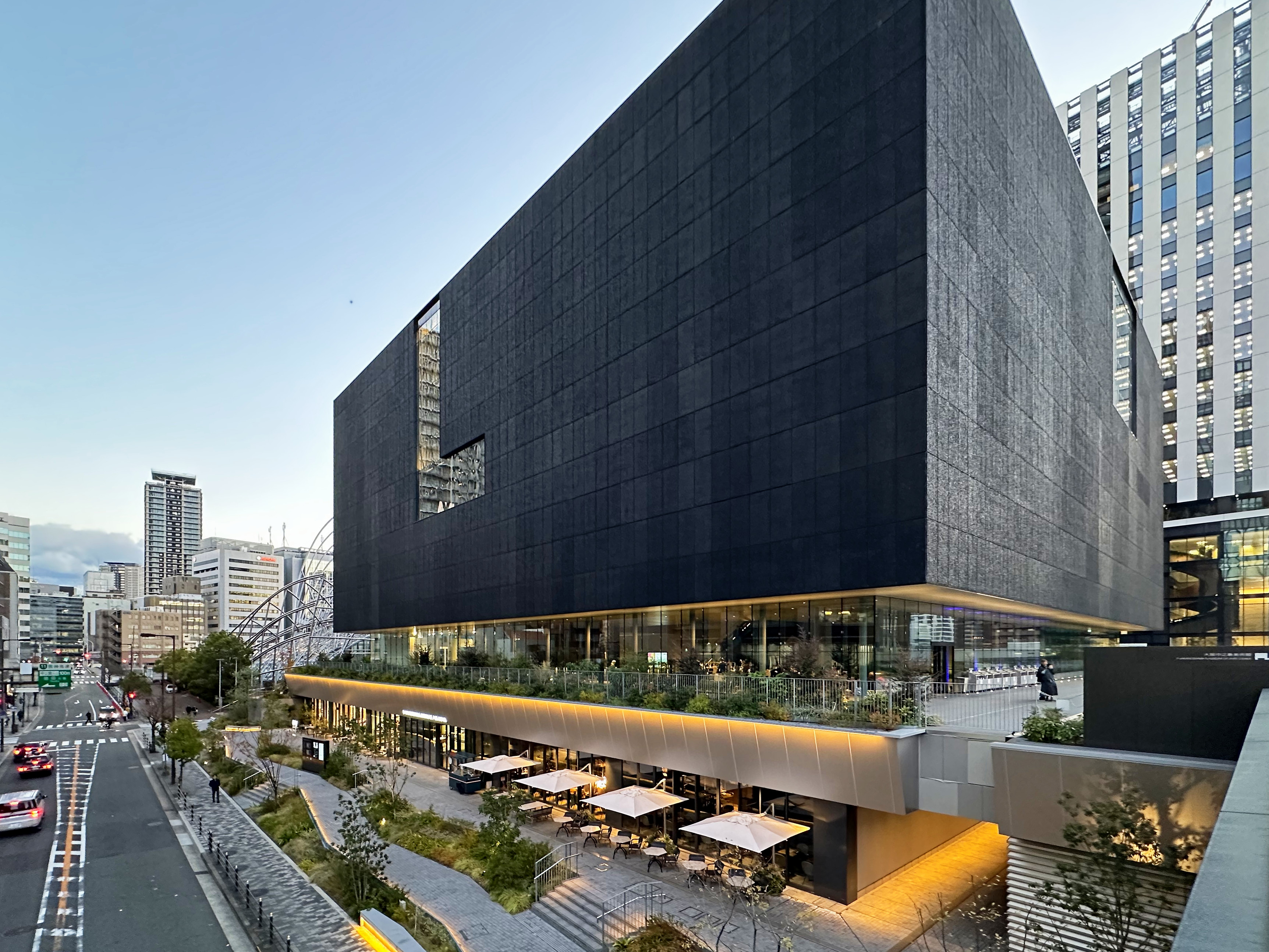
Nakanoshima Museum of Art: The Black Box on the River
From the air, it registers as a dark void in Osaka's dense urban fabric -- a five-story black cube sitting on a narrow sandbank island between the Dojima and Tosabori rivers. Sixty-three meters square and twenty-six meters high, clad in 609 precast concrete panels blended from Iwate Gensho stone and Kyoto sand, the Nakanoshima Museum of Art absorbs light rather than reflecting it. Architect Endo Katsuhiko designed this deliberate darkness as a frame. The openings cut into the black walls let interior light spill outward, signaling human activity inside -- art being made, seen, discussed. The building won the 2022 JIA Grand Prix from the Japan Institute of Architects, and the choice of site carries its own meaning: this patch of Nakanoshima once held the Gutai Pinacotheca, the headquarters and exhibition venue of the Gutai Art Association, one of the most radical art movements of postwar Japan. The new museum stands precisely where Japanese artists first challenged the boundaries of what art could be.
An Island Between Rivers
Nakanoshima has been central to Osaka's identity for centuries. The narrow sandbank between the Dojima and Tosabori rivers served as an important center of trade and commerce since the Middle Ages. The specific site of the museum was once the Hiroshima Clan's storage facility, complete with a harbor called Funairi where ships could dock directly. That mercantile history -- goods arriving by water, being stored, sorted, and sent onward -- echoes in the museum's own function as a place where art is collected, organized, and presented to the public. Endo Katsuhiko's design acknowledged this layered past. Selected through an open architectural competition held between 2016 and 2017, his proposal combined a historical analysis of the site with modern urban requirements. The lower two floors are open public spaces, creating a seamless transition between museum and city. The upper floors contain the art galleries, elevated above the third floor for flood protection -- a practical concession to the rivers that define the island.
The Painter Who Died at Thirty
The museum holds the largest collection of works by Saeki Yuzo, and his story haunts the galleries. Born in Kita Ward, Osaka City in 1898, Saeki attended Kitano High School before studying at the Tokyo Fine Arts School -- now Tokyo University of the Arts. After graduating, he moved to France and dedicated his short life to painting Parisian cityscapes with an intensity that consumed him. He died in 1928 at the age of thirty. His work might have been lost to history if not for Yamamoto Hatsujiro, an Osaka businessman and art collector who recognized the importance of Saeki's paintings. In 1983, the Yamamoto family donated thirty-three of Saeki's works that had survived the war to the city of Osaka. Today the museum houses around sixty of his paintings, including loans. They are vivid, urgent canvases -- Paris rendered by an Osaka-born artist who burned through his life painting streets he would never call home.
Where Gutai Broke the Rules
The Gutai Art Association, founded by Yoshihara Jiro in 1954, was one of the first postwar art movements to reject conventional approaches to painting and sculpture. Members threw paint, tore through paper canvases, embedded lightbulbs in mud, and created installations that anticipated Western performance art by a decade. Their headquarters -- the Gutai Pinacotheca -- stood on the very ground where the Nakanoshima Museum now rises. The collection honors this legacy with many works by Yoshihara and other Gutai members, alongside pieces by Osaka and Kansai region artists who worked in that creative ferment. The broader collection of paintings, graphics, and sculptures includes world-renowned works of Western modernism: a bronze by Alberto Giacometti titled Le Nez, a nude by Amedeo Modigliani, and works by Jules Pascin, Giorgio De Chirico, Umberto Boccioni, and Constantin Brancusi. The conversation between Japanese avant-garde and European modernism runs through the collection like a current.
Six Thousand Works Behind Black Walls
The museum's holdings total approximately 6,000 works as of 2024, a remarkable number given that 5,000 were donated and only 1,000 purchased. The collection spans from the mid-nineteenth century to the present, encompassing Western paintings by Japanese artists, nihonga, modern European art, contemporary art, prints, photographs, sculpture, and design. The design collection alone is formidable: when the Suntory Poster Collection of some 18,000 items transferred to the museum in 2012, it joined existing furniture and tableware holdings to create one of the largest design collections in the world. The posters include works by Henri de Toulouse-Lautrec and Alfons Mucha, tracing the evolution of modern design from the Arts and Crafts movement through Art Nouveau, the Wiener Werkstatte, De Stijl, and Bauhaus. More than 3,000 works have been loaned to over 800 museums worldwide, making Nakanoshima a quiet engine of international cultural exchange.
From the Air
Located at 34.692°N, 135.491°E on Nakanoshima island in central Osaka. From altitude, the museum's distinctive black cubic form is visible on the narrow island between the Dojima and Tosabori rivers, contrasting sharply with surrounding buildings. The island also hosts the Museum of Oriental Ceramics and the underground National Museum of Art. Osaka Itami Airport (RJOO) lies approximately 10 nautical miles to the northwest. Kansai International Airport (RJBB) is about 25 nautical miles south-southwest on its artificial island in Osaka Bay. Best viewed at 2,000-4,000 feet AGL to appreciate the black cube's relationship to the river-island geography of central Osaka.