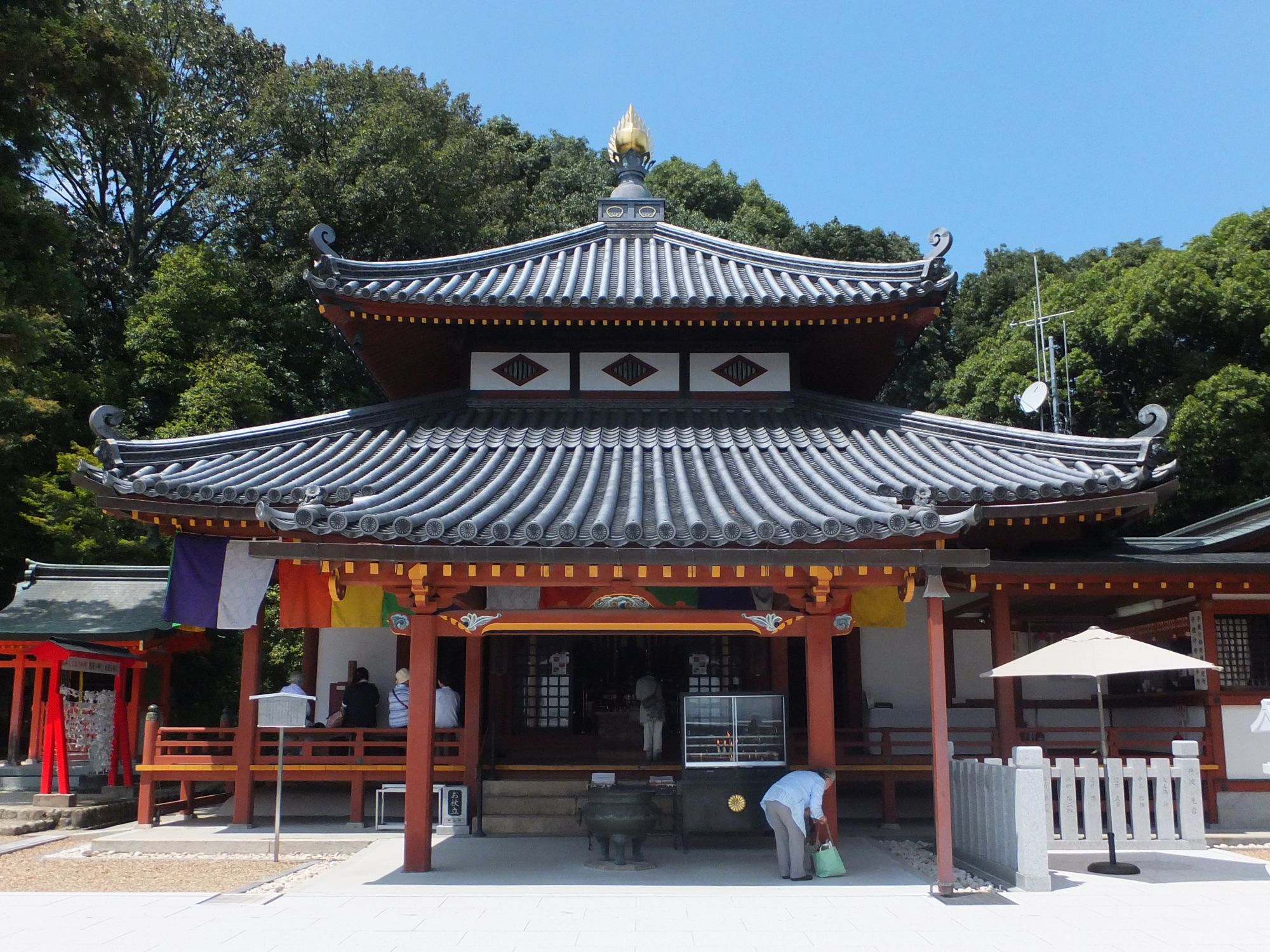
Nakayama-dera: The Temple Where Japan's Mothers Pray
The childless Toyotomi Hideyoshi -- the peasant who unified Japan, the warlord who invaded Korea, the ruler who reshaped an entire nation -- knelt and prayed for something all his power could not guarantee: a son. He prayed at Nakayama-dera, a Shingon Buddhist temple tucked into the hills of Takarazuka in Hyōgo Prefecture, the 24th stop on the thousand-year-old Saigoku Kannon Pilgrimage. When his heir Toyotomi Hideyori was born, Hideyoshi credited this temple. Centuries later, Nakayama Yoshiko came here seeking the same blessing. Her prayer was answered with the safe birth of the child who would become Emperor Meiji, the monarch who opened Japan to the modern world. Nakayama-dera has been many things across its long history -- a place to appease restless spirits, a stop on Japan's oldest pilgrimage circuit, a casualty of civil war. But its deepest identity is as the temple where mothers come to pray.
Spirits in the Cave
According to temple legend, Emperor Ōjin established a place of worship on this mountainside to enshrine the spirits of two princes -- Kagosaka and Oshikuma, sons of Emperor Chūai. Prince Shōtoku, one of the most revered figures in Japanese Buddhism, later founded the temple proper to appease these spirits and those of Mononobe no Moriya, who had been defeated in the struggle between Buddhism and Shinto that shaped sixth-century Japan. The original site is the Oku-no-in sanctuary, located in the mountain behind the current temple complex, where a worship hall was built to encompass a cave in a large rock said to contain Prince Kagosaka's spirit. The principal image -- a statue of the Eleven-Faced Kannon -- is said to have come from the Three Kingdoms of Korea, modeled after an Indian queen. The three statues together display thirty-three faces, matching the number of temples on the Saigoku Pilgrimage, so that worshipping here is said to grant the same merit as completing the entire circuit.
A Seal from the Underworld
The temple's connection to the Saigoku Pilgrimage has its own origin story, layered with the supernatural logic of medieval Japan. In 718, a priest named Tokudo from Hase-dera in Yamato Province received a sacred seal from Emma, king of the underworld, who instructed him to spread the faith in Kannon. Tokudo placed the seal in a stone chest inside a sarcophagus within the Shiratorizuka Kofun in Harima Province. He tried to popularize Kannon pilgrimages, but the idea did not take hold. Approximately 270 years passed. Then, during the Heian period, cloistered Emperor Kazan discovered the seal in its stone chest and revived the Saigoku Thirty-three Kannon Pilgrimage. Nakayama-dera was designated the 24th temple in the circuit, a position it holds to this day. The story may be legend, but the pilgrimage it describes is real, ancient, and still walked.
The Bell Rope and the Birth Prayers
The temple's reputation as a place for fertility and safe childbirth prayers traces to a story from the late Heian period. A man named Tada Yukitsuna was troubled by his wife's unbelief. The Kannon at Nakayama-dera converted her through the "bell rope" -- the cord used to ring the temple bell -- and the couple found happiness again. From that point, pilgrimages for safe childbirth gained momentum, drawing devotion from the imperial family, aristocrats, samurai like Minamoto no Yoritomo, and commoners alike. The tradition reached its most famous moment when Toyotomi Hideyoshi, the great unifier of Japan, prayed fervently during the Azuchi-Momoyama period and credited the temple with the birth of Hideyori. In gratitude, Hideyori later served as patron for the temple's reconstruction, rebuilding the main hall, Goma-dō, Amida-dō, and other buildings in 1603, with Katagiri Katsumoto serving as construction commissioner.
Burned by Nobunaga, Raised by Hideyori
Nakayama-dera's buildings did not survive the Sengoku period unscathed. In 1578, the entire temple complex was destroyed during the Battle of Arioka Castle, a conflict between the rebellious warlord Araki Murashige and Oda Nobunaga, the first of Japan's three great unifiers. The temple lay in ruins until the Keichō era (1596-1615), when it was relocated to its current site and rebuilt under Toyotomi Hideyori's patronage. More destruction came in 1995, when the Great Hanshin earthquake damaged many of the temple's structures. The Tahōtō pagoda, called "Daigan-tō," was rebuilt and completed in 2007. The five-story pagoda, "Seiryu-tō," followed in 2017. The cycle of destruction and rebuilding at Nakayama-dera spans from feudal warfare to modern natural disaster, each reconstruction an act of faith in the temple's continuing purpose.
Plum Blossoms and Pilgrim Steps
Today, Nakayama-dera remains an active temple and a celebrated destination during plum blossom season, when the grounds bloom in pink and white. The complex holds multiple National Important Cultural Properties, including Heian-period Buddhist statues and a Muromachi-period sculpture of Prince Shōtoku. The temple is a two-minute walk from Nakayama-kannon Station on the Hankyu Railway's Takarazuka Line. At the end of the Bakumatsu period, Nakayama Yoshiko prayed here for safe childbirth and delivered the future Emperor Meiji, binding the temple to one of the most consequential births in Japanese history. From the air, Nakayama-dera appears as a cluster of traditional temple rooflines and pagoda towers set against the wooded hillside above Takarazuka, the rebuilt five-story pagoda standing as the most prominent vertical element. Below and to the south, the city stretches toward the Osaka plain.
From the Air
Located at 34.82°N, 135.37°E in Takarazuka, Hyōgo Prefecture, on the hillside above the city. The temple complex is identifiable by its five-story pagoda and traditional rooflines set against forested slopes. Best viewed at 2,000-3,000 feet AGL. Osaka Itami Airport (RJOO) lies approximately 5 nautical miles to the southeast. Kobe Airport (RJBE) is roughly 15 nautical miles to the south-southwest. The terrain rises into the Rokko mountain range to the west and north.