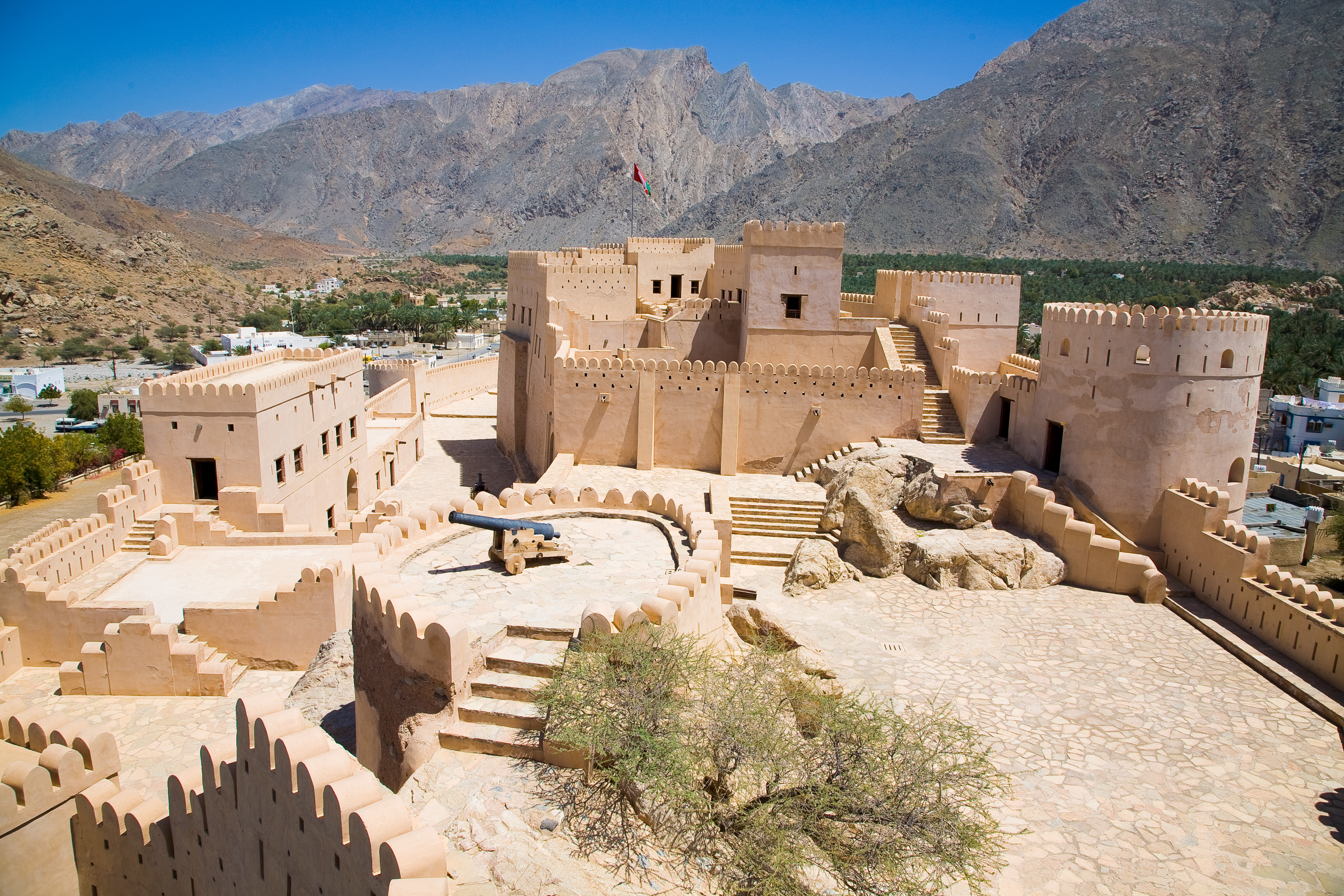
Nakhal Fort
Every Friday morning, the sound of bleating goats echoes off walls that once held cannons. Nakhal Fort -- also known as Husn Al Heem -- sits on a rocky outcrop at the base of Jebel Nakhal, a spur of the Western Hajar range, roughly 120 kilometers west of Muscat. The juxtaposition is pure Oman: a fortification built to command the entrance to Wadi Ar Raqeem now hosts a weekly livestock auction in its precincts, while tourists wander museum galleries upstairs examining historic guns and traditional handicrafts.
Stone Throne Above the Wadi
The fort commands the entrance to Wilayt Nakhal with the authority of a natural feature. Bedrock juts into its interior walls in places, blurring the line between architecture and geology. The rocky prominence on which it stands was not so much chosen as inherited -- the kind of site that demands fortification, where terrain does half the defensive work. Behind it, Jebel Nakhal rises sharply into the Hajar range, the jagged limestone spine that runs along Oman's northeastern coast. Below, the wadi opens toward the Al Batinah coastal plain, a corridor that has channeled travelers, traders, and armies for centuries.
Layers of Occupation
The fort's foundations are old enough to resist precise dating, though the structure reached its current form by the 1830s. Successive rulers expanded what earlier generations built, adding towers, walls, and chambers in the pragmatic Omani style that favors thickness over decoration. The result is a layered structure where rooms from different centuries sit atop one another, connected by narrow staircases and passageways designed as much for defense as for circulation. By the time of its restoration, the fort had accumulated centuries of military, administrative, and domestic use. In November 2003, Prince Charles visited the restored fort during an official trip to Oman, walking through the same rooms that had once housed garrison soldiers and provincial governors.
A Living Fortress
What sets Nakhal apart from Oman's many restored forts is how it refuses to become purely a monument. The Ministry of Tourism operates a museum inside with exhibits of historic firearms, and recent renovations have furnished rooms with traditional Omani furniture, handicrafts, and artifacts that evoke domestic life rather than just military might. But it is the Friday goat auction that keeps the fort anchored in the present. Farmers from surrounding villages drive their animals into the fort's precincts, and the bargaining unfolds in the shadow of watchtowers. The market has no fixed stalls and no permanent infrastructure -- just people, goats, and the ancient walls.
The Mountain Gateway
Nakhal sits at one of the natural gateways into the Hajar Mountains, and the hot springs of Ain A'Thawwarah nearby have drawn visitors long before the fort became a tourist attraction. The surrounding landscape shifts rapidly from the flat, date-palm-studded Batinah coast to rugged mountain terrain within a few kilometers. Wadi Ar Raqeem cuts through the rock in a narrow defile that makes the fort's strategic position obvious even to casual visitors. From the upper battlements, the view encompasses both the green strip of irrigated agriculture below and the barren, folded rock of the Hajar rising behind -- a visual summary of how Oman has always lived between sea and mountain, cultivation and wilderness.
From the Air
Nakhal Fort sits at 23.39N, 57.83E, approximately 120 km west of Muscat, at the foot of the Western Hajar range. Best viewed below 3,000 feet AGL for detail of the rocky prominence. The Al Batinah coast stretches to the north, and the Hajar Mountains provide dramatic terrain to the south. Nearest major airport is Muscat International (OOMS). The wadi entrance and surrounding palm groves are visible landmarks.