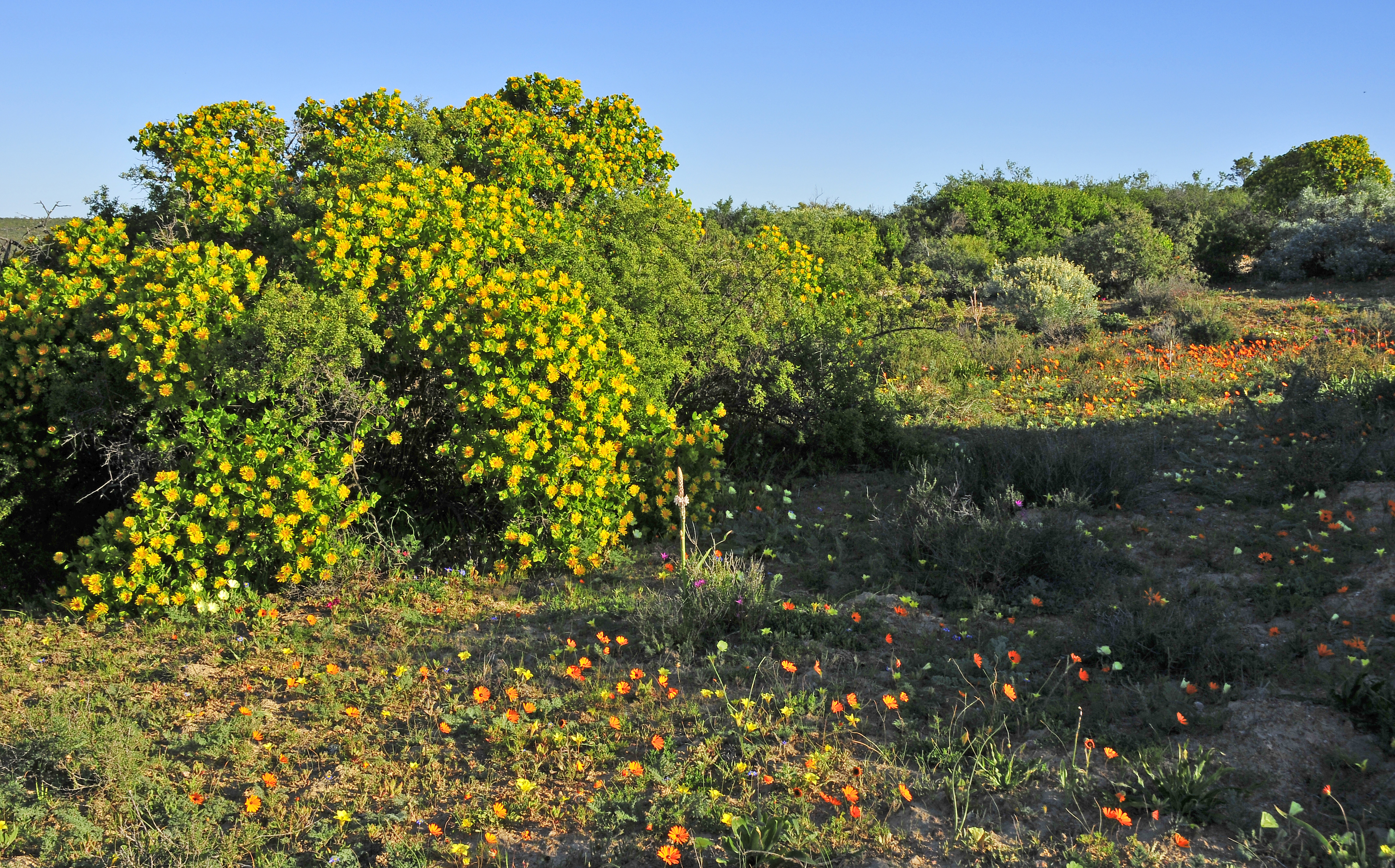
Namaqua National Park
For most of the year, the land looks like it has given up. Dry, sandy, the kind of semi-desert terrain that barely registers from the air -- just brown and beige stretching toward the Atlantic. Then winter rains come, and Namaqua National Park performs what may be South Africa's most improbable transformation. Thousands of wildflower species detonate across the landscape in sheets of orange, purple, yellow, and white, turning a park that covers part of the 440,000-square-kilometer Succulent Karoo biome into something that looks digitally enhanced but is entirely real.
The Succulent Karoo's Crown Jewel
Namaqua National Park sits on the Atlantic coast of Namaqualand in South Africa's Northern Cape, established in 1999 to protect one of the planet's most botanically rich arid regions. The Succulent Karoo is the only arid biome in the world recognized as a biodiversity hotspot, and this park sits at its heart. The spring bloom is the headline act, but the park protects far more than flowers. Sixty species of spiders from 21 families have been documented here, along with arachnids like the pale orange-yellow scorpion Hottentotta arenaceus that inhabits the coastal section. One spider species found in the park, Asemesthes affinis, has been recorded in only one other place on earth: Angola.
When the Desert Catches Fire
The bloom typically peaks between August and September, and its intensity depends entirely on how much rain fell during the preceding winter. In a good year, the display is staggering -- carpets of daisies and mesembryanthemums covering every visible surface, the flowers tracking the sun through the day so that the entire landscape seems to rotate. An estimated 100,000 tourists visit Namaqualand annually during flower season, roughly two-thirds of them South African and one-third international. Most wildflower species are protected under law, and picking them carries fines. The flowers are not decorative extras in this ecosystem; they are the ecosystem, brief and brilliant evidence that the Succulent Karoo is alive in ways that its parched appearance for the rest of the year does nothing to suggest.
Life at the Edge
Beyond the flowers, Namaqua is a park defined by its edges -- between desert and ocean, between drought and abundance, between visibility and concealment. The coastal section meets the cold Atlantic, where fog rolls in and provides moisture that sustains species adapted to capture it. Inland, the Skilpad section offers rocky terrain dotted with succulents that have evolved extraordinary water-storage strategies. The park's remoteness is part of its character. Only four chalets exist for overnight accommodation, and guests must bring all their own provisions since the nearest basic shop is 22 kilometers away. There is electricity, but the isolation is intentional. This is a place designed for the landscape, not for convenience.
A Fragile Economy of Color
The South African government has identified tourism as a path to improving Namaqualand's economy, and the annual flower season is the region's primary draw. But the reality on the ground is sobering. Despite the tourist traffic, local residents continue to have very low incomes and high unemployment. The flowers bring visitors, but the wealth they generate has not transformed the communities that live alongside the park year-round. It is a tension common to conservation areas in developing regions -- the natural spectacle attracts global attention, while the people nearest to it see little of the benefit. Namaqua National Park is a success story of ecological preservation, but the human story alongside it remains unfinished.
From the Air
Located at 30.04S, 17.59E on the Atlantic coast of Namaqualand. The park extends from the coastline inland, visible from altitude as a transition from coastal fog zone to arid interior. Nearest airport is Springbok (SBU), approximately 70km northeast. Best viewed in August-September during spring bloom, when the desert floor turns visibly multicolored even from cruising altitude. The Skilpad section is inland; the coastal section meets the Atlantic directly. Beware of low coastal fog during morning hours.