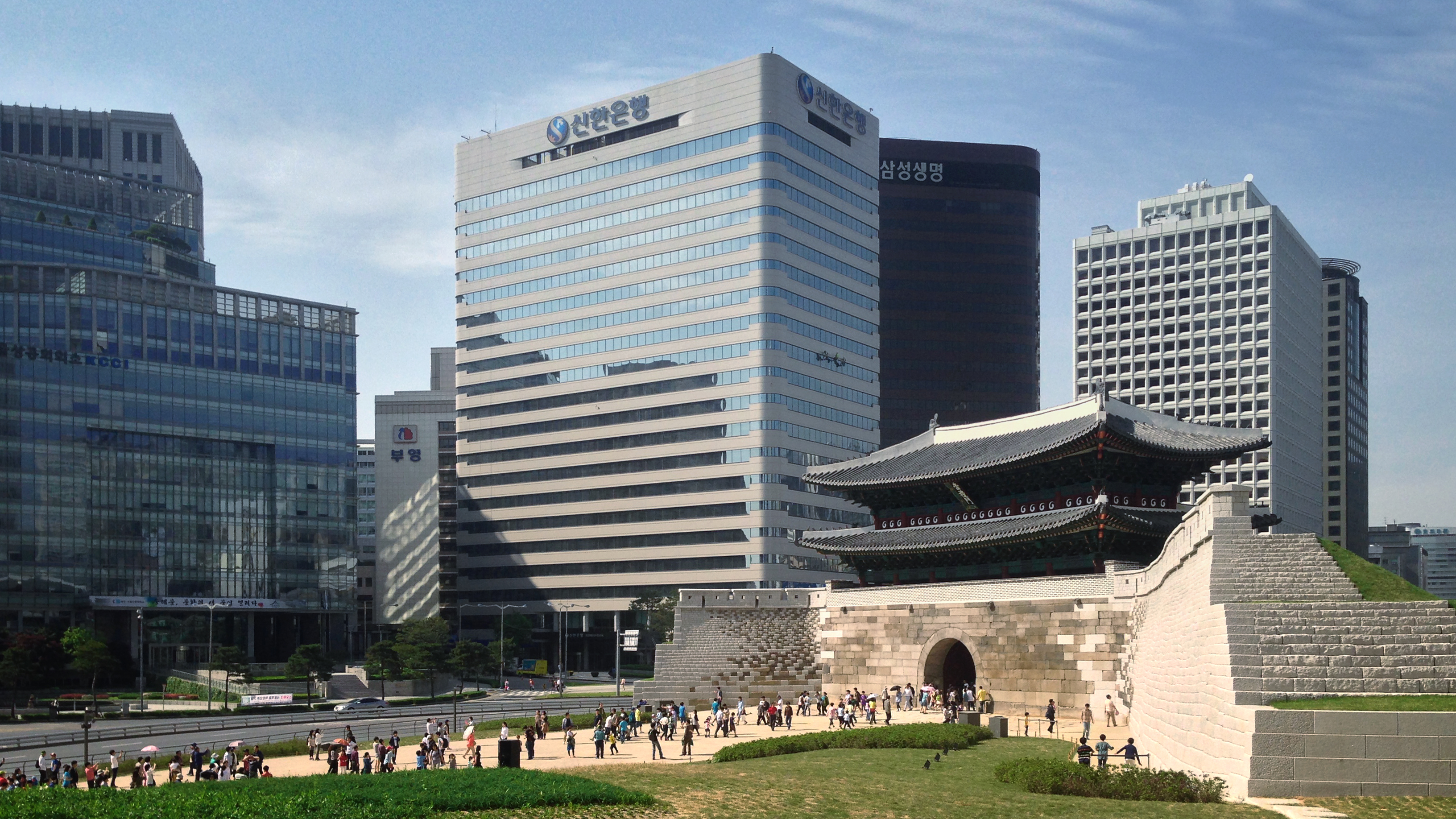
Namdaemun
The name on the gate is written vertically, and there is a reason for that. When King Taejo of Joseon built his capital city in the 1390s, feng shui advisors warned that Mount Gwanaksan to the south was shaped like fire, threatening Gyeongbokgung Palace with spiritual combustion. The vertical inscription on the gate, Sungnyemun, contains the Chinese character for fire, and written top to bottom rather than side to side, the character was believed to project a protective barrier against the mountain's fiery energy. For more than 600 years, this gate stood as the southern boundary of Seoul. Then, on a February night in 2008, fire came not from the mountain but from a man with a lighter and a grudge.
Gate Against Tigers
Construction of Namdaemun began in 1395 during the fourth year of King Taejo's reign and was completed in 1398. The gate's practical functions were straightforward: greet foreign emissaries, control access to the capital, and keep out Siberian tigers, which still roamed the Korean peninsula. The structure was rebuilt in 1447 under King Sejong the Great, the same king who created the Korean alphabet. Made of wood and stone with a two-tiered pagoda-shaped tiled roof, Namdaemun was one of three major gateways through Seoul's city walls, a stone circuit stretching 18.2 kilometers and standing up to 6.1 meters high. Before the 2008 fire, it was the oldest wooden structure in Seoul, a distinction earned simply by surviving longer than everything around it.
Surviving Empires and Armies
The gate's endurance required more luck than planning. In the early 20th century, Japanese colonial authorities demolished much of Seoul's medieval city wall to modernize traffic flow. A visit by the Crown Prince of Japan prompted the specific demolition of walls around Namdaemun, because the prince was deemed too exalted to pass through a gateway. The gate was closed to the public in 1907 when an electric tramway was built nearby. In 1938, it was designated Korean Treasure No. 1 by the Governor-General of Korea, an ironic honor from the occupying power. The Korean War inflicted extensive damage, and the gate received its last major pre-fire repair in 1961, with a ceremony held on May 14, 1963. On December 20, 1962, it was elevated to National Treasure No. 1, the first among all of South Korea's designated cultural assets.
Ten Minutes That Erased Six Centuries
At approximately 8:50 p.m. on February 10, 2008, fire broke out in the wooden pagoda atop the gate. More than 360 firefighters fought the blaze, which roared out of control after midnight and destroyed the structure that had stood since the 15th century. Police quickly arrested a 69-year-old man named Chae Jong-gi, who confessed to spraying paint thinner on the floor and igniting it. His motive was prosaic and bitter: he was angry about not receiving full payment for land he had sold to developers. On April 25, 2008, he was convicted and sentenced to ten years' imprisonment. The speed of the destruction stunned the nation. During a 2005 renovation, conservators had created 182 pages of detailed blueprints as a contingency against exactly this kind of emergency. Three years later, those blueprints became the most important documents in Korean heritage preservation.
National Treasure, Rebuilt
The Cultural Heritage Administration declared Namdaemun's restoration the most expensive heritage project in South Korean history, budgeted at approximately 20 billion won, roughly 14 million dollars. President Lee Myung-bak proposed a private donation campaign. The process was painstaking: 22,000 roof tiles were produced in a traditional kiln in Buyeo, South Chungcheong Province. Ornamental patterns and colors were based on those used in the 1963 repair, which was considered closest to the early Joseon original. Harsh winter weather in Seoul delayed completion by four months. On April 29, 2013, restoration was declared complete, and the gate reopened to the public on May 5, coinciding with Children's Day. The celebration was genuine, but short-lived. Within six months, paint began chipping off and wood cracked. President Park Geun-hye ordered an investigation into the quality of the work, a reminder that rebuilding a national symbol requires more than good intentions.
The Name Argument
Even the gate's name carries political weight. The government officially calls it Sungnyemun, the name written in hanja on the wooden plaque. Most Koreans call it Namdaemun, which simply means Great South Gate. A common belief holds that Namdaemun is a Japanese colonial imposition and should be rejected. But Joseon dynasty annals show that Koreans were using directional nicknames for the city's eight gates long before the Japanese arrived. The argument over what to call the gate mirrors a larger Korean tension between official identity and popular usage, between what the state decrees and what people actually say. Standing at the gate today, with the 24-hour Namdaemun Market buzzing nearby and Seoul Station just beyond, the gate occupies both names comfortably, an artifact of one dynasty's feng shui anxieties that has become a modern nation's most treasured landmark.
From the Air
Located at 37.560N, 126.975E in Seoul's Jung District, between Seoul Station and Seoul Plaza. The gate sits in a traffic island surrounded by major roads and is identifiable from lower altitudes. Nearest airport is Gimpo International (RKSS), about 15 km west. Incheon International (RKSI) is approximately 50 km west. The nearby Seoul Station building and Namdaemun Market provide additional visual reference points.