Namsos Campaign
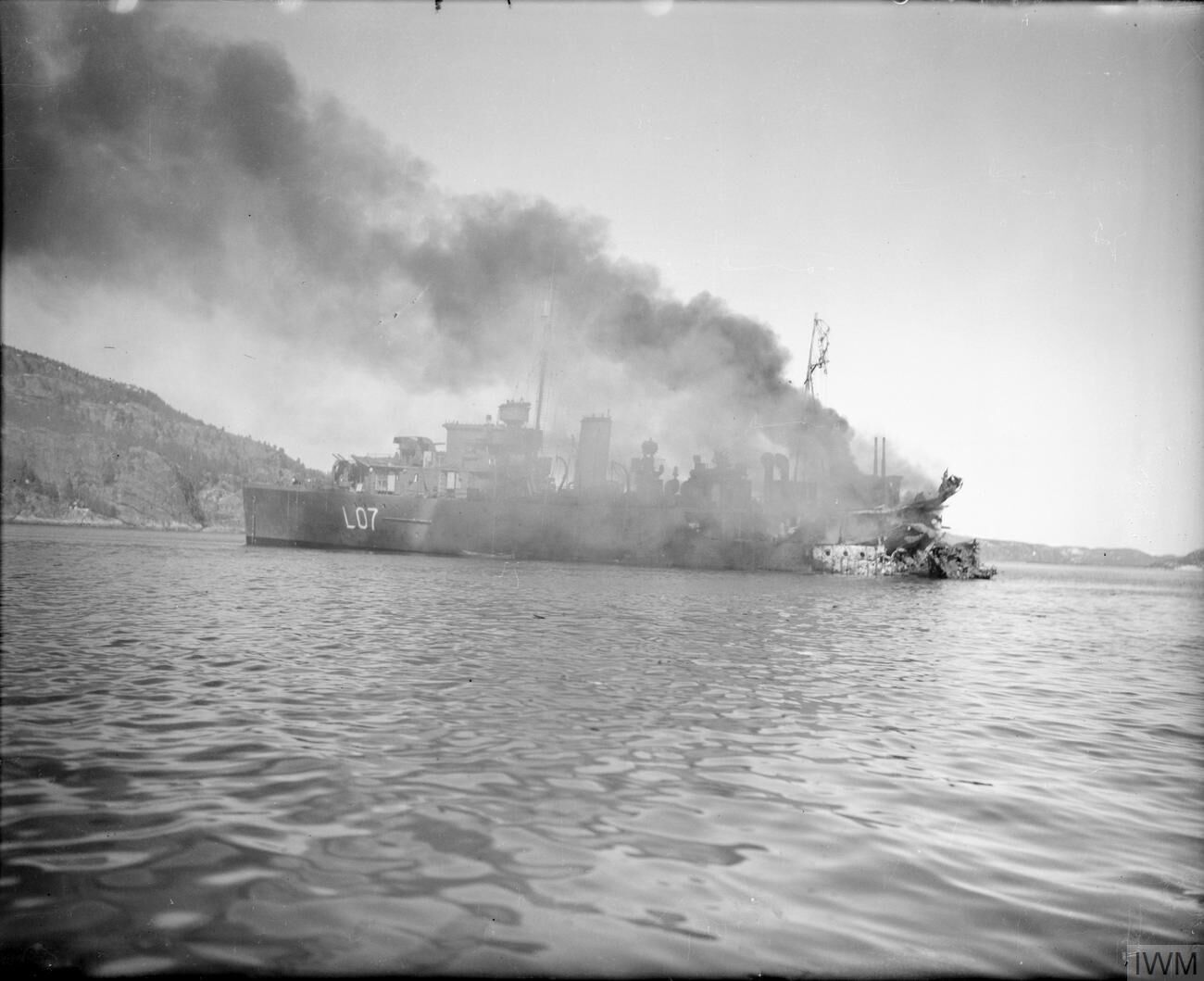
When Lord Louis Mountbatten brought his destroyers through the fog toward Namsos on the night of May 3, 1940, he did not know if the Germans already held the town. Rounding the last bend of the fjord, he saw Namsos on fire. A burning trawler lay ahead, German bombers swarmed above, and everything along the wharves was ablaze. But there on the shore stood Major General Adrian Carton de Wiart with 5,500 Allied troops lined up in good order, waiting to be taken off. They had held central Norway for barely two weeks. Now all that remained was to get out alive.
Why Namsos Mattered
Norway had been neutral when Germany attacked on April 9, 1940. The strategic prize was Narvik, the ice-free port through which Swedish iron ore flowed to German war factories -- in a normal year, 80 percent of the ore exports passed through it. But Germany did not stop at Narvik. Simultaneous strikes hit Oslo, Bergen, Trondheim, and other coastal cities. The Namsos campaign was part of the Allied response: a pincer movement to retake Trondheim, Norway's third-largest city and the key to controlling the central coast. British and French forces would land at Namsos to the north and at Andalsnes to the south, squeezing the German garrison in Trondheim from both directions. It was a sound plan on paper. On the ground, it fell apart almost immediately.
Five Hours of Darkness
The one-eyed, one-handed General de Wiart -- a Victoria Cross recipient who had been shot in the face, head, stomach, ankle, hip, leg, and ear in previous conflicts -- showed characteristic energy upon landing. Working within the five hours of April darkness available at this latitude, he dispersed troops and supplies into the hills before German reconnaissance could detect the landings. He established his headquarters in Namsos, posted guards on the essential bridge over the Namsosfjord, and pushed forces south toward Steinkjer where the two roads to Trondheim converged. Speed was critical. French Chasseurs Alpins -- elite mountain troops -- arrived on April 19 under air attack, though one of their transports was too long to enter the harbor and returned to Britain without unloading supplies, leaving soldiers without ski straps and much of their equipment.
Bombed Into Retreat
Without air cover, the Allied position was hopeless. German bombers from Trondheim's Vaernes airfield struck Namsos repeatedly, reducing much of the town to burning rubble. On April 21, the Luftwaffe devastated Steinkjer, destroying roughly 80 percent of the town's buildings and leaving over 1,800 civilians homeless. British and French troops, armed for infantry combat but facing unchallenged air power, could do little but take cover. Norwegian forces under Colonel Ole Getz fought alongside the Allies near Grong and along the approaches, but they too lacked anti-aircraft capability. The planned direct naval assault into Trondheimsfjord was cancelled -- de Wiart was never told -- and without it the pincer movement had no point. By late April, evacuation was the only realistic option.
Out Through the Fog
Mountbatten's evacuation convoy left Scapa Flow on April 29, was bombed crossing the North Sea on May 1, and ran into thick fog 40 miles short of the rendezvous at Kya Lighthouse. The first attempt to reach Namsos had to be cancelled. On May 2, Mountbatten moved ship to ship through fog banks on a rocky coast, masts protruding above the murk to give German bombers approximate targets. When the fog lifted briefly over Namsos, he saw the town burning and enemy aircraft everywhere, and withdrew. On May 3, Admiral John Cunningham screened the convoy with cruisers and destroyers while Mountbatten led HMS Kelly into the fjord at 26 knots as the sun went down. The evacuating troops marched through a town that no longer existed, boarding the ships in disciplined order. By dawn, 5,500 soldiers were at sea. They left behind a gutted town, a handful of abandoned vehicles, and the Allied hope of holding central Norway.
What Namsos Taught
The campaign lasted barely three weeks and accomplished nothing militarily. It demonstrated, with painful clarity, that ground forces without air superiority were doomed against a modern opponent, a lesson the British would relearn at Dunkirk weeks later. Norwegian civilians in Namsos and Steinkjer paid the heaviest price, their towns reduced to ashes by German bombing. The Norwegian military, only partially mobilized and weakened by a decade of pacifist-era budget cuts, fought bravely but could not compensate for the disorganization of the Allied effort. De Wiart himself, who had survived more wounds than seemed humanly possible, later summed up the campaign with characteristic bluntness. The operation's failure contributed to the fall of Neville Chamberlain's government in Britain and Winston Churchill's rise to prime minister -- an irony, since Churchill had been one of the chief architects of the Norwegian intervention.
From the Air
Located at 64.47N, 11.49E at the town of Namsos on the Namsenfjord, Trondelag, Norway. The town sits at the head of the fjord, with the surrounding hills and valleys visible at moderate altitude. Namsos Airport, Hoknesora (ENNM) is located nearby. Trondheim Airport, Varnes (ENVA) lies approximately 190 km to the south-southwest. The fjord approach from the Norwegian Sea provides dramatic terrain context. At 3,000-5,000 feet AGL, the relationship between the town, the fjord, and the surrounding hills that constrained military operations is clearly visible. Steinkjer lies roughly 55 km to the southeast along the road that was the campaign's axis of advance.