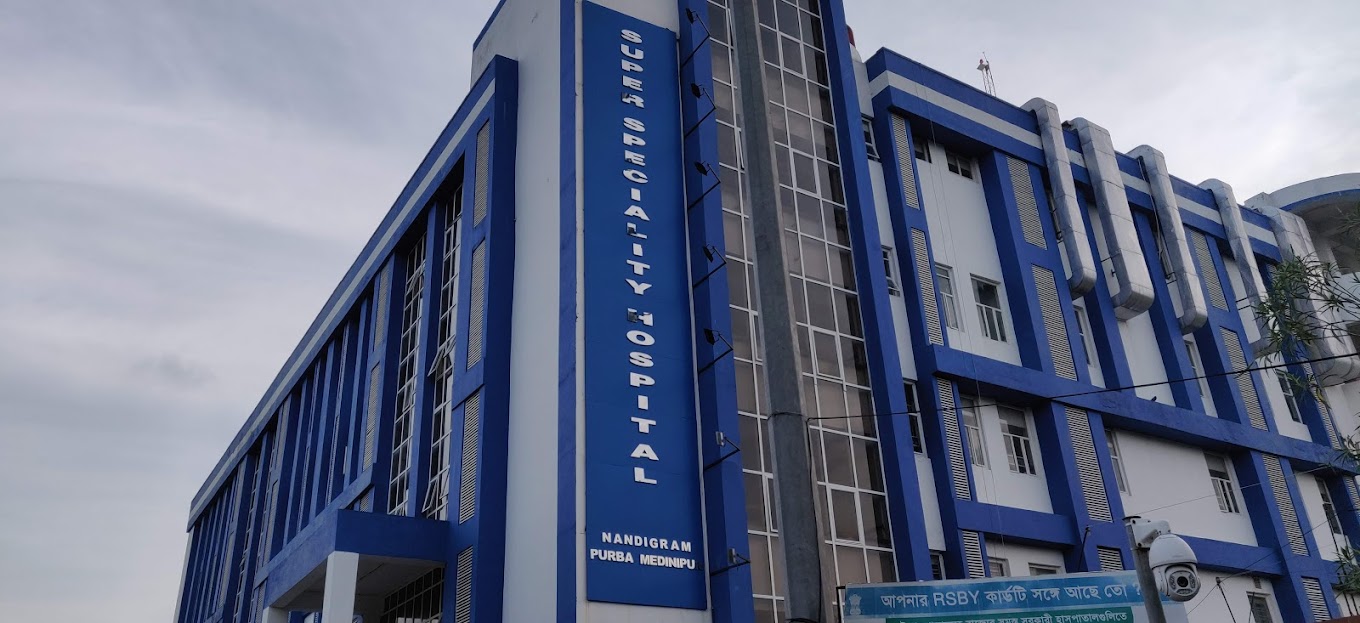
Nandigram
Nandigram has been freed twice. The first time was during the independence movement, when local leaders Bhupal Chandra Panda, Ajoy Mukherjee, Sushil Kumar Dhara, and Satish Chandra Samanta helped wrest the nearby town of Tamluk from British control for a brief period before India gained full independence in 1947 -- making it one of the only parts of modern India liberated twice. The second liberation was less triumphant. In 2007, when the West Bengal government approved plans for the Salim Group to build a chemical hub under the special economic zone policy, the farmers and fishermen of Nandigram refused to surrender their land. The resistance that followed left fourteen villagers dead in clashes with police and turned this census town in the Purba Medinipur district into a symbol of the human cost of industrialization imposed without consent.
Between the Rivers
Nandigram sits in the Haldia subdivision of West Bengal's Purba Medinipur district, cradled between two rivers. The Ganga, flowing here as the Bhagirathi, and the Haldi -- the downstream extension of the Kanshabati -- bracket the town's edges, their seasonal floods depositing the silt that makes the surrounding land some of the most productive agricultural territory in the region. Rice paddies, vegetable gardens, and fish ponds define the landscape. Fresh vegetables, rice, and fish flow from Nandigram to the markets of Haldia, the satellite city of Kolkata located across the water. A ferry operated by Haldia Municipality connects the two -- a lifeline for the farmers and small traders who depend on Haldia's commercial center to sell their produce. Without the ferry, Nandigram is effectively cut off.
The Fourteen
When the West Bengal government announced in early 2007 that the Indonesian Salim Group would establish a chemical hub in Nandigram under India's special economic zone policy, it envisioned industrial transformation for a predominantly rural area. The villagers saw something different: the loss of the fertile land that sustained their families. Resistance organized quickly and grew fierce. Clashes between villagers and police escalated through the year, culminating in violence that left fourteen people dead. Accusations of police brutality drew national attention and condemnation. The Nandigram movement became a landmark in India's ongoing debate about land acquisition, development, and the rights of rural communities to refuse industrialization they did not choose. The chemical hub was never built. The land remained with its farmers.
A Town That Teaches
Despite its small population -- the 2011 census counted 5,803 residents -- Nandigram has built an educational infrastructure that belies its size. Five primary schools serve the youngest students, while Nandigram BM Girls High School and Nandigram BMT Sikshaniketan provide secondary and higher secondary education. Sitananda College, also known as Nandigram College and affiliated with Vidyasagar University, anchors the town's claim to higher education. This emphasis on learning is not accidental. In post-independence India, Nandigram positioned itself as a center of learning and played a role in the development of nearby Haldia. The town's educational ambitions stand in quiet contrast to its more recent fame as a site of political conflict, suggesting a community that has long invested in its children's futures even when its own present was uncertain.
No Railway, No Highway
Nandigram is a place you have to want to reach. No railway line connects it directly; the nearest station is Mograjpur on the Digha-Tamluk line. Roads are moderately developed, and the primary public vehicles within the villages are buses, shared jitney trekkers, and van rickshaws. The nearest busy bus stop is at Math Chandipur. This relative isolation has shaped Nandigram's character. Without easy access to Kolkata's metropolitan sprawl, the town has retained a rural identity rooted in agriculture and river life. The ferry to Haldia remains the most important transportation link, carrying farmers to market in the morning and bringing them home with empty crates by evening. It is this very self-sufficiency -- this deep connection to the land and water -- that made the proposed chemical hub feel less like development and more like dispossession.
From the Air
Located at 22.01N, 87.99E in the Haldia subdivision of Purba Medinipur district, West Bengal. The town sits in flat deltaic terrain between the Bhagirathi (Ganga) and Haldi rivers. Nearest major airport is Netaji Subhas Chandra Bose International Airport, Kolkata (VECC), approximately 120 km to the northeast. Look for the ferry crossing to Haldia across the river as a visual landmark. At 2,000-3,000 feet AGL, the pattern of rice paddies, fish ponds, and river channels characterizes the landscape. The industrial complex of Haldia is visible to the north across the water.