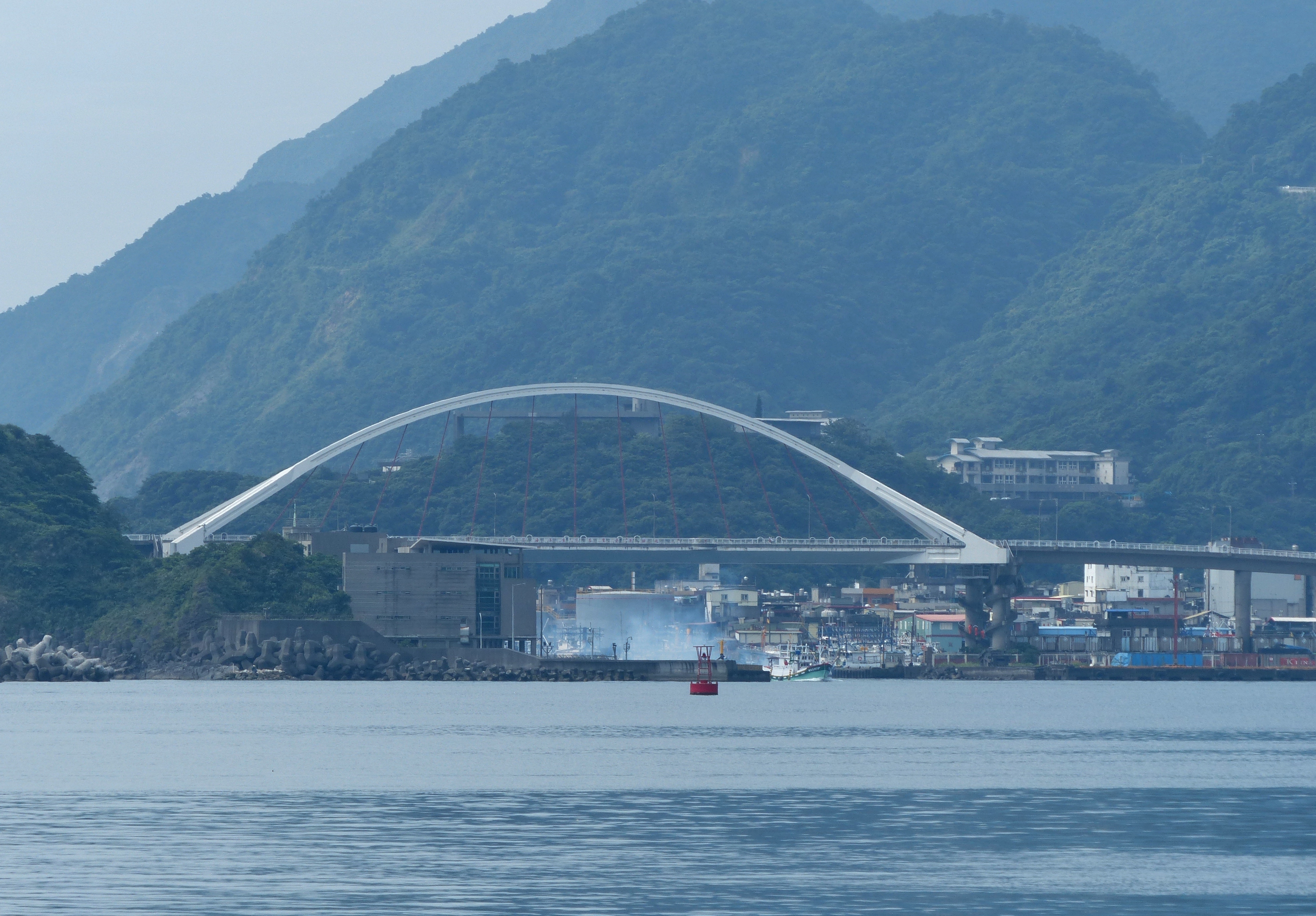
Nanfang'ao Bridge
The video is twelve seconds of disbelief. A fuel tanker truck is crossing Nanfang'ao Bridge, nearly at the far side, when the steel arch above it buckles. The roadway drops. The truck slides backward, plunges into the harbor, and erupts in flame. Below, fishing boats that had been moored in the shadow of the bridge are crushed under falling steel and concrete. Workers on the boats - migrant fishermen who had been repairing nets and equipment - are trapped under the wreckage.
It was 9:30 in the morning on October 1, 2019. Nanfang'ao Bridge, Taiwan's only steel single-arch bridge and an icon of Su'ao Township's fishing harbor in Yilan County, had stood for twenty-one years. It had been inspected once.
Built High for Fishing Boats
Nanfang'ao Bridge was designed by MAA Consultants and constructed between 1996 and 1998, commissioned by the Ministry of Transportation and Communications and built by the Yilan County Government. Its purpose was practical: the previous bridge over Nanfang'ao Fishing Port sat too low for large fishing vessels to pass underneath. The new bridge's single steel arch lifted the roadway high enough to clear the tallest masts in the harbor, and its sweeping curve became a local landmark - a graceful piece of infrastructure that appeared on postcards and tourism brochures.
After construction, the bridge was transferred to the Keelung Port Bureau, later reorganized as the Taiwan International Ports Corporation, for ongoing management. Management, however, did not include regular inspection. In twenty-one years of service, the bridge received exactly one structural assessment, conducted by Chien Hsin University of Science and Technology in 2016. That inspection found that the bridge's expansion joints were "obviously warped, damaged and sagging." No repairs followed.
Twelve Seconds on a Tuesday
The day before the collapse, Typhoon Mitag had battered the Yilan coast, and a 3.8 magnitude earthquake struck the area at 1:54 in the morning. Whether these events contributed to the structural failure remains uncertain - MAA Consultants could not determine the immediate cause before the broken components were recovered from the harbor. What the investigation eventually established was worse than any single trigger.
The bridge collapsed onto three fishing boats moored below, trapping and injuring migrant workers from the Philippines and Indonesia who were aboard. Six people on the bridge itself were caught in the fall. Rescue operations mobilized the military, Coast Guard Administration, and National Airborne Service Corps. President Tsai Ing-wen visited the site. By October 3, six people were confirmed dead, their bodies recovered at the Su'ao branch of Taipei Veterans General Hospital. The oil tanker driver survived with multiple fractures, spinal injuries, and internal bleeding, spending weeks in intensive care.
Twenty-Two Percent
In November 2020, the Taiwan Transportation Safety Board published its final report. The findings were stark: the bridge collapsed because its supporting steel cables had corroded to the point of catastrophic failure. By the time of the collapse, those cables retained only 22 to 27 percent of their original functional cross-section area. More than three-quarters of the structural steel that held the bridge up had been eaten away by rust, salt air, and neglect.
The report identified three compounding failures: corrosion, lack of proper maintenance, and lack of repair. A bridge spanning a fishing harbor in a typhoon-prone, earthquake-active coastal region had been inspected once in two decades. The 2016 inspection had flagged visible damage. Nothing was done. In August 2022, the Yilan District Prosecutors' Office charged six individuals involved in the bridge's construction and management with negligence. Premier Su Tseng-chang, visiting the wreckage in the immediate aftermath, ordered inspections of every bridge in Taiwan - a command that came twenty-one years too late for Nanfang'ao.
A New Arch Over the Harbor
Construction of a replacement bridge began in October 2020, overseen by the Directorate General of Highways at a cost of NT$848.5 million. The new bridge was completed on December 18, 2022 - a little over three years after the collapse, matching the government's initial timeline. It spans the same harbor, serves the same fishing fleet, and carries the same road.
The old bridge's collapse resonated beyond Yilan County. It joined a pattern of infrastructure failures across Taiwan that raised questions about the pace of development versus the rigor of maintenance. Bridges, tunnels, and overpasses built during decades of rapid economic growth were aging, and inspection regimes had not kept pace. For the migrant fishermen who worked in Nanfang'ao's harbor - workers from Southeast Asia who powered much of Taiwan's fishing industry - the collapse was a reminder that the infrastructure they depended on daily was only as safe as the attention it received. The new bridge stands. The question it answers is not whether Taiwan can build. It is whether Taiwan will maintain what it builds.
From the Air
Located at 24.59°N, 121.87°E at Nanfang'ao Fishing Port in Su'ao Township, Yilan County, on Taiwan's northeastern coast. The fishing harbor is visible from the air as a sheltered inlet with dense boat moorings and the distinctive arch of the replacement bridge spanning the harbor entrance. Su'ao is a major fishing port identifiable by its breakwaters and harbor infrastructure. Taipei Songshan Airport (RCSS/TSA) is approximately 70km to the northwest. Taiwan Taoyuan International Airport (RCTP/TPE) is about 100km west. The coast here transitions from the flat Yilan Plain to the steep mountains of the Suhua Highway heading south. Weather is often overcast with frequent precipitation; the area is exposed to typhoons from the Pacific.