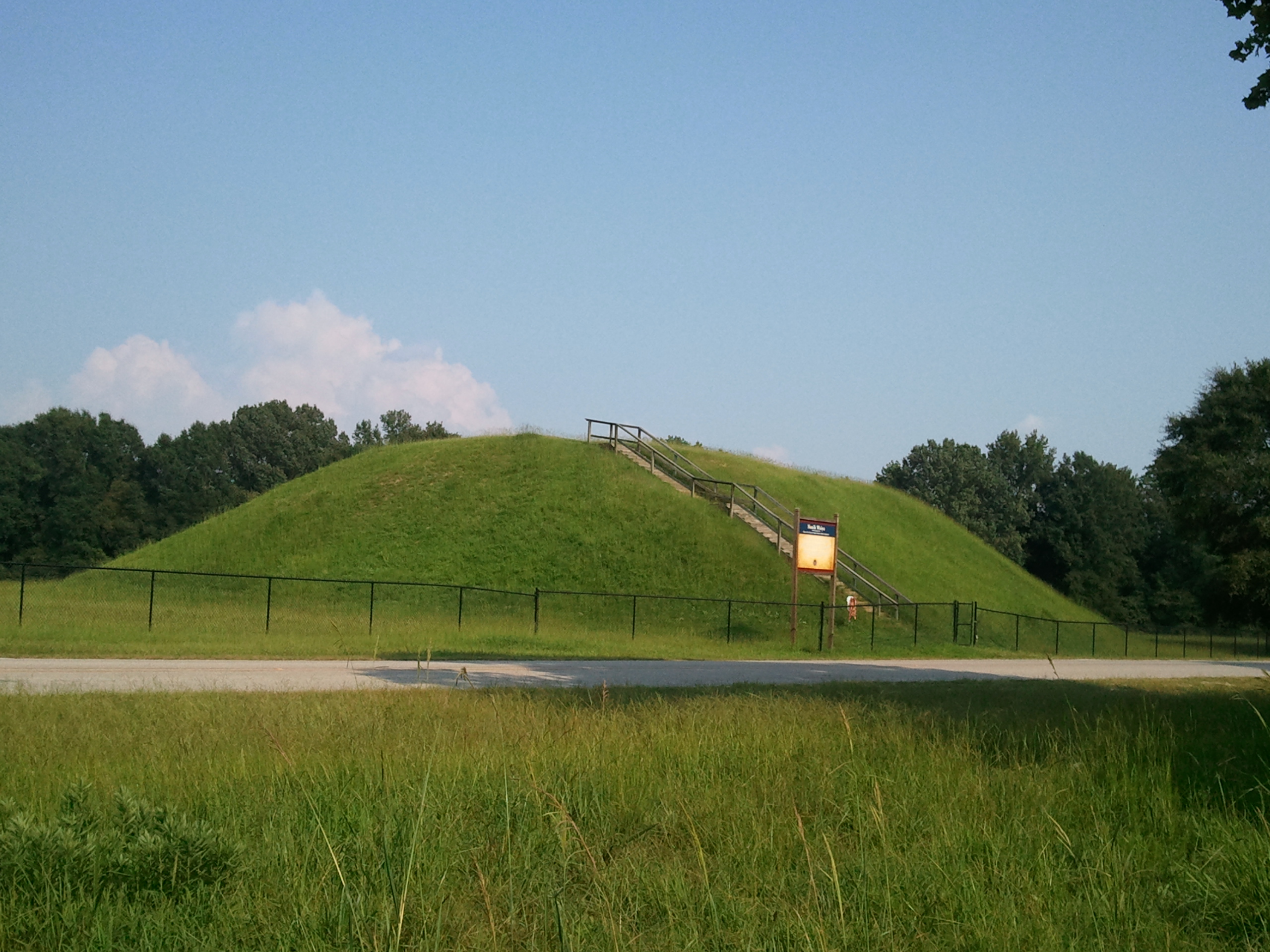
Nanih Waiya
The Choctaw call it Inholitopa iski, the Mother Mound. From this spot in the rolling piney woods of southern Winston County, Mississippi, their creation stories say the first Choctaw emerged into the world. Some versions place the emergence from a cave nearby. Others say the people simply rose from the earth of the mound itself. The details shift with each storyteller, but the anchor never moves: Nanih Waiya, the slanting hill, the place of creation, has been the spiritual center of the Choctaw nation since at least the seventeenth century. Built between 300 and 600 CE during the Middle Woodland period, this platform mound predates the Choctaw oral traditions attached to it by hundreds of years. It is one of the oldest continuously venerated sites in North America.
The Shape of Sacred Ground
Nanih Waiya is a platform mound, its earthen mass rising above the surrounding forest floor. Archaeological evidence dates its construction to the Middle Woodland period, making it roughly contemporaneous with the Hopewell culture and sites like the Pinson Mounds in Tennessee and Ingomar Mound elsewhere in Mississippi. No archaeological excavation of the mound itself has ever been undertaken. What scholars know comes from surface artifacts and observation. The mound was once significantly larger, bounded on three sides by a circular earthwork enclosure roughly ten feet tall that encompassed a full square mile. Time and erosion have diminished it. In the 1850s, observers noted smaller mounds nearby, but these were plowed away by farmers and never dated. They may have belonged to the later Mississippian culture, but without data, nothing can be confirmed. In 1973, cave explorers surveyed a nearby cave, descending 137 feet. Water began 35 feet from the entrance and deepened steadily as they pressed forward.
Where Nations Were Born
Choctaw belief holds that Nanih Waiya is far more than archaeology. It is the birthplace of a people. Some Choctaw storytellers say their nation emerged from the mound or a nearby cave. Other versions hold that the Chickasaw, the Creek, and possibly even the Cherokee also trace their origins here. The name itself carries layers of meaning: 'leaning hill,' 'stooping hill,' or 'place of creation' in the Choctaw language. The mound has been a site of pilgrimage since the 1600s, though the Choctaw did not hold major public festivals there. Their religious practices were private, centered on rituals of death, burial, and communication with spirits. Archaeologists note that unlike many neighboring tribes, the Choctaw do not appear to have practiced the Green Corn ceremony. The sacred landscape around Nanih Waiya reflects a spiritual tradition that is quiet, personal, and enduring.
Taken and Returned
The Treaty of Dancing Rabbit Creek, drawn up in September 1830, forced the Choctaw to cede millions of acres, including Nanih Waiya, to the United States. The removal that followed scattered the Choctaw to Indian Territory in present-day Oklahoma. But not all left. During investigations by the Choctaw Claims Commission in the 1840s, J.F.H. Claiborne recorded testimony from Choctaw witnesses who 'regard this mound as the mother, or birth-place of the tribe, and more than one claimant declared that he would not quit the country as long as the mound remained.' The land passed into private hands. Eventually the state of Mississippi acquired it and operated Nanih Waiya as a park. In 2006, state legislation returned the site to the Luke family, who then deeded it to the Mississippi Band of Choctaw Indians in 2008. After nearly 180 years, the Mother Mound belongs to the Choctaw again.
A Quiet Persistence
Nanih Waiya has been listed on the National Register of Historic Places since 1973. The site remains a place of cultural significance for the Mississippi Band of Choctaw Indians, a federally recognized tribe. There are no grand monuments here, no visitor centers crowded with tourists. The mound sits in the forest much as it has for seventeen centuries, a low earthen rise that holds more meaning per square foot than most places in America. The surrounding landscape of Winston County is rural Mississippi at its quietest: pine forests, red clay, small roads threading between small towns. The mound endures not through spectacle but through the persistence of the people who claim it as their origin. The Choctaw never stopped regarding Nanih Waiya as their mother. They simply waited until the land acknowledged what they always knew.
From the Air
Coordinates: 32.9214N, 88.9486W. Nanih Waiya sits in rural southern Winston County, Mississippi, surrounded by pine forests and agricultural land. The mound is not easily visible from altitude due to tree cover, but the general area lies approximately 25nm northeast of Philadelphia, Mississippi. The nearest significant airport is Meridian Regional Airport / Key Field (KMEI), roughly 50nm to the south-southeast. From 2,000-3,000 feet AGL, the rolling terrain and dense forest canopy of east-central Mississippi dominate the view, with scattered clearings and small communities along rural highways.