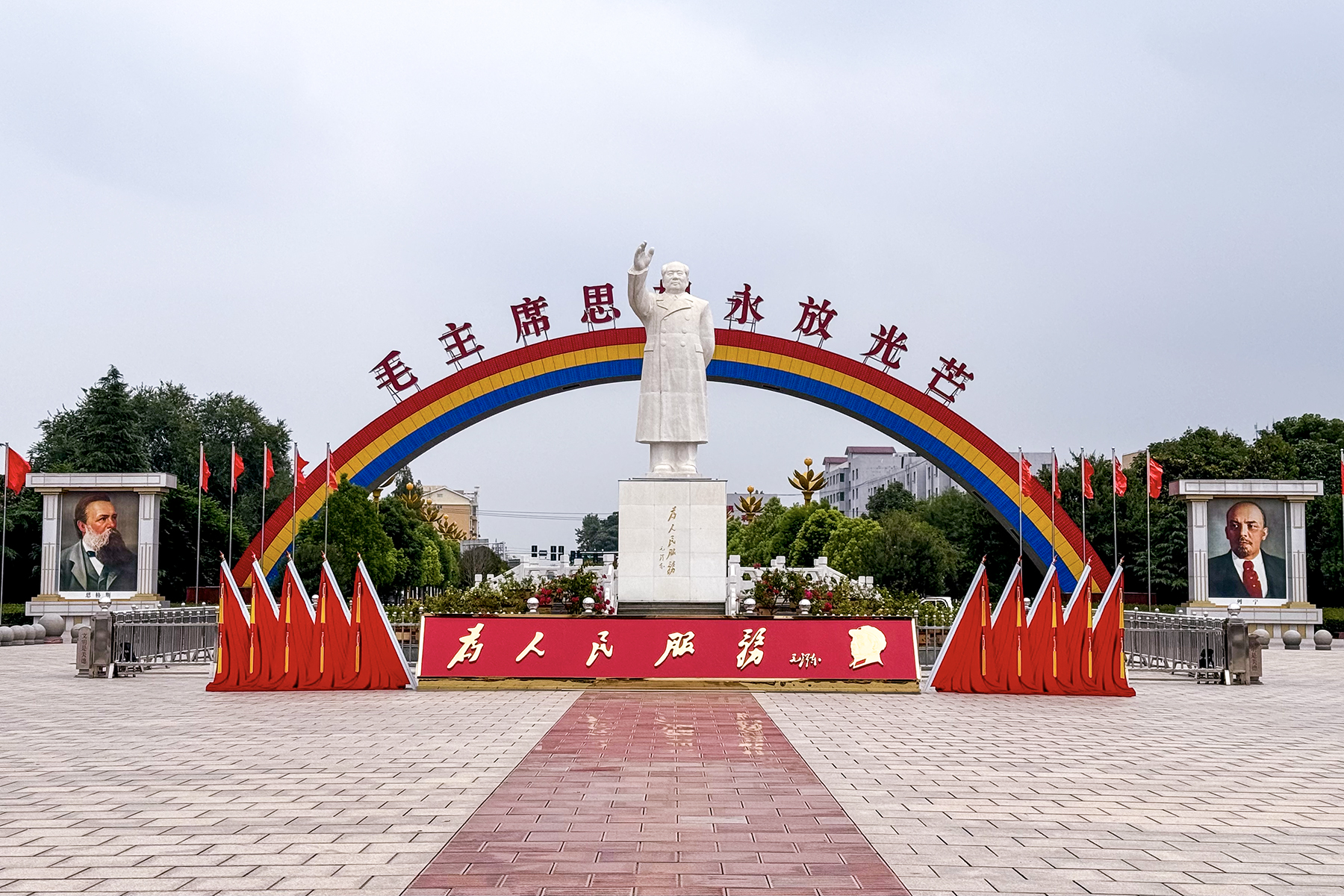
Nanjie
In 1986, while the rest of China raced toward market capitalism under Deng Xiaoping's reforms, a village of 3,400 people in Henan province did the opposite. Nanjie re-collectivized its farms and factories, restoring a system the nation had spent a decade dismantling. The decision made this 1.78-square-kilometer settlement one of the most unusual places in modern China -- a living time capsule where Maoist economics persists in the shadow of the world's fastest-growing economy.
Swimming Against the Tide
China's household responsibility system had parceled collective land into private plots beginning in the early 1980s, unleashing an agricultural boom that lifted hundreds of millions from poverty. Nanjie tried privatization too, for four years, before its leadership decided to reverse course. In 1986, agricultural production and local industry were re-collectivized under the Nanjie Village Group. The enterprise pays residents only 30 percent of their salary in cash; the remaining 70 percent flows into communal services -- housing, education, healthcare. Villagers receive what they need, and the collective decides what that means. The model inspired a handful of other villages across China to attempt the same experiment.
Noodles, Beer, and a Billion-Yuan Bubble
For a time, the numbers looked extraordinary. Nanjie's GDP climbed from 47 million yuan in 1990 to 1.8 billion by the late 1990s, driven by factories producing instant noodles, beer, and flour products. But the boom concealed deep structural problems. From 1998 to 2007, output fell more than 20 percent, and the village's debt-to-GDP ratio crossed 100 percent. Critics pointed to a fundamental contradiction: much of Nanjie's prosperity depended on migrant workers from surrounding areas -- people who outnumbered locals two or three to one but received none of the collective's benefits. A 2008 investigation by the Southern Metropolis Daily accused the village of propping up its economy through cheap outside labor and preferential loans from Communist Party officials.
Life Inside the Collective
Daily life in Nanjie operates under rules that would be familiar to anyone who lived through the Mao era. Judicial punishments include mandatory political study sessions, public denunciation, and expulsion from the village. Migrant laborers report working twelve-hour days followed by compulsory political study after their shifts. The village draws steady streams of visitors through "red tourism" -- Chinese citizens who come to experience a place that feels frozen in the ideological past. For some, Nanjie represents nostalgia for a simpler, more egalitarian time. For others, it raises uncomfortable questions about what collectivism demands of the individual.
An Experiment in Amber
Nanjie occupies an awkward place in contemporary China. It is too small to matter economically, yet too symbolically charged to ignore. The Chinese New Left points to it as proof that alternatives to pure capitalism remain viable. Skeptics see a Potemkin village sustained by political patronage rather than genuine productivity. What no one disputes is its singularity. In a nation of 1.4 billion people spread across cities that change faster than maps can track, Nanjie endures -- a village where the slogans never came down and the collective never dissolved, waiting to see whether history will vindicate or simply forget it.
From the Air
Located at 33.81N, 113.96E in central Henan province. The village sits on the flat agricultural plains of the Yellow River basin, surrounded by farmland. Nearest major airport is Zhengzhou Xinzheng International (ZHCC/CGO), approximately 150 km to the northeast. At cruising altitude, the flat terrain of the Central Plains stretches in every direction, with the Funiu Mountains visible to the southwest.