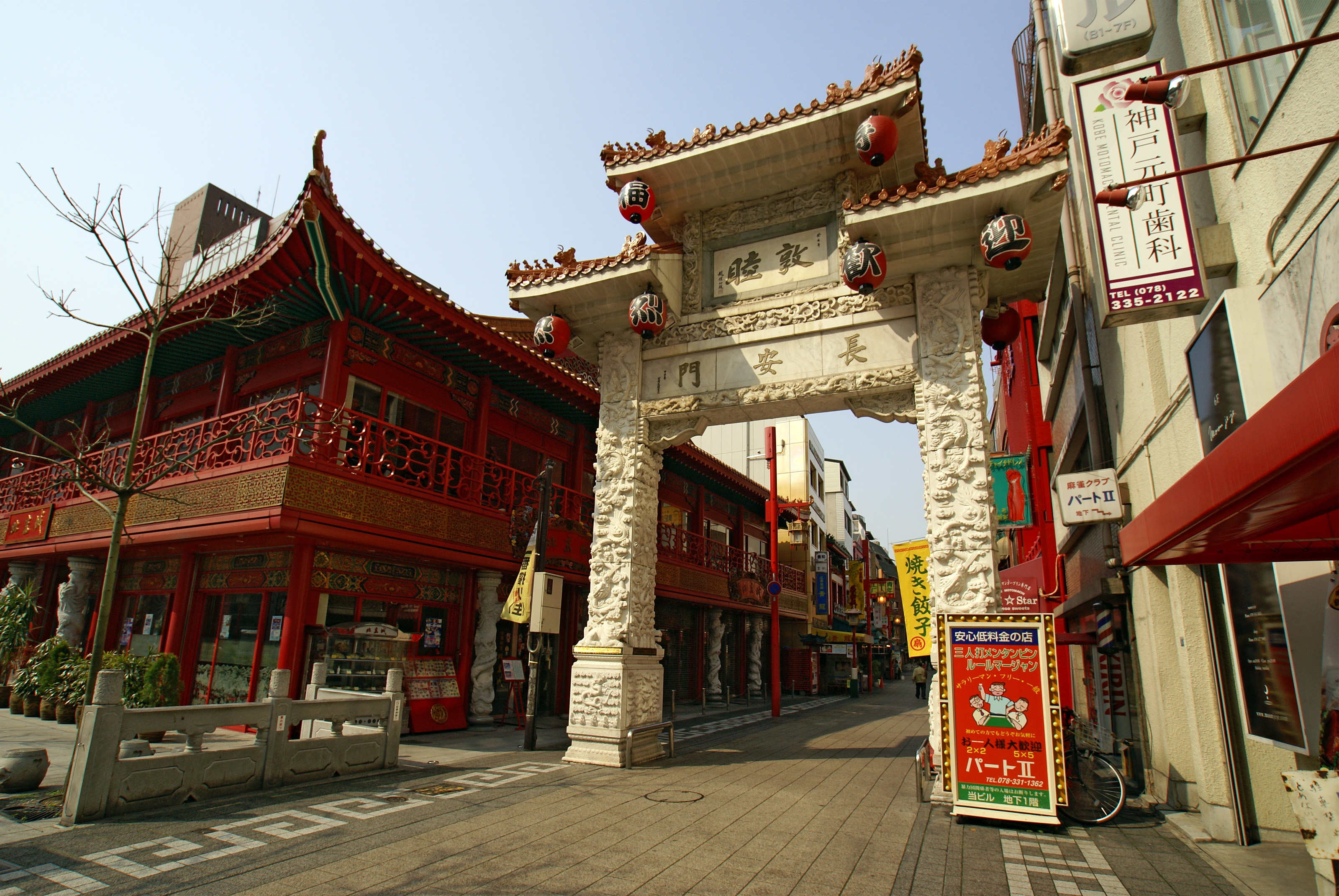
Nankin-machi
Walk through the Chang'an Gate on the east side of Nankin-machi and the city of Kobe disappears. The arched entrance, erected in 1985, frames a narrow corridor of red lanterns, steaming food stalls, and the sharp scent of dumplings crisping on iron griddles. This is one of only three major Chinatowns in Japan -- alongside Yokohama and Nagasaki -- and it occupies barely a few city blocks in central Kobe, just south of Motomachi Station. But what Nankin-machi lacks in size it compensates for in sheer tenacity. This neighborhood has been leveled twice in the past century and rebuilt both times, each revival a declaration by its residents that this ground belongs to them.
When the Port Opened
Nankin-machi traces its origins to 1868, when the port of Kobe opened to foreign trade under the Meiji government's policy of engagement with the outside world. Among the first arrivals were Chinese immigrants from the southern provinces of Guangdong and Fujian, who settled in the western end of Kobe's designated foreign district. Many came from Nanjing -- and the neighborhood's name, Nankinmachi, translates directly to 'Nanjing Town.' The community grew quickly. By the early 1920s, Nankinmachi was a vibrant enclave bustling with Chinese-owned businesses, restaurants, and family homes. A temple dedicated to Guan Yu, the Chinese god of war and loyalty known locally as Kantei-byo, anchored the spiritual life of the district. The neighborhood became the focal point for all subsequent Chinese migration to Kobe, a role it still plays today.
Twice Destroyed, Twice Rebuilt
World War II ended Nankinmachi's first golden age. Allied bombing raids devastated Kobe, and the Chinatown neighborhood was destroyed along with much of the city. In the war's aftermath, the remaining Chinese community -- those who had chosen to stay in post-war Japan rather than return to a China undergoing its own upheaval -- rebuilt the neighborhood from the rubble. For fifty years, the revived Nankinmachi thrived again. Then, at 5:46 a.m. on January 17, 1995, the Great Hanshin earthquake struck. The 7.3-magnitude tremor killed 6,434 people across the region and left eight buildings in Nankinmachi completely destroyed. The Chinese New Year celebrations scheduled for January 31 had to be canceled. But the community rebuilt again, quickly, and today approximately 10,000 people reside in the neighborhood that refuses to disappear.
Gates, Lions, and Zodiac Stone
The physical identity of modern Nankinmachi took shape in 1985, when the Chang'an Gate was erected at the eastern entrance. Two more archways followed: Xi'an Gate to the west and Nanlou Gate from the south. The northern entrance has no arch but is guarded instead by a pair of stone lions. At the intersection of Nankinmachi's north-south and east-west axes stands a pavilion carved with the twelve animals of the Chinese zodiac. This central point has become the neighborhood's informal gathering spot -- a place where visitors pause to photograph the carvings, rest on nearby benches, and orient themselves within the compact grid of streets. The granite floors, the ornamental archways, and the red-painted storefronts together create a visual coherence that sets Nankinmachi apart from the surrounding Japanese cityscape.
Eating Through the Streets
Food defines Nankinmachi more than any single landmark. Over a hundred Chinese restaurants, stalls, and food shops line the narrow streets, and most display their offerings on stands outside -- steamed buns, dim sum, dumplings, and Chinese pastries arranged to catch the eye of passersby. The cooking traditions blend Cantonese, Fujianese, and Japanese influences, a fusion born from more than 150 years of cultural exchange. Western steak houses and Japanese eateries also operate within the neighborhood's boundaries, but the dominant flavor is unmistakably Chinese. During Lunar New Year and the Mid-Autumn Festival, specialty delicacies appear: mooncakes for the autumn, traditional New Year's sweets for the spring. Mahjong clubs and souvenir shops fill the gaps between restaurants, and the sound of tiles clicking mingles with the sizzle of woks and the chatter of tourists navigating the crowded lanes.
From the Air
Nankin-machi is located at 34.69N, 135.19E in central Kobe, just south of Motomachi Station and adjacent to the Daimaru Department Store. The neighborhood is not individually visible from altitude but sits within Kobe's dense urban waterfront, identifiable by its position between the Rokko mountain range to the north and Kobe's port facilities to the south. Kobe Airport (RJBE) is approximately 6 nm south-southeast on an artificial island. Osaka Itami Airport (RJOO) lies roughly 18 nm northeast. The Chinatown district occupies a compact footprint of a few city blocks in the Motomachi commercial area.