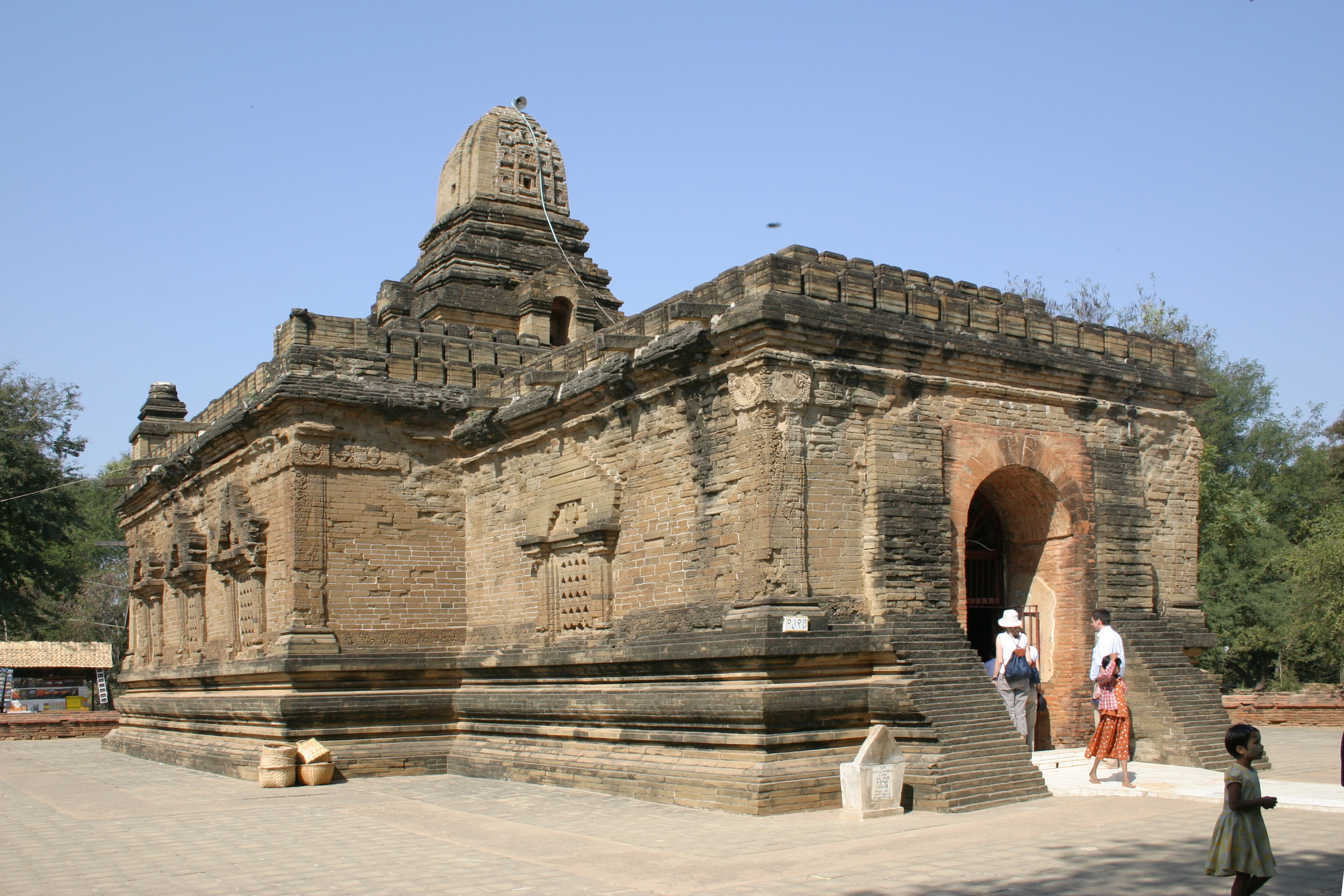
Nanpaya Temple
The name says everything. Nanpaya means "palace temple," and what sounds like a contradiction is actually precise history. This was the residence of a king who was also a prisoner. When the Burmese monarch Anawrahta conquered the Mon capital of Thaton around 1054 AD, he brought the defeated King Makuta back to Bagan in chains. Makuta, also known as Manuha, was settled in Myinkaba Village, a mile south of the city proper, close enough to be watched but far enough to be kept from power. There, according to tradition, the captive king built himself a dwelling that eventually became a temple, and he filled it not with the Buddhist imagery of his captors but with the Hindu gods of a different tradition entirely: Brahma, Vishnu, and the sacred symbols of Brahmanical India.
Four Pillars of Defiance
The interior of Nanpaya is dominated by four massive square stone pillars that support the ceiling of the central hall. Each pillar bears elaborate carvings of three-headed Brahma, seated in padmasana, the lotus position, holding lotus petals. The carvings are deep-relief work, assembled from individually carved stones bonded with a powerful adhesive. Giant angular flower patterns cover the remaining surfaces. Around the pillars, the walls carry additional carvings of lotus pots, stylized vines, and Mon motifs, including the hintha bird, a sacred emblem of the Mon people. In a city that was rapidly becoming the center of Theravada Buddhism in Southeast Asia, a captive king chose to fill his temple with Hindu iconography. Whether this was personal devotion, cultural assertion, or quiet resistance, the pillars still stand as his statement.
Stone, Brick, and Mud
Nanpaya's construction materials set it apart from nearly every other structure in Bagan. While most temples in the archaeological zone use brick alone, Nanpaya combines mud mortar, brick, and stone, a rare triple combination that reflects Mon building traditions rather than Burmese ones. The layout follows a classic plan: a square inner sanctum connected to a front hall, the mandapa, with ornate lattice windows of brick and stone filtering the light. The Pantamao floral reliefs carved into the stone borders represent a decorative vocabulary imported from Indian artistic traditions. Every material choice and every carved pattern speaks to the cultural distance between the builder and the city he was forced to call home.
Vishnu Dreaming on the Cosmic Ocean
Inside the temple, visitors once encountered an elaborate sculptural program depicting the Hindu cosmos. A central statue, now missing, occupied the main hall. Arched windows are framed by carvings of kalasa pots, makara guardians, and lotus vines. Partially preserved statues show Vishnu riding the great bird Garuda. But the most significant sculpture, now mostly lost, depicted the cosmic creation myth: Vishnu reclining on the serpent Shesha, floating on the ocean of eternity. From Vishnu's navel, a lotus was said to rise, giving birth to the god Brahma, who would then create the world. Today only the serpent's tail remains, a fragment of a once-grand representation of one of Hinduism's central narratives. That such imagery was carved inside a temple in Bagan speaks to the religious complexity of the medieval Pagan Empire, where Buddhism, Hinduism, and local nat spirit worship coexisted in ways that modern categories struggle to contain.
The Nearby Echo
Close to Nanpaya stands the Nang Pagoda, built in the twelfth century by Nagathaman, a son-in-law of both King Narapati Sithu and King Manuha. This cave-temple, constructed from thick stone slabs, commemorates the site where Manuha is believed to have lived during his captivity. Its carved lotus pots, hintha motifs, makara guardians, and betel leaf sculptures continue the artistic vocabulary of Nanpaya, and its architectural style is unique within the Bagan region, found nowhere else. Together, Nanpaya and the Nang Pagoda form a small cultural enclave within the Buddhist landscape, a pocket where Mon identity and Hindu tradition persisted for generations after the fall of Thaton.
Hindu Survival in a Buddhist Sea
Nanpaya remains one of the oldest Hindu structures in the Bagan archaeological zone, a rare survivor in a landscape dominated by Buddhist pagodas and monasteries. Time and earthquakes have taken their toll. Yet the temple endures as evidence of something history often smoothes over: that religious landscapes are rarely as uniform as they appear. The Mon people who were brought to Bagan after the conquest of Thaton carried their own traditions, their own sacred symbols, their own architectural knowledge. Nanpaya is the physical proof that those traditions did not simply vanish upon arrival. Instead, they were carved into stone and built into walls, where they have outlasted the empire that tried to absorb them.
From the Air
Located at 21.153N, 94.859E in Myinkaba Village, just south of the main Bagan temple plain in central Myanmar. The temple sits adjacent to the Manuha Temple. Bagan Nyaung-U Airport (VYBG) is approximately 5 km to the northeast. The Bagan archaeological zone, with over 2,000 temples visible from the air along the Irrawaddy River's east bank, is unmistakable from 3,000-5,000 ft. Nanpaya is a smaller structure in the southern cluster near Myinkaba. Best visibility during the dry season (November-March).