Naoshima
A giant yellow pumpkin covered in black polka dots sits at the end of a concrete pier, the Seto Inland Sea stretching behind it in every direction. The sculpture belongs to Yayoi Kusama, but it also belongs to Naoshima, a small island of roughly 3,000 people that has become one of the most improbable art destinations on Earth. What was once a quiet place defined by fishing boats and a Mitsubishi smelter is now defined by Tadao Ando's concrete museums half-buried in hillsides and old village houses reimagined as conceptual installations.
From Smelter to Gallery
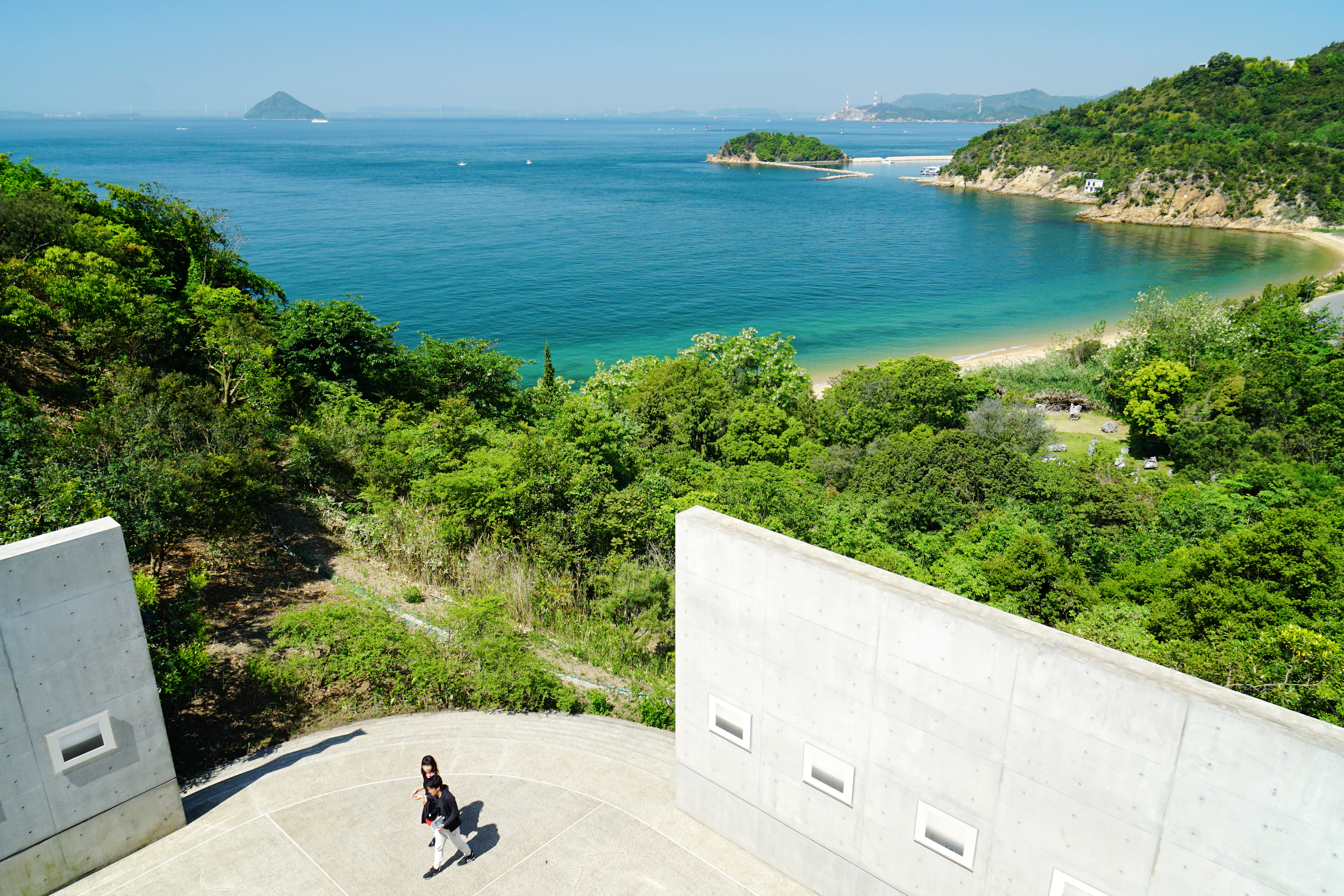
Naoshima's transformation began in the late 1980s when Soichiro Fukutake, founder of Benesse Holdings, chose this unassuming island as the site for a cultural experiment. The first settlement on the island was at Tsumuura, a fishing port on the southeastern tip, and Honmura grew as a coastal castle town during the warring states period between 1467 and 1568. For centuries, the island's identity was tied to the sea. Then Mitsubishi Materials built a smelter and refinery, and industry defined the place for decades. Fukutake's vision reversed that trajectory entirely. Benesse House, designed by architect Tadao Ando, opened as both museum and hotel, embedding art into the landscape rather than walling it off from it. Guests sleep among the exhibits. The building itself disappears into the hillside, its raw concrete corridors framing views of the inland sea through carefully positioned windows.
Houses That Became Art
In the village of Honmura, the Art House Project took the radical step of turning abandoned traditional homes into permanent installations. Artists were given entire structures to transform, and the results blur the line between architecture, sculpture, and experience. Walking the narrow lanes of Honmura feels like moving through an ordinary Japanese village until you step through a doorway and find a darkened room where LED numbers flicker in water, or a house whose wooden floors have been replaced with glass over a subterranean pool. The Haisha, a former dental clinic, became a three-dimensional collage of objects embedded in walls and floors. These are not galleries displaying art. They are art inhabiting the shell of domestic life, making the ordinary strange and the strange strangely intimate.
Light Buried Underground
The Chichu Art Museum, whose name means "art museum within the earth," is perhaps Ando's masterwork on the island. The entire structure sits below ground level, with no exterior walls visible from the surface. Natural light enters through geometric openings cut into the earth, illuminating galleries designed for just three artists: Claude Monet, Walter De Maria, and James Turrell. Five of Monet's Water Lilies paintings hang in a white marble room flooded with daylight from above, the space so hushed that visitors unconsciously lower their voices. Turrell's installation plunges viewers into pure color, the boundaries of the room dissolving in gradients of light. Reaching the museum requires a thirty-minute walk uphill from Miyanoura port, a climb that functions as a kind of pilgrimage, the effort sharpening attention for what waits below.
Island Time, Island Rules
Naoshima operates on rhythms that confound visitors accustomed to big-city convenience. Most museums close on Mondays. Restaurants keep irregular hours and many serve only lunch. A single 7-Eleven and two small Co-op supermarkets supply the island's groceries. The town bus circumnavigates the island for 100 yen but runs infrequently, timed to ferry arrivals from Uno port on Honshu or Takamatsu on Shikoku. Though the island administratively belongs to Kagawa Prefecture in Shikoku, it sits closer to the Honshu shore. Visitors who adapt to the pace discover that the constraints are part of the point. Walking between sites along hilly coastal roads, passing elderly residents tending gardens, the art becomes inseparable from the rhythms of a small community that has absorbed the extraordinary into its daily life.
From the Air
Naoshima sits at 34.47N, 134.00E in the Seto Inland Sea, visible as a small hilly island between the coasts of Honshu and Shikoku. From the air, look for the island's distinctive shape and the cluster of buildings along its southern coast where the Benesse art complex is located. Nearby airports: Takamatsu (RJOT) approximately 30nm southeast, Okayama (RJOB) approximately 25nm northeast. Best viewed at 2,000-4,000 feet AGL on clear days when the inland sea's calm waters contrast with the island's green hills.