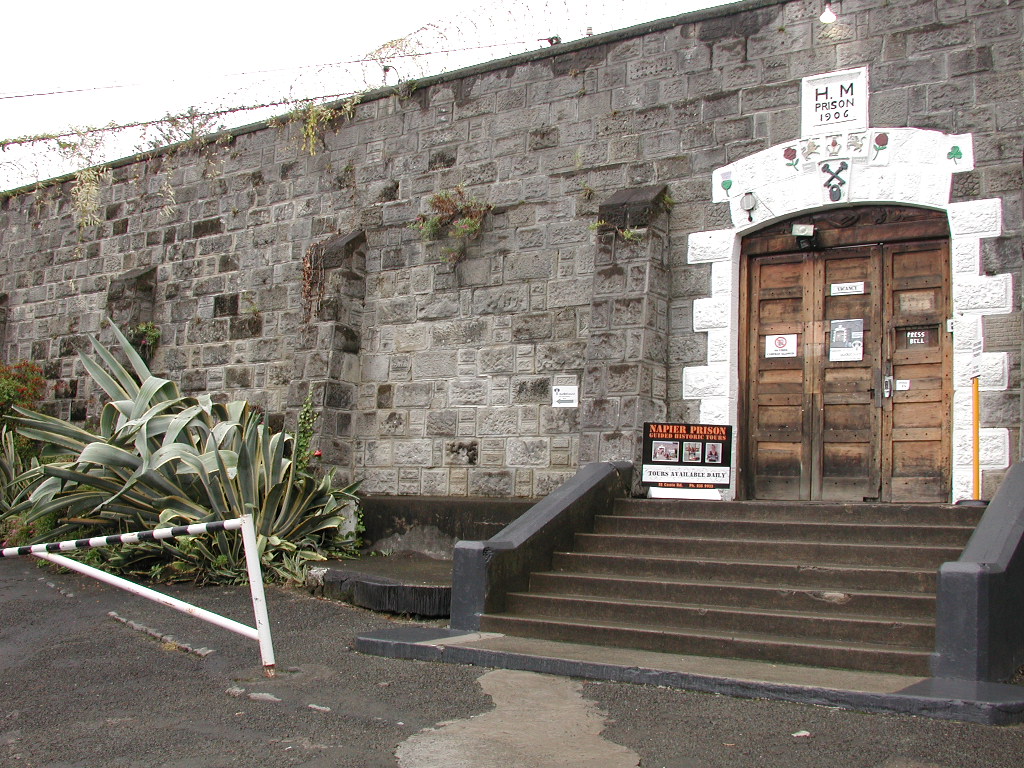
Napier Prison
The walls of Napier Prison have held more kinds of suffering than most buildings endure in a lifetime. Built on Napier Hill in 1862, the complex served as a prison for 131 years, but also housed an orphanage and a psychiatric unit at various points in its history. Four people were hanged within its walls during the nineteenth century. When the prison was finally decommissioned in 1993, it had outlasted every other prison complex in New Zealand. Nine years later, it reopened as a tourist attraction, trading one kind of captive audience for another.
Layers of Confinement
From the outside, Napier Prison looks like what it is: a utilitarian compound perched on a hill above a city that has reinvented itself around Art Deco elegance. Inside, the corridors and cells tell a more complicated story. The prison did not simply hold convicted criminals. At different periods, orphaned children lived within these walls, as did people committed to a psychiatric unit. The overlap of these populations in a single institution reflects a nineteenth-century approach to social problems that drew few distinctions between those who had broken the law and those who had simply lost their families or their mental health. John Purcell, superintendent during the prison's later years, oversaw a facility whose original purpose had long since expanded beyond its design.
Where the Earth Split
Napier Prison holds a distinction that no other building in the region can claim. It is the only structure where visitors can see the original fault trace from the 1931 Hawke's Bay earthquake, the magnitude 7.8 event that killed 256 people and levelled the cities of Napier and Hastings. The earthquake raised the land by several metres and rearranged the coastline, but the prison on its hilltop survived. The visible fault line running through the building connects the prison's history to the larger story of the region: a place shaped by forces both human and geological, where the ground itself is unreliable.
From Cells to Selfies
In 2002, the prison opened its doors to tourists. Guided day and night tours lead visitors through cell blocks and exercise yards, while self-guided audio tours are available throughout the day. The site has attracted television producers as well: the 2006 show Redemption Hill was filmed on location, and in 2011 a crew from Ghost Hunters International spent four days investigating the prison's reputation for paranormal activity. That investigation drew criticism from local Maori, who considered the approach disrespectful. Reports of ghostly occurrences at the site include unexplained footsteps, doors moving on their own, and sightings linked to the anniversaries of the nineteenth-century executions.
The Weight of Walls
Walking through Napier Prison today, the architecture itself communicates constraint. The narrow corridors, small windows, and thick walls were designed to control movement and limit freedom. The exercise yards are cramped. The cells are barely large enough for a bed. These were not spaces designed for rehabilitation; they were designed for containment, and the building's fabric has not changed enough to disguise that original intent. What has changed is the visitor's relationship to the space. Where prisoners once marked time, tourists now take photographs. Where orphans once waited for a future, guides recount the building's history. The prison endures as a physical record of how New Zealand once dealt with those it could not, or would not, accommodate in the world outside.
From the Air
Located at 39.48S, 176.92E on Napier Hill, overlooking the city and the coastline. The prison complex is visible on the hillside above Napier's Art Deco downtown. Nearest airport: Hawke's Bay Airport (NZNH), approximately 6 km northwest. At 1,500-2,500 ft, Napier Hill and its buildings are clearly visible against the backdrop of Hawke Bay. The contrast between the hilltop prison and the rebuilt Art Deco city below it is especially striking from the air.