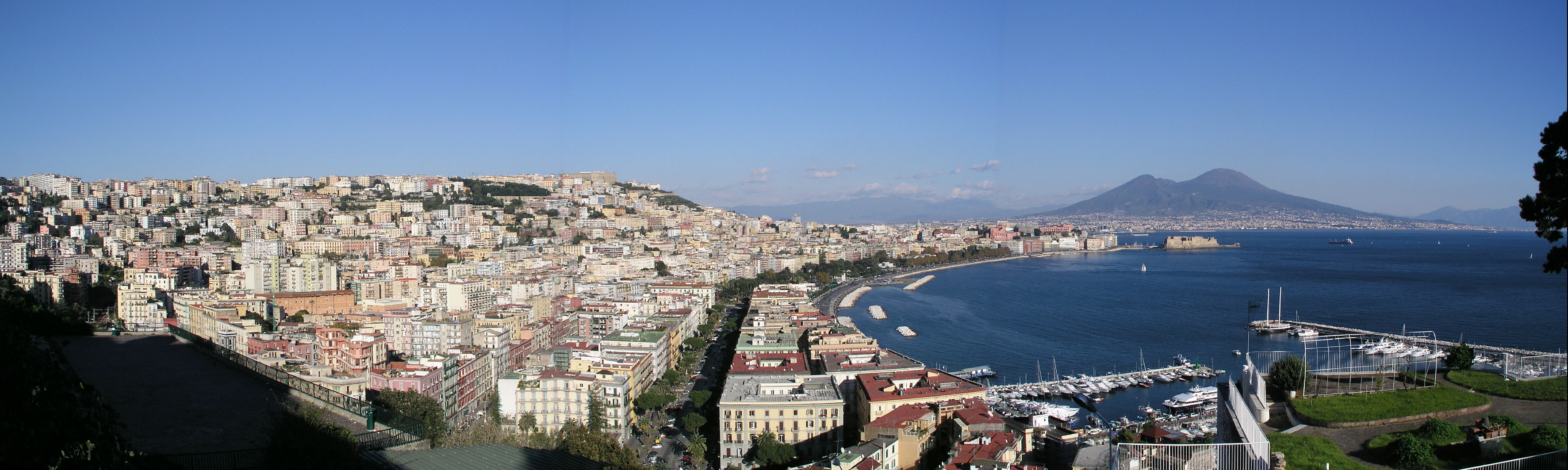
Naples
Italy has no city more intense than Naples. This southern metropolis of 920,000 operates by rules the north cannot understand, and it makes no apologies. Visitors often find the chaos overwhelming: traffic follows no logic, and street life never pauses, not even at three in the morning. Before efficiency became an Italian virtue, all of Italy looked something like this. Vesuvius still looms over the bay, the same volcano that destroyed Pompeii, and its geological menace adds urgency to a city that hardly needs more. Neapolitans invented pizza, drink their coffee standing at bars, and have staged opera at San Carlo since 1737. Here, Italian culture takes its most concentrated form.
The Centro Storico
Europe's largest historic center belongs to Naples. Its UNESCO-listed streets run deep through time: Greek foundations support Roman remains, which hold medieval churches, which hold Baroque palaces. The Spaccanapoli slices straight through the city along paths established by Greek urban planning, routes that millennia have not managed to shift. Churches fill every block. Noble families built palaces on every corner. Street life pours from doorways at all hours. Later centuries could never replicate this kind of density.
Living in the centro storico means accepting its challenges alongside its splendor. Scooters ignore pedestrians, laundry hangs above the narrow streets, and the noise simply never stops. But beauty and chaos are inseparable here; one creates the other, and together they define what Naples is.
Vesuvius
Every view from Naples frames the same volcanic cone. Vesuvius erupted in 79 CE, burying Pompeii and Herculaneum and killing thousands, and it remains active today. Its last eruption came in 1944. When the next one arrives is unpredictable; that it will arrive is not. A million people now live in the red zone, and experts openly doubt the evacuation plans could work in time.
Climb to the crater on a clear day and the panorama is staggering. You stand on something capable of destroying everything visible below. Pompeii and Herculaneum, preserved through the very destruction that ended them, are now among Italy's most visited archaeological sites. The volcano gives the Bay of Naples its drama and its dread in equal measure.
The Pizza
Pizza was born here. Legend credits the margherita to a baker honoring Queen Margherita with the colors of the Italian flag, and some of Naples's pizzerias have been serving pies since before Italy was even a unified nation. True Neapolitan pizza follows strict dogma: the crust must blister in a blisteringly hot oven, the tomatoes must be San Marzano, and the mozzarella must be fresh. Call it religion, because it functions like one.
At the best pizzerias, tourists queue around the block while locals somehow skip ahead. Naples's persistent poverty keeps prices low; fierce competition keeps quality high. Eat pizza here every single day and you will not tire of it. Everywhere else, pizza is imitation. In Naples, it remains the original.
The Underground
Beneath Naples lies a second city. Generations have hollowed out the soft volcanic tufo stone, creating a labyrinth of quarries, cisterns, shelters, and catacombs. Napoli Sotterranea tours descend into this underworld, passing Roman aqueducts and World War II bomb shelters on paths that hold layers of history the surface has simply built over.
The tufo made all of this possible. Easy to excavate, it provided building material for the city above while opening vast spaces below. But the underground also poses real danger. Caves collapse without warning, tunnels compromise modern infrastructure, and no one has fully mapped what lies beneath every building. Naples is a city with secrets under its feet.
The Bay
Few bays in the world rival this one. A sweeping crescent holds the city and Vesuvius together, then extends south toward Sorrento and the island of Capri. Painters have captured these views for centuries. The wealthy have long claimed the islands. Day-trippers board boats each morning for destinations barely an hour away. The bay is both Naples's setting and its escape.
It also shapes daily life in ways that go beyond scenery. The bay provides the seafood, the ferries connect the communities, and the relationship with water defines what Mediterranean living actually means. Naples owes its desirability to this location, even if it must share the shoreline with a volcano that could erase it all.
From the Air
Naples (40.85N, 14.27E) sits on the Bay of Naples in southern Italy with Mount Vesuvius rising to the east. Naples International Airport (LIRN/NAP) lies 6km north of the city center, offering one runway 06/24 at 2,628m. Urban development crowds around the airport on all sides. At 1,281m, Vesuvius dominates the eastern skyline. South of the city, the bay curves toward Sorrento, and Capri is visible offshore. From altitude, the dense historic center stands out clearly against the surrounding sprawl. Expect Mediterranean weather: hot dry summers and mild wet winters. Sea breezes off the bay are common, and visibility is often excellent, rewarding pilots with dramatic views of the volcano.