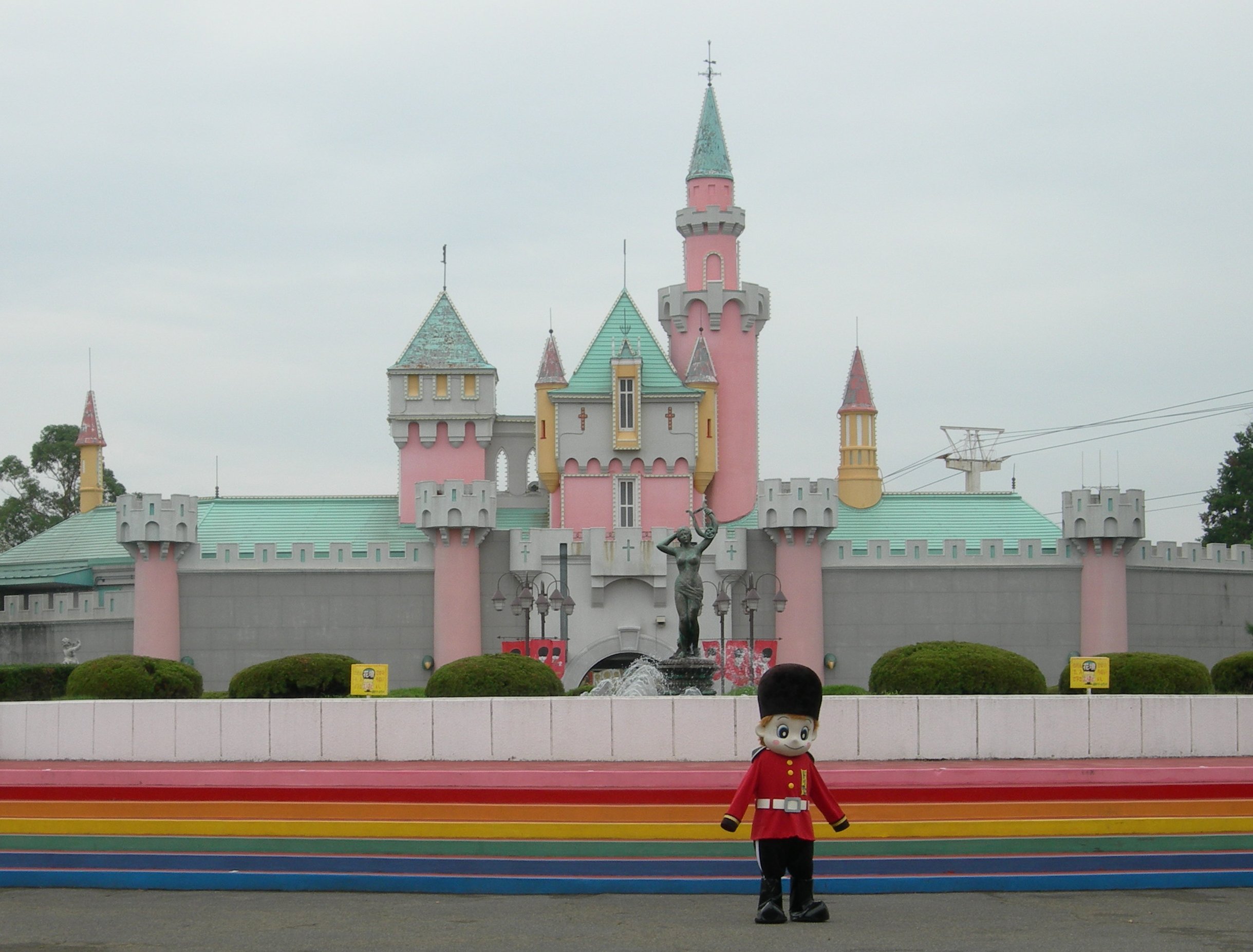
Nara Dreamland: Japan's Bootleg Magic Kingdom
The castle looked right. The Main Street looked right. The Matterhorn looked right, and the monorail circled overhead just like the one in Anaheim. But Nara Dreamland was not Disneyland -- it was a businessman's dream that got close enough to the real thing to succeed brilliantly, then close enough to the real thing to fail spectacularly. Kunizo Matsuo opened his park on July 1, 1961, six years after visiting the original Disneyland in California and walking away convinced that Japan needed exactly this. He tried to franchise the Disney name. Walt Disney's Imagineers reportedly drew up concepts. The deal collapsed over licensing terms. Matsuo built it anyway, stripping out the copyrighted characters but keeping everything else -- the layout, the architecture, the feeling. For twenty-two years, it worked. Then Tokyo Disneyland opened, and the slow unwinding began.
The Almost-Disney Deal
When Disneyland opened in Anaheim in 1955, it was unlike anything the world had seen -- a theme park where the experience was designed down to the sightlines and the trash cans. Kunizo Matsuo, a Japanese businessman, recognized its potential immediately. He flew to California, toured the park, and began negotiations with Walt Disney to bring a licensed version to Japan. The talks progressed far enough that Disney's Imagineers reportedly created design concepts for the project. But the deal fell apart, most likely over the complexities of international licensing agreements. Matsuo was left with the vision but not the brand. His solution was audacious: build the park without the Disney name, copying the physical design while replacing Mickey and friends with original mascots -- Ran-chan and Dori-chan, two children dressed as bearskin guards, along with a cast of anthropomorphic animal characters. The entrance featured its own Train Depot, its own Main Street, and its own Sleeping Beauty Castle at the hub.
The Glory Years
Nara Dreamland opened to the public on July 1, 1961, near the ancient capital of Nara in Japan's Kansai region. The resemblance to Disneyland was shameless and effective. Visitors entered through a near-replica of Disneyland's front gate, strolled down a Main Street designed to look like small-town America, and arrived at a castle that could have fooled anyone who had not seen the original. The park featured a Matterhorn-type mountain with a bobsled ride running through it, a Skyway gondola system, an Autopia-style driving course, and a monorail circling the grounds. At its peak, Nara Dreamland attracted more than 1.6 million visitors a year. In a Japan that did not yet have a genuine Disney park, Matsuo's imitation was the closest thing available, and families came from across the Kansai region to experience it. For two decades, the illusion held.
Death by Disneyland
In 1979, the Oriental Land Company reached an agreement with the Walt Disney Company to build the real thing in Japan. Tokyo Disneyland opened on April 15, 1983, and the effect on Nara Dreamland was immediate. Why visit a copy when the original -- expanded, updated, and backed by Disney's full creative machine -- was now a bullet train ride away? Attendance dropped from 1.6 million to around one million visitors annually. In 1993, the supermarket chain Daiei acquired Nara Dreamland's parent company, but the bleeding continued. On March 31, 2001, Universal Studios Japan opened in Osaka, just 40 kilometers from Dreamland's gates. Five months later, Tokyo DisneySea launched alongside Tokyo Disneyland. Caught between genuine Disney magic and Universal's blockbuster spectacle, Nara Dreamland's attendance plummeted to 400,000 visitors a year. The park closed permanently in August 2006, forty-five years after it opened.
The Haikyo Years
Nara Dreamland's second life began the moment its gates closed. Between 2006 and 2016, the abandoned park became one of Japan's most famous haikyo -- ruins explored by urban adventurers drawn to the melancholy beauty of decay. The castle still stood, its paint fading. The monorail track curved overhead, its cars frozen in place. Weeds pushed through the pavement of Main Street. The bobsled track rusted on the Matterhorn. Graffiti appeared on walls and ride vehicles. Some trespassers rearranged the park's character statues, posing them in eerie positions on broken attractions. Others reported hearing strange sounds near the park's boat ride -- likely a water pump still running somewhere in the derelict infrastructure, though the more romantic explanation blamed bullfrogs. Photographs and videos of the abandoned park circulated widely online, turning Nara Dreamland into an internationally recognized symbol of Japan's haikyo subculture.
Demolition and Memory
Nara City's government took ownership of the property after the park's owners fell behind on property taxes. In 2013, the city put the site up for auction but received no bids. On October 10, 2016, demolition began. Over the next fourteen months, the castle, the Matterhorn, the monorail, and every other structure were torn down. By December 2017, Nara Dreamland was gone entirely. What remains is the story itself -- a tale of ambition and imitation that mirrors Japan's broader relationship with American pop culture in the postwar decades. Matsuo did not simply copy Disneyland; he recognized something universal in its appeal and tried to bring it home. That the original eventually came to Japan on its own terms, and that the copy could not survive the comparison, gives the story its bittersweet arc. The site near Nara now sits empty, a cleared lot where a castle once stood and 1.6 million people a year once believed in someone else's dream.
From the Air
Located at 34.70°N, 135.82°E, approximately 3 kilometers northwest of central Nara. The former park site has been demolished and cleared as of December 2017, so no structures remain visible. The location sits on relatively flat terrain near the hills north of Nara. From the air, look for the cleared lot surrounded by residential areas and wooded hillsides. The nearest major airports are Kansai International Airport (RJBB), approximately 40 nautical miles to the south-southwest, and Osaka Itami Airport (RJOO), approximately 18 nautical miles to the west. The ancient city of Nara, with Nara Park's distinctive open grasslands and temple complexes, is visible to the southeast.