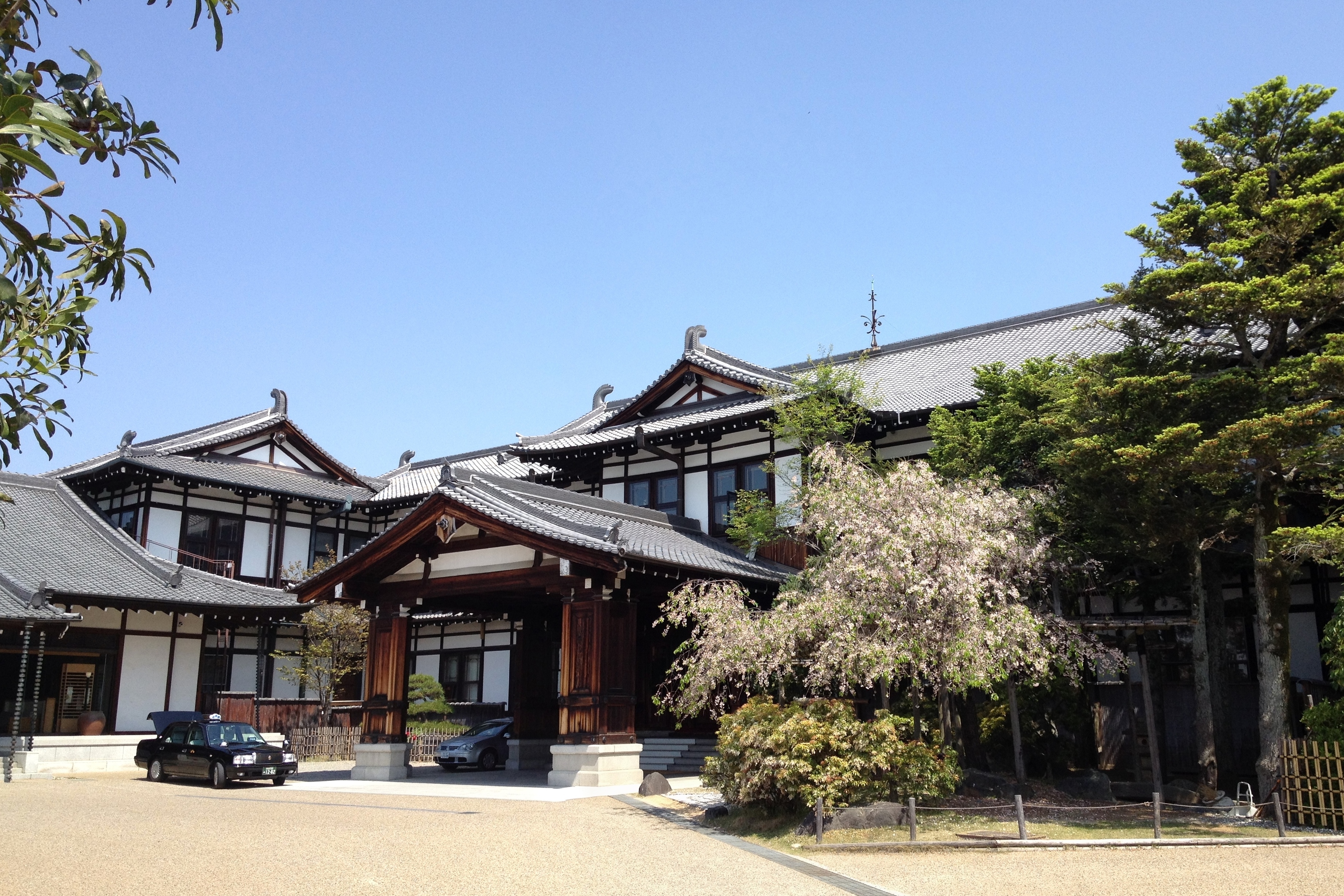
Nara Hotel: The Guestbook That Reads Like a History of the Twentieth Century
In the tea lounge of the Nara Hotel, a grand piano sits in a position of quiet honor. Albert Einstein played it over two days in December 1922, during a visit that placed the physicist's name alongside emperors, prime ministers, and Hollywood legends in what may be the most remarkable guest register in Japan. The hotel opened on October 17, 1909, designed by Tatsuno Kingo -- the same architect who gave Japan the Bank of Japan headquarters and the Marunouchi facade of Tokyo Station. Perched on a wooded hillside above Nara Park, where wild sika deer have wandered for more than a thousand years, the hotel was built to receive the world. And the world came.
Tatsuno's Hilltop Masterpiece
Tatsuno Kingo was among the most important architects of the Meiji era, a period when Japan was rapidly modernizing and selectively absorbing Western design. His best-known works -- the Bank of Japan building and the red-brick Marunouchi facade of Tokyo Station -- defined the look of institutional Japan at the turn of the century. For Nara, he created something more intimate: a hotel that married Western grandeur with Japanese sensibility, set into the hillside so that every window framed the ancient parkland below. The building combined European architectural forms with local materials and craftsmanship, producing a structure that felt both cosmopolitan and deeply rooted. Tatsuno also mentored a generation of architects, including Kataoka Yasushi. When the hotel celebrated its centennial in 2009, the building itself was the guest of honor -- a hundred years old and still receiving visitors in the manner its architect intended.
A Guest Register Like No Other
The parade of names through the Nara Hotel's doors tells the story of the twentieth century in miniature. Emperor Taisho and Empress Teimei arrived with Crown Prince Hirohito in 1916. Sergei Prokofiev, the Russian composer, stayed for over a week in May 1918. Bertrand Russell signed the register in July 1921. Edward, Prince of Wales, visited in 1922 -- the same year Einstein sat down at that piano. Charles Lindbergh came in 1931, four years after his solo Atlantic crossing. Charlie Chaplin checked in during 1936. Emperor Puyi of China stayed in 1935 and, in a characteristically lavish gesture, gave medals to every member of the hotel staff. Helen Keller visited in 1937. After the war, Richard Nixon arrived as vice president in 1953. Joe DiMaggio stayed in 1954 -- Marilyn Monroe had a reservation but canceled. Jawaharlal Nehru brought his daughter Indira Gandhi in 1957. Robert F. Kennedy came as Attorney General in 1962. Audrey Hepburn stayed for three nights in March 1983. The Dalai Lama visited in 2003.
The Imperial Thread
No institution has been more closely entwined with the Nara Hotel than the Japanese Imperial family. From Emperor Taisho's visit in 1916 through Emperor Heisei and Empress Michiko's stays in 2002 and 2008, the hotel has served as the imperial accommodation of choice when the court visits Nara. Emperor Showa returned repeatedly -- in 1928, 1932, 1940, 1970, 1979, and 1981, sometimes with Empress Kojun, who made her own separate visits in 1937, 1941, and 1954. Crown Prince Akihito and Crown Princess Michiko stayed with their daughter Princess Sayako in 1987. Prince Akishino and Princess Akishino visited in 1990. The hotel's relationship with the imperial household is not merely ceremonial -- it reflects Nara's own status as a former capital and spiritual heart of Japan, a place where emperors come not to conduct affairs of state but to reconnect with the country's oldest cultural traditions.
Above the Sacred Deer
The hotel's location is inseparable from its character. It sits on a hillside above Nara Park, where more than 1,200 wild sika deer roam freely among ancient temples and shrines. The deer have been protected here for over a thousand years, considered sacred messengers of the deity Takemikazuchi at nearby Kasuga Grand Shrine. Guests at the Nara Hotel look out over this living landscape -- the parkland, the rooftops of Todai-ji and Kofuku-ji, the forested slopes of Mount Wakakusa. The hotel is partially owned by the West Japan Railway Company, linking it to the broader network of heritage hospitality that Japan maintains along its rail corridors. Unlike the towering modern hotels of Tokyo and Osaka, the Nara Hotel keeps to the scale of its surroundings, offering a pace of hospitality measured not in efficiency but in continuity. The Mikasa dining room, the first-floor hallways, and that tea lounge with Einstein's piano preserve the atmosphere of a Japan that knew how to welcome the world without losing itself.
From the Air
Located at 34.68°N, 135.83°E on a wooded hillside above Nara Park. From the air, the hotel building is visible among the tree canopy on the eastern edge of Nara city, adjacent to the broad green expanse of Nara Park with Todai-ji and Kofuku-ji temple compounds nearby. Best viewed at 2,000-3,000 feet AGL. Osaka Itami Airport (RJOO) lies approximately 25 nautical miles west. Nara is also accessible from Kansai International Airport (RJBB), about 40 nautical miles to the south-southwest. Mount Wakakusa (342m) provides a useful visual landmark to the east of the park.