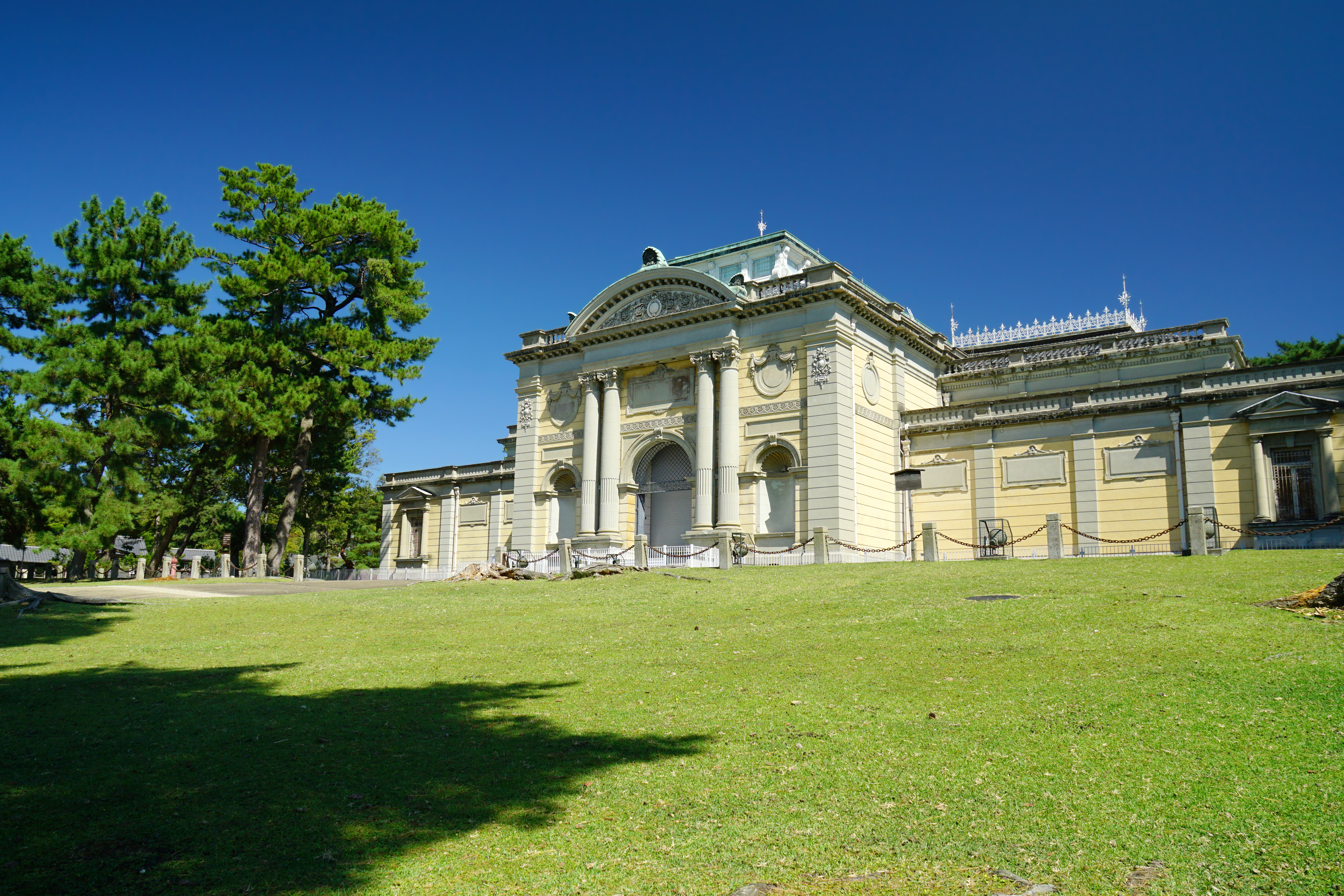
Nara National Museum: Where Buddhist Art Meets French Renaissance
Step through the ornate West Entrance of the Nara National Museum and you are walking into a collision of civilizations. The building is French Renaissance -- columns, decorative ornamentation, the full vocabulary of European grandeur -- yet its purpose from the very beginning has been to house the sacred art of Japanese Buddhism. Architect Katayama Tokuma, who served the Imperial Household Agency, completed this original building in 1894, creating one of the most striking examples of Meiji-period European architecture in Japan. The government designated it an Important Cultural Property in 1969. But the real treasures are inside: centuries of Buddhist sculpture, painting, and devotional objects drawn from the temples and shrines that cluster around Nara Park, the city that served as Japan's capital from 710 to 784.
Katayama's European Dream in an Ancient Capital
Katayama Tokuma was born in 1854 and spent his career designing buildings that made Western architectural forms speak Japanese purposes. For the Nara museum, he chose French Renaissance style -- a deliberate statement that Japan's ancient capital could hold its own in the international conversation about art and culture. The building that opened in 1894, with its first exhibition following in 1895, was lavish in its exterior ornamentation, particularly around the West Entrance, where carved stone details rival anything in contemporary European museum design. The choice of style was not accidental. The Meiji government was building institutions to preserve and display Japanese cultural heritage using the organizational models of the West, and the architecture followed suit. Katayama died in 1917, but his Nara building endures as both a museum and an artifact -- a piece of Meiji ambition preserved in stone.
Guardians of the Buddha
The museum's core collection is Buddhist art, and the holdings are extraordinary. Sculpture, paintings, altar articles, and devotional objects fill galleries that draw from the vast religious heritage of the Nara region. Many works belong not to the museum itself but to the surrounding temples and shrines -- Kofuku-ji, Todai-ji, Kasuga Grand Shrine -- which entrust their treasures to the museum for safekeeping and display. Each autumn, the museum stages its most anticipated event: the exhibition of properties from the Shosoin repository, the eighth-century imperial storehouse at Todai-ji that holds thousands of objects from the Silk Road era. These annual exhibitions draw scholars and visitors from across the world. The collection also includes twelfth-century works of remarkable delicacy. A Conservation Center opened in 2002 to rescue, examine, and restore National Treasures and other cultural properties, with specialists working on sculptures, paintings, and ancient texts.
Three Architects, One Campus
The museum campus tells the story of Japanese architecture across three generations. Katayama's 1894 original anchors the site with its European confidence. Then came Junzo Yoshimura, born in 1908, who designed the supplemental wings in a modernist vocabulary. Construction on the West Wing began in December 1970 and finished in March 1972. The East Wing followed, inaugurated in October 1997 and opening in April 1998, its design deliberately echoing the West Wing for visual coherence. A 150-meter Lower Level Passageway connects all three buildings underground, housing a museum shop, a lounge restaurant, and exhibit cases explaining Buddhist sculpture construction techniques. This passageway is free to enter -- visitors and locals use it as a rest area without buying museum tickets. The result is a campus that layers Meiji grandeur, mid-century modernism, and late-twentieth-century design into a unified whole, each generation respecting the others.
The Tea House with Eight Windows
Hidden in the inner garden of the museum grounds sits Hassoan, a Japanese tea house whose story predates the museum by centuries. Originally built on the grounds of Daijo-in, a sub-temple of Kofuku-ji, during the middle Edo period, the tea house is named for its many windows -- a design preference associated with the legendary tea master Furuta Oribe, who lived from 1544 to 1615. Hassoan is one of the Three Great Tea Houses of Nara, alongside Rokusoan at Kofuku-ji and Okiroku at Todai-ji. The structure contains a tea room of four tatami mats with a tokonoma alcove, built in the rustic style with a hipped and gabled thatched roof. Inside, rush partially covers the ceiling while other areas expose the finished underside of the roof. In 1890, Nara residents petitioned for Hassoan to be placed under the care of the Imperial Nara Museum, and in 1892 the tea house was moved to the museum grounds -- a community act of preservation that predates the modern conservation movement by decades.
Living Repository
Today the Nara National Museum operates as part of Japan's National Institutes for Cultural Heritage, merged in 2007 with the Tokyo, Kyoto, and Kyushu National Museums. The Buddhist Art Library, established in 1980, collects books, replicas, rubbings, and photographs related to Buddhist art, opening its archives to the public since 1989. The Conservation Center employs restorers who specialize in the delicate work of preserving ancient sculptures, scroll paintings, and handwritten texts, and who advise temple custodians throughout the region on caring for their irreplaceable holdings. The museum sits at the heart of a 660-hectare cultural landscape that includes World Heritage Sites, 47 buildings designated as National Treasures or Important Cultural Properties, and 374 designated works of art. It is not simply a building that contains art -- it is the institutional nerve center of one of the densest concentrations of cultural heritage on Earth.
From the Air
Located at 34.68°N, 135.84°E in the heart of the Nara Park cultural district. From the air, the museum's original Western-style building is identifiable by its distinctive French Renaissance architecture amid the green parkland of Nara. Todai-ji's massive Great Buddha Hall (Daibutsuden) is visible nearby to the north, and the forested slopes of Mount Wakakusa (342m) rise to the east. Best viewed at 2,000-3,000 feet AGL. Osaka Itami Airport (RJOO) lies approximately 25 nautical miles to the west. Kansai International Airport (RJBB) is about 40 nautical miles south-southwest.