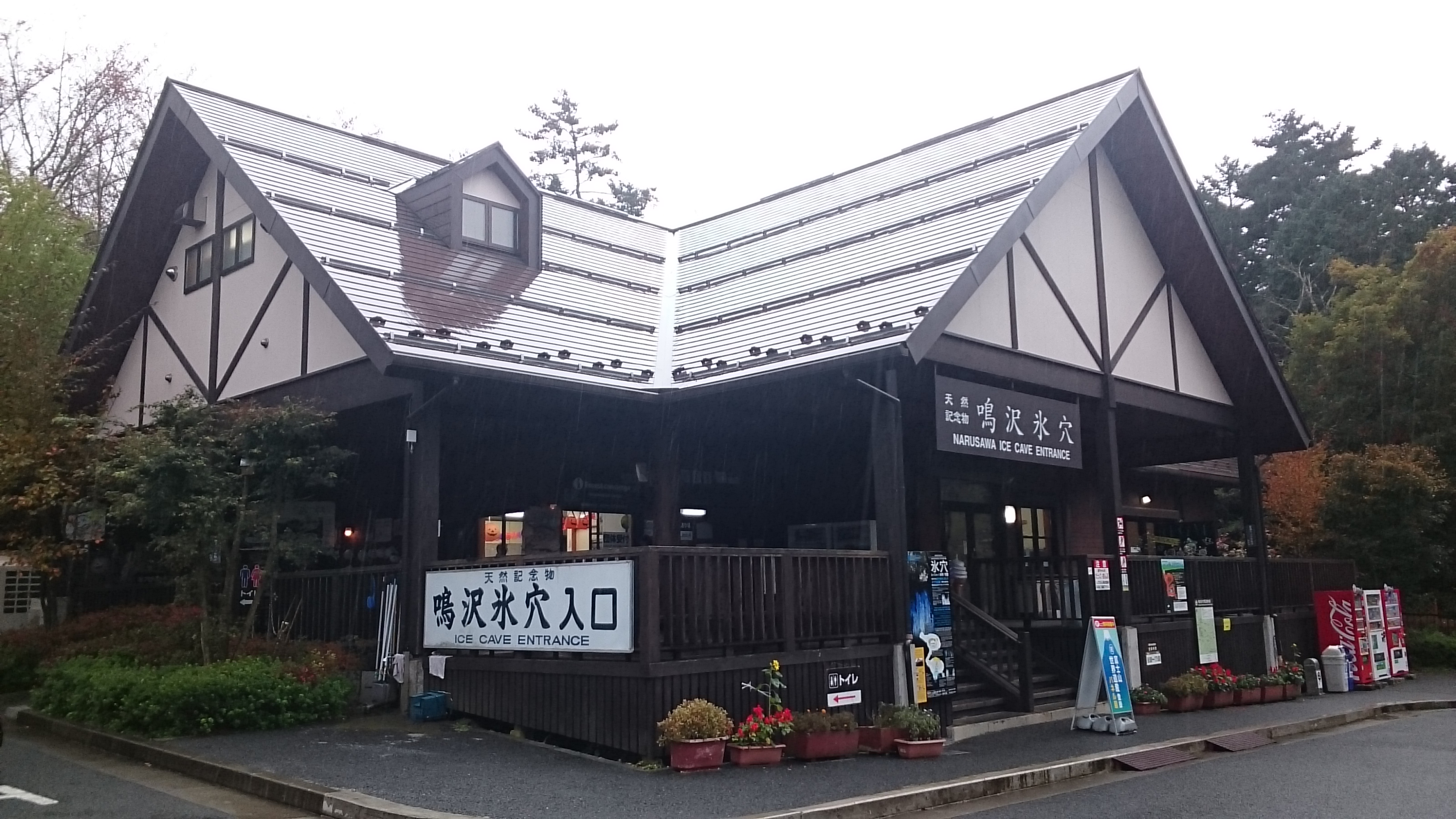
Narusawa Ice Cave
Step underground at the base of Mount Fuji and the temperature drops to 3 degrees Celsius in midsummer. The Narusawa Ice Cave is a 156-meter lava tube where enormous ice pillars -- some reaching three meters tall and half a meter thick -- grow upward from the cave floor each winter like frozen stalagmites. The cave formed during one of Mount Fuji's most violent recorded eruptions in 864 AD, when lava poured not from the summit crater but from a new vent called Mount Nagao on the volcano's northeast flank. That eruption lasted ten days, split a lake in two, and created the vast lava plain now buried beneath the Aokigahara forest -- the dense, silent woodland known as the Sea of Trees.
Born in Fire, Dressed in Ice
The cave's creation is a story of opposing elements. When the 864 eruption sent rivers of molten rock flowing northwest, the outer layers of lava cooled and hardened first, forming a rigid shell while still-molten rock continued to drain through the interior. The result was a hollow tunnel -- a lava tube -- with walls of solidified basalt and a floor that would, over centuries, become coated in perpetual ice. The tube extends 156 meters along the visitor route, splitting into two lobes that range from 1.5 to 11 meters wide and one to 3.6 meters high. The porous volcanic rock overhead acts as insulation, trapping cold air that sinks into the cave during winter and never fully warms. Every year the ice pillars rebuild themselves, growing thickest between December and March before gradually thinning through summer. In early spring, the stalagmites and stalactites of ice sometimes connect, forming frozen columns that span floor to ceiling.
The Shogun's Cold Storage
Centuries before mechanical refrigeration existed, the people living around Mount Fuji recognized the cave's practical value. During the Edo period (1603-1868), workers carved rectangular blocks from the ice pillars and packed them for transport to the shogun and his court in Edo, present-day Tokyo. The ice survived the journey because the blocks were dense and slow to melt, a luxury commodity in an era when keeping anything cold required ingenuity. The cave served other industries too. Silkworm farmers stored cocoons in the freezing chambers to halt the pupae's development, preserving them until they were needed. Seed merchants kept grain and crop seeds here to promote better germination. This tradition of cold storage continued well into the early 1900s, only fading when electric refrigerators made the difficult trek to the cave unnecessary. In 1929, the Japanese government designated Narusawa Ice Cave as a Natural Monument, alongside its neighboring lava tubes Fugaku Wind Cave and Lake Sai Bat Cave.
Into the Aokigahara
The cave sits within the Aokigahara forest, a woodland so dense that its canopy blocks most sunlight and muffles sound. The forest grew atop the hardened lava flows from the 864 eruption, its trees rooted in thin soil over volcanic rock. The same eruption that created the Narusawa Ice Cave also carved out two of the Fuji Five Lakes when its lava split an existing body of water. Walking to the cave entrance means passing through this atmospheric forest, where moss blankets every surface and the volcanic substrate creates an uneven, otherworldly terrain. The Aokigahara has accumulated centuries of folklore -- tales of ghosts, demons, and spirits haunt its reputation. But the forest is also a place of remarkable ecological resilience, where life has colonized bare lava rock over roughly 1,160 years. The cave entrance descends steeply via metal stairs, and visitors navigate the ice-coated passages on a marked route that loops through both lobes before returning to daylight.
A Trio of Underground Monuments
Narusawa Ice Cave is one of three major lava tubes at Mount Fuji's northern base, all designated as Natural Monuments of Japan in 1929. Fugaku Wind Cave, located nearby, is known for its constant cool breezes and was also used for silkworm cocoon storage. Lake Sai Bat Cave, the third, serves as a habitat for bats. Together, the three caves offer a window into the volcanic plumbing beneath one of the world's most famous mountains. The region around the caves, accessible from Kawaguchiko Station on the Fujikyuko railway, has become one of the Fuji Five Lakes area's most visited attractions. The average temperature of 3 degrees Celsius inside Narusawa makes it a striking contrast to the humid Japanese summers outside, and the ice formations -- backlit and shimmering in the cave's installed lighting -- draw visitors year-round, though the pillars are at their most spectacular in late winter and early spring.
From the Air
Narusawa Ice Cave (35.4747N, 138.6664E) is located at the northwest base of Mount Fuji within the dense Aokigahara forest canopy. The cave itself is not visible from the air, but the Aokigahara forest is clearly identifiable as a dark, uniform tree canopy covering the lava flows northwest of Fuji's cone. The nearest airport is Mt. Fuji Shizuoka Airport (RJNS) to the south. From the air, orient using Lake Sai and Lake Shoji to the west and Lake Kawaguchi to the northeast. Recommended viewing altitude for the Aokigahara forest region is 3,000-5,000 feet AGL. The cave is along Japan National Route 139, which is visible as a road cutting through the forest.