Nasir-ol-Molk: The Mosque That Paints with Light
Every morning, the winter prayer hall of the Nasir-ol-Molk Mosque becomes a different room. Sunlight strikes the western Shabestan's seven stained glass doors and shatters into red, azure, yellow, orange, and green -- color pooling on Persian carpets, climbing the twelve columns, sliding across the vaulted ceiling. Photographers arrive at dawn to capture it. By midday, the effect fades to ordinary shadow. The mosque was built between 1876 and 1888, late in the Qajar era, when Shiraz's aristocrats competed through architecture. It was commissioned by Mirza Hasan Ali Nasir ol-Molk, whose family name the mosque still carries. The building is beautiful at any hour. But at sunrise, it becomes something photography cannot quite convey -- a room where light itself appears to have weight and texture.
An Aristocrat's Commission
Mirza Hasan Ali Nasir ol-Molk was not a sultan or a shah. He was one of the lords of Shiraz, son of Ali Akbar Qavam ol-Molk, the city's kalantar -- a title roughly equivalent to mayor or chief magistrate. In the Qajar period, such men built mosques the way Renaissance merchants built chapels: as acts of devotion that were also acts of display. Nasir ol-Molk commissioned three architects for the project. Mohammad Hasan-e-Memar, who had already designed the celebrated Eram Garden, led the design. Mohammad Hosseini Shirazi and Mohammad Reza Kashi-Saz-e-Shirazi -- whose name translates roughly as 'the tile-maker of Shiraz' -- handled construction and the extensive tilework. The building took twelve years to complete, from 1876 to 1888. A poem inscribed on marble greets visitors at the entrance.
The Orsi Tradition
The stained glass that makes Nasir-ol-Molk famous is not European stained glass. Persian Orsi windows combine wood and colored glass in a technique developed during the Safavid and Qajar eras. Where European church windows tell stories through illuminated images -- saints, biblical scenes, symbolic narratives -- Orsi windows serve as sources of light itself. The distinction matters theologically. In Islam, light is a major symbol of the divine, referenced directly in the Quran. The Orsi windows at Nasir-ol-Molk don't depict God; they let God in, if you read the light that way. The Persian chemist Jabir ibn Hayyan published techniques for obtaining colored glass as early as the 8th century in his book Kitab al-Durra al-Maknuna. The craft has deep roots in this region.
Pink Tiles and Pointed Arches
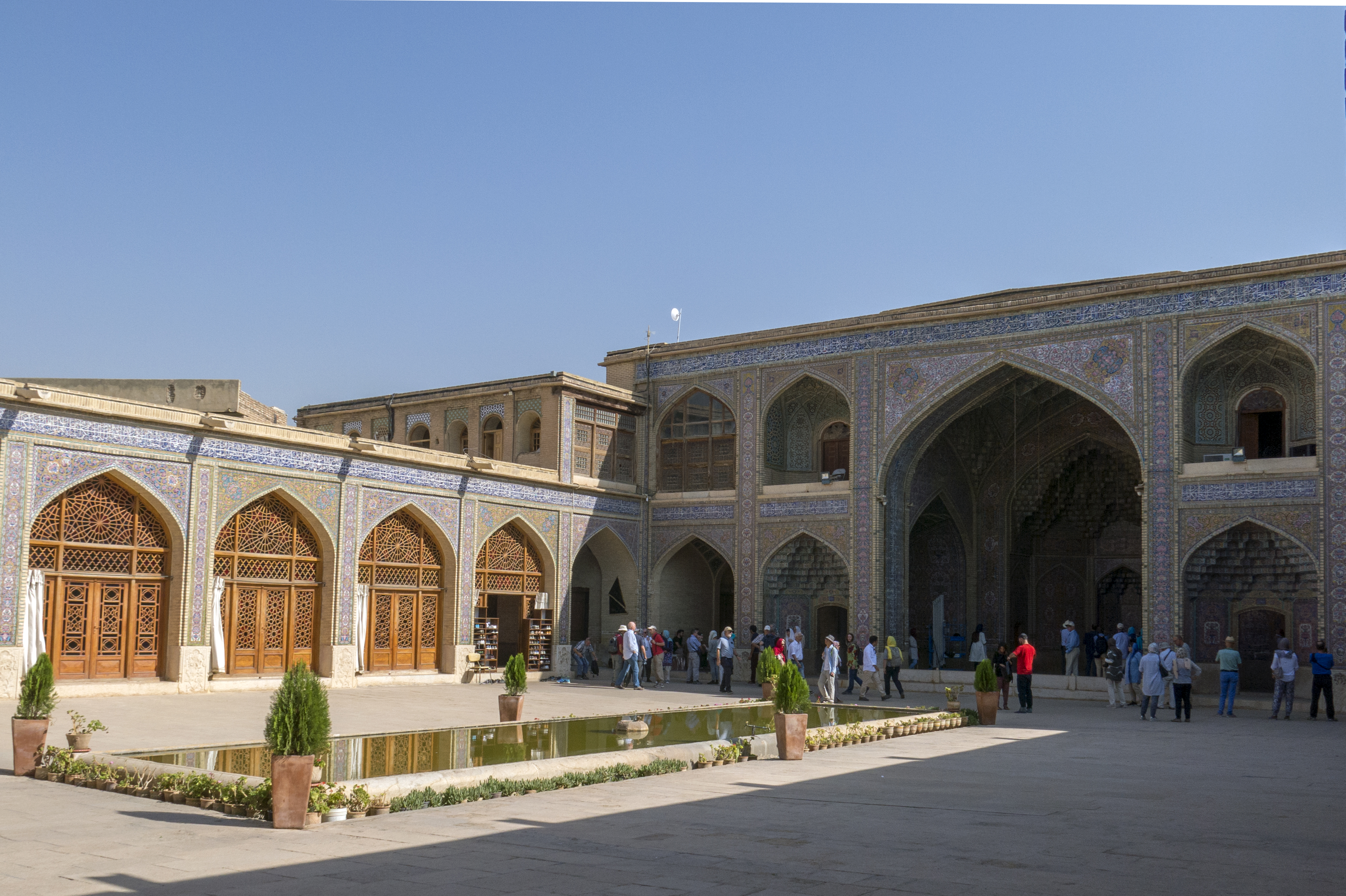
The mosque sits in the Gowd-e Araban district of Shiraz, south of Lotfali Khan Zand Street, next to the Shah Cheragh shrine. Its exterior is defined by the extensive pink-toned tilework that gives it the nickname 'Pink Mosque.' Blue, yellow, azure, and white tiles complement the dominant rose hue. Inside, the building contains two Shabestans -- underground or semi-underground prayer halls common in Persian mosque architecture. The western Shabestan, the winter prayer hall, gets the famous light show. Two rows of six columns divide the interior into smaller sections, each arch and vault contributing to the interplay of structure and shadow. A shallow, wide pool occupies the center of the sahn, reflecting the sky and the surrounding arcades. The northern porch features three half-arches on three sides, an unusual geometric arrangement.
Late Qajar Twilight
Nasir-ol-Molk was completed just a few decades before the Qajar dynasty fell. The era was one of cultural refinement layered over political decline -- aristocrats building exquisite mosques and gardens while the empire weakened around them. The mosque captures that paradox: lavish attention to tilework and glass and proportion, funded by a provincial elite whose world was about to change. The building was added to the Iran National Heritage List in 1955 and remains under the protection of the Endowment Foundation of Nasir-ol-Molk. Today it functions primarily as a tourist attraction, one of the most photographed buildings in Iran. Visitors come for the light, as they should. But the building rewards slower attention too -- the muqarnas vaulting, the calligraphy, the geometry of the arcade columns, the way the pool in the courtyard doubles the sky.
From the Air
Located at 29.61°N, 52.55°E in central Shiraz, Fars Province, Iran, in the Gowd-e Araban district near the Shah Cheragh shrine. Shiraz International Airport (OISS) lies approximately 15 km southeast. The mosque is identifiable within the dense urban fabric of historic Shiraz by its distinctive pink-tiled exterior and turret-style minarets. From altitude, the Shah Cheragh shrine's mirrored dome nearby serves as the primary visual landmark. Shiraz sits at roughly 1,500 meters elevation in a valley surrounded by the Zagros foothills. Morning light from the east is the key feature -- the famous stained glass effect occurs at sunrise on the western prayer hall's east-facing windows.