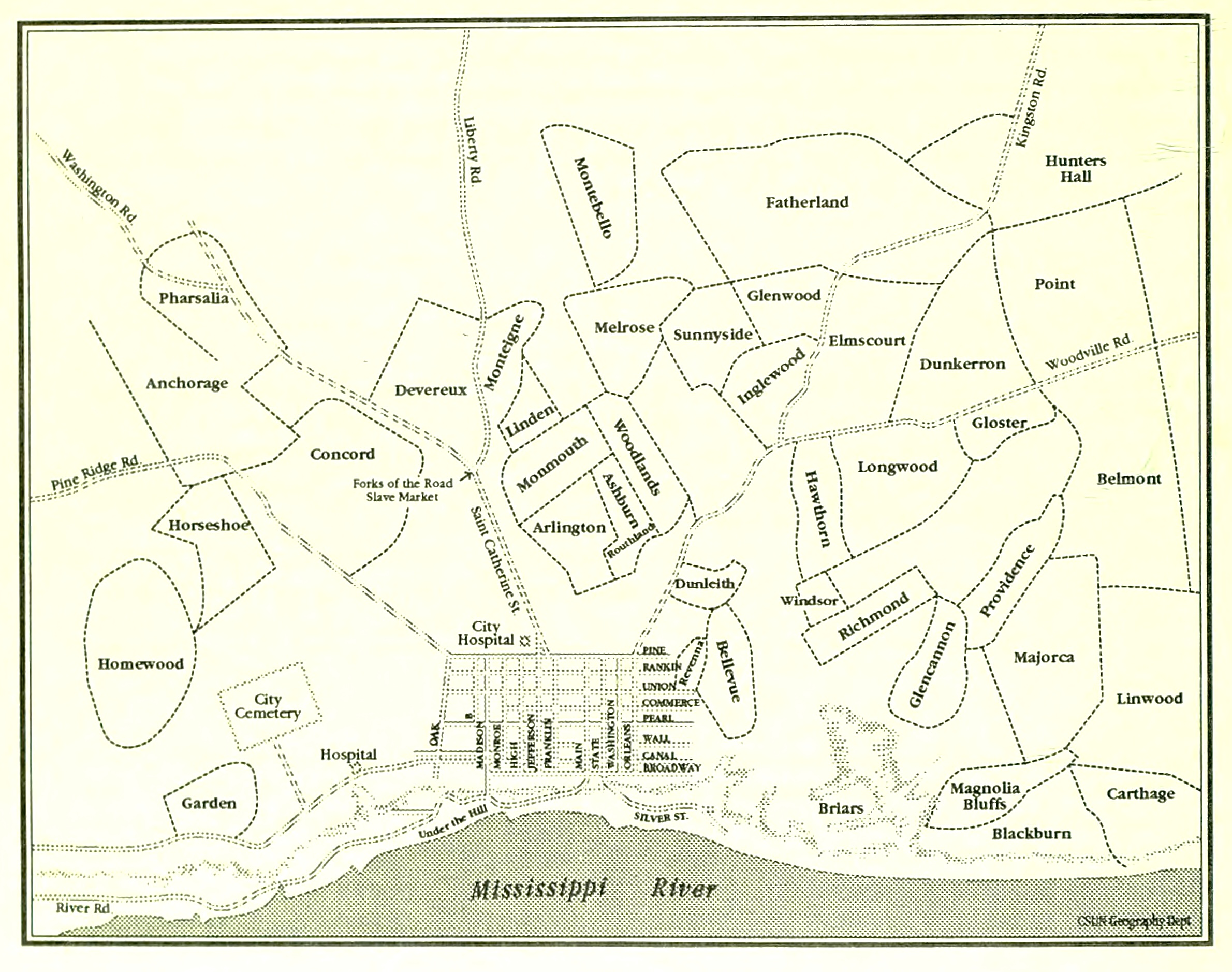
Natchez Slave Market
In 1834, a visitor from New England counted more than four thousand enslaved people passing through a cluster of rough wooden buildings at a crossroads one mile east of downtown Natchez. The place was called the Forks of the Road, and it was the second-largest slave market in the United States, surpassed only by New Orleans. Unlike the auction blocks of other Southern cities, the Forks operated on a first-come, first-served basis -- buyers browsed among hundreds of men, women, and children held in pens and three-story wooden buildings, selecting individuals as though shopping a storefront. The market thrived for thirty years, from 1833 to 1863, feeding the insatiable demand of the cotton frontier. Today, the site is part of Natchez National Historical Park, a quiet intersection where the ground holds the memory of tens of thousands of lives bought and sold.
From the River Landing to the Crossroads
The slave trade in Natchez predates the formal market by decades. In the 1780s, enslaved people arrived at the riverboat landings at Natchez-Under-the-Hill, the rough waterfront district at the base of the bluffs. As the Natchez Trace -- the overland route from Nashville -- grew in use during the 1790s, the trade shifted inland. By the early 1800s, slave sales were conducted at multiple locations around the settlement, including the steps of the Mansion House. A visitor in 1808 counted eighty-odd flatboats tied up at the landing and described a scene of constant commercial flux. By 1817, travelers reported fourteen flatboats loaded with enslaved people for sale. William Wells Brown, who accompanied a slave shipment to Natchez around 1830, described a warehouse at the boat landing for temporarily holding newly arrived enslaved people, with the main pens further inland, up the cliff and near town.
Cholera, Scandal, and the Move to the Forks
The formal Forks of the Road market was born from crisis. In 1833, as cholera swept through the region, several slave traders signed a public letter agreeing to move their operations permanently outside the city limits. The catalyst, according to an Alabama newspaper, was the slave dealer Isaac Franklin -- partner in the notorious Franklin and Armfield firm -- who had dumped the bodies of several enslaved cholera victims, including a teenage girl and an eight-month-old baby shipped from Alexandria, Virginia, into a ravine near town. The signers of the letter were only a fraction of the thirty-two non-resident slave merchants operating in Natchez that year. The new site, at the intersection of Liberty Road and Washington Road (now D'Evereux Drive and St. Catherine Street), quickly became a major commercial hub. By 1834, the novelist J. H. Ingraham described it as a cluster of rough wooden buildings in the angle of two roads, surrounded by four or five other pens holding hundreds of enslaved people of all ages.
The Scale of Suffering
The numbers alone convey the enormity. Confederate general William T. Martin, who had worked as an attorney for slave trading firms, recalled seeing six hundred to eight hundred people in the market at one time. In peak years, three or four thousand enslaved people passed through the Forks. Four or five large traders operated in Natchez each winter, each holding fifty to several hundred people. They brought their human merchandise late in the fall, sold out by May, and returned to Virginia and Kentucky for more. The traders built three large three-story buildings to hold several hundred people. At that time, Natchez had a population of about three thousand, a majority of whom were Black -- and as many enslaved people as the entire white population of the city were sold in or near it each year. Enslaved people were transported from Virginia, Maryland, Kentucky, and the Carolinas, torn from families and communities to feed the cotton economy of the Deep South.
The Pens Come Down
The Forks of the Road operated until July 13, 1863, when Federal troops arrived in Natchez. That fall, members of the 12th Wisconsin Infantry received orders to tear down the slave pens at the Forks of the Road. They were joined by the men of the newly created 58th Regiment of the United States Colored Troops -- formerly enslaved men destroying the very structures that had imprisoned people like themselves. It was an act of demolition loaded with meaning, soldiers pulling apart the wooden buildings plank by plank. The physical structures vanished, and for more than a century the site became an unremarkable intersection, its history largely unmarked and unspoken.
Ground That Remembers
In June 2021, the city of Natchez transferred a portion of the Forks of the Road site to the National Park Service, making it part of Natchez National Historical Park. A federal law passed in 2017 authorized the park to eventually encompass eighteen acres of the former market grounds. Archaeological work has uncovered artifacts from the market's operation. The site today is spare and understated -- interpretive markers stand at a modern intersection where the roads still fork, just as they did when thousands of people were held in pens here. There are no reconstructed buildings, no dramatic monuments. The emptiness is the point. The Forks of the Road forces visitors to stand on ground where human beings were bought and sold, and to reckon with an economy that treated people as merchandise. It is among the most important sites of its kind preserved anywhere in the United States.
From the Air
The Forks of the Road site is at 31.556N, 91.384W, about one mile east of downtown Natchez at the intersection of Liberty Road and D'Evereux Drive. From the air, look for the road fork east of the dense historic downtown area on the bluff. Hardy-Anders Field/Natchez-Adams County Airport (KHEZ) is 6nm northeast. Approach from the east along the road network to spot the intersection. Baton Rouge Metropolitan Airport (KBTR) lies to the south and Alexandria International Airport (KAEX) to the west.