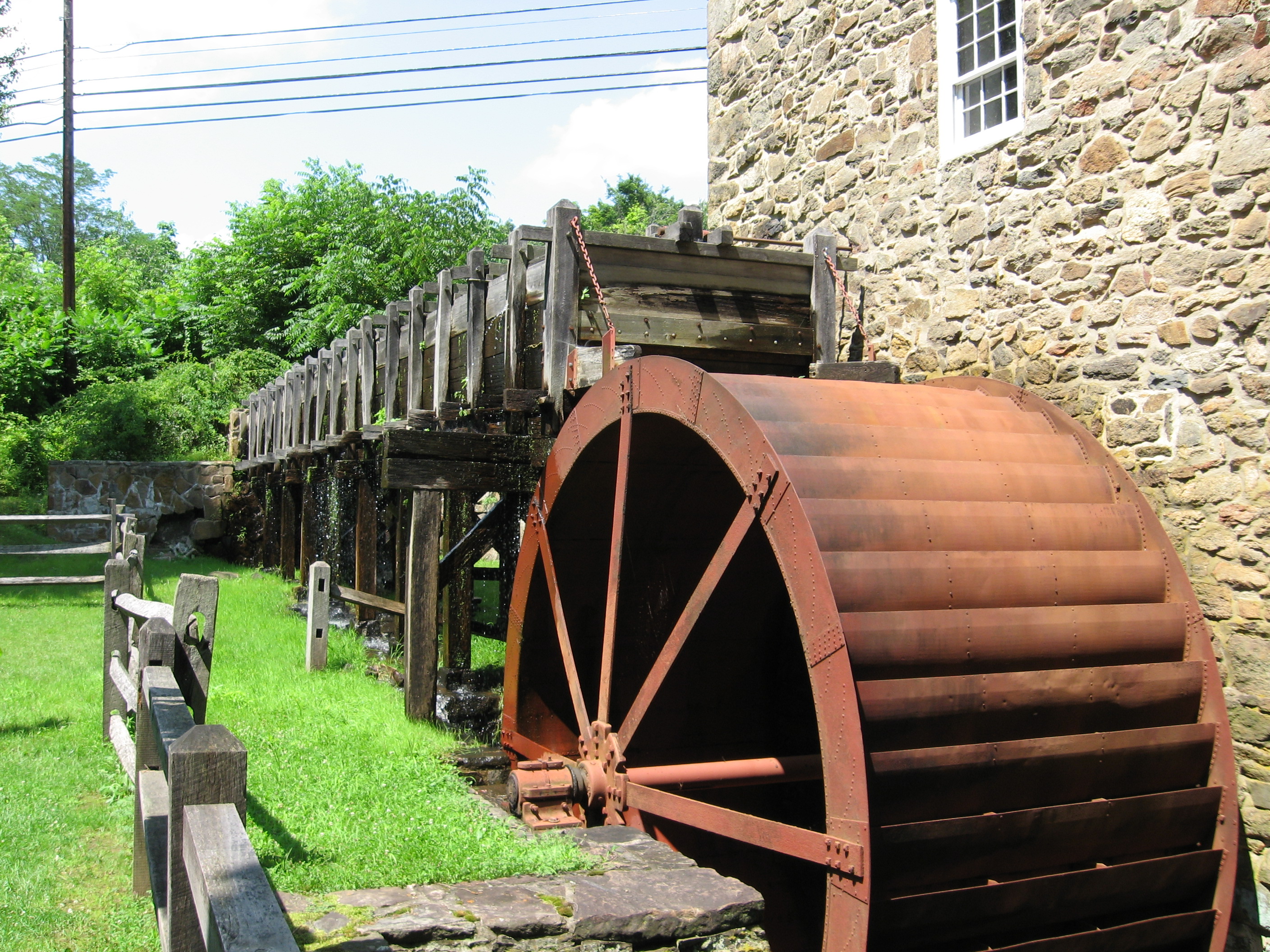
Nathan Cooper Gristmill
Ten tons of grain a day. That was the capacity of the mill that Nathan Cooper built on the Black River in 1826, and the number tells you something about the ambitions of a retired Revolutionary War general who looked at a burned-out mill site in Morris County and saw an industrial operation. Cooper was 74 years old when he purchased the 4.5 acres along New Jersey Route 24 in Chester Township for $750. The parcel came with a milldam, a sawmill, an old gristmill, and a wooden water wheel -- remnants of an earlier mill built in the 1760s. What Cooper constructed in their place still stands: a four-story random fieldstone building that anchored the economy of an entire community for nearly a century.
Oliver Evans on the Black River
Cooper's 1826 mill was no rustic operation. Inside the fieldstone walls, four sets of millstones connected by elevators to grain cleaners and flour sifters -- a system incorporating the designs of Oliver Evans, the American inventor who had revolutionized milling with his automated flour-production process in the 1780s. Evans's designs eliminated much of the manual labor of traditional milling by using gravity and mechanical conveyance to move grain through cleaning, grinding, and sifting stages. Applied to the Black River's steady current, these innovations turned Cooper's mill into something approaching a factory, capable of processing wheat, corn, and other grains at a rate that served farmers across the surrounding countryside.
Milltown's Main Street
By the 1880s, the settlement that grew around the mill had earned the name Milltown, and the Cooper operation sat at the center of a bustling commercial strip. Main Street hosted a blacksmith shop, a general store, a tavern, and the Mountain Spring Distillery alongside a cider mill. The Cooper gristmill, as one local history put it, "played a key role in the community and the region's industrial development." The family parlayed their milling income into broader enterprises, including mining operations under the banner of Cooper, Hewitt & Co. Nathan A. Cooper, who inherited the mill from his uncle, watched the business grow through the most prosperous decades of rural Morris County's economy. The Coopers built family mansions in nearby Chester Borough -- monuments to the wealth that the river and the millstones had produced.
The Wheels Stop Turning
The mill ground its last commercial flour in 1913, closing out nearly nine decades of continuous operation. But the building survived where so many others did not. The Morris County Park Commission acquired the mill and its surrounding 14 acres in 1973 and has operated it as a historic site since. Listed on the National Register of Historic Places in 1976, the mill has been preserved largely as it appeared in the 1880s, with additions of electricity and a replacement water wheel. The Friends of Fosterfields and Cooper Gristmill, a nonprofit organization, provides funding and expertise. From April through October, the mill opens its doors for educational programs and summer camps, and the millstones still turn -- not for commerce, but for the benefit of visitors who want to see what ten tons a day looked like.
Stone and Water
The Black River slides past the mill's foundation as it has for two centuries, indifferent to the shift from industry to education. The fieldstone walls -- random, uncut, hauled from local quarries and streambeds -- give the building a texture that brick and clapboard mills lack, a roughness that speaks to the materials at hand in early nineteenth-century New Jersey. From the mill race, you can trace the path the water took to the wheel, the wheel to the gears, the gears to the stones. It is a legible machine, a building whose purpose you can read in its architecture. In an era when most historic mills survive only as foundations or photographs, the Nathan Cooper Gristmill endures as a working reminder of the mechanical ingenuity that powered rural America.
From the Air
Located at 40.779N, 74.721W along the Black River in Chester Township, Morris County, New Jersey. The four-story stone mill sits adjacent to NJ Route 24 and is surrounded by parkland. Look for the small dam and mill race along the Black River corridor. Nearby airports include Morristown Municipal Airport (KMMU, 14 nm E) and Somerset Airport (KSMQ, 12 nm S). Best viewed at 2,000-3,000 ft AGL. The stone building is visible as a distinct structure amid the green park acreage.