Nathaniel Russell House
The staircase has no visible means of support. It spirals upward through three stories of the house at 51 Meeting Street, each cantilevered step holding the one above and below, curving in an elegant ellipse that seems to defy gravity. Visitors have been staring upward in disbelief since the house opened as a museum in the 1950s. Nathaniel Russell, the Rhode Island merchant who built this place in 1808, would have appreciated their wonder. He was a man who understood the power of appearances. He arrived in Charleston in 1765, built a fortune trading in captive Africans and other goods, married into the Hopton family at age fifty, and then spent five years constructing a residence that announced his status to anyone who walked through its door.
Geometry in Gray Brick
Russell commissioned an unknown architect to build what became one of the most important neoclassical houses in America. The result is a study in pure geometric form. Three stories of gray Carolina brick rise from a large downtown lot, the low hip roof concealed behind a bracketed cornice and paneled balustrade so that nothing interrupts the clean lines of the facade. The entrance faces east, its eight-paneled door flanked by four fluted pilasters and crowned with an elliptical transom. Above, an iron balcony bearing the monogram NR stretches across the full width of the facade. On the south side, a polygonal bay rises the full height of the house, wrapped by a second balcony that emphasizes the piano nobile, the principal floor where the tallest windows sit. All eleven windows of that second story are capped with marble voussoirs and set into niches with red brick arches, connected by a continuous stone string course that runs like an architectural necklace around the building.
Rooms That Curve
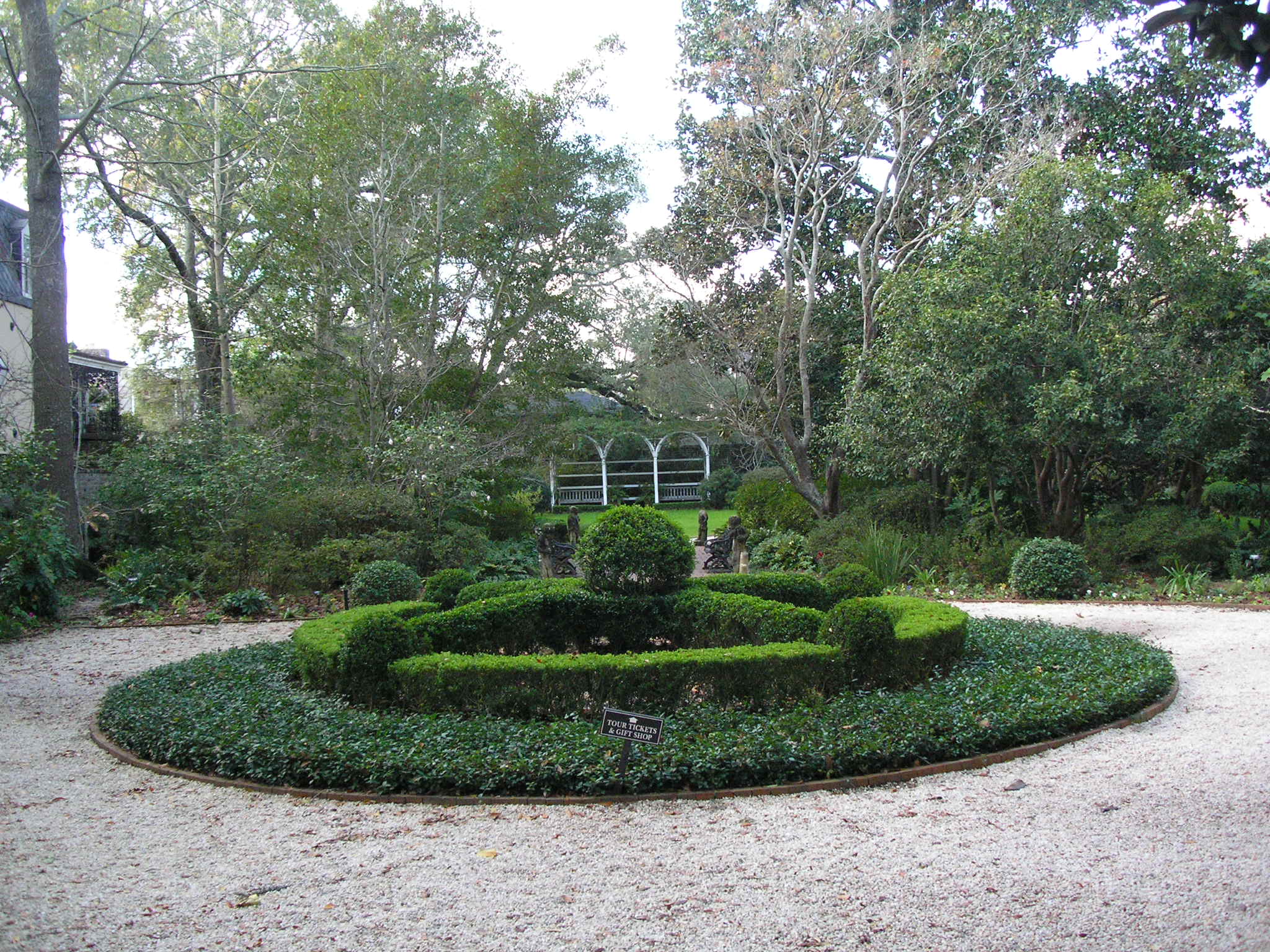
Step inside and the geometry intensifies. Each of the three main floors holds three rooms, each a different shape: rectangular in front, oval in the center, square in the rear. The neoclassical style demanded this kind of spatial variety, rooms that surprise and delight as you move through them. Elaborate plaster decoration covers the ceilings in intricate patterns. The curved entry doors are faux-grained, painted to resemble flame-grained mahogany on the outside and tortoise shell on the inside. Curved mullioned mirrors on one wall balance the windows opposite, bouncing light deeper into the interior. The effect is theatrical, a house designed to perform for its guests. Outside, a formal English garden with gravel paths and boxwood hedges completes the composition. Behind the main house stands the two-story slave quarters where as many as eighteen enslaved people lived and worked, maintaining the household that made this elegance possible.
The Price of Elegance
Nathaniel Russell's wealth did not materialize from thin air. He arrived from Bristol, Rhode Island, a port city deeply embedded in the transatlantic slave trade, and he carried that business to Charleston. His merchant operations included the trafficking of enslaved Africans. The eighteen people held in bondage at 51 Meeting Street cooked in the kitchen, laundered the linens, tended the gardens, cleaned the rooms with their curved doors and geometric ceilings. The beauty of the house existed because of their labor, and the fortune that built it was accumulated through the sale of human beings. When Russell completed construction in 1808 at the age of seventy, he had created an architectural jewel. The people who made it function had no choice in the matter.
Owners, Nuns, and Near Demolition
After Russell's death, the house passed to his daughter Sarah Russell Dehon, who lived there until 1857. Her children sold it to Robert Allston, a rice planter who occupied it while serving as governor of South Carolina. In 1870, Allston's executors sold the property to the Sisters of Our Lady of Mercy, who ran a boarding school in its rooms for thirty-five years. The Mullally and Pelzer families converted it back to a private residence in 1905. By 1953, the owners put the house on the market. When no buyer appeared after two years, they proposed subdividing the property. Historic Charleston Foundation, barely eight years old at the time, raised sixty-five thousand dollars to purchase the house and grounds intact, then opened it to the public. A multi-year restoration beginning in 1995 returned the architectural details and interior finishes to their 1808 appearance.
Saved Twice
The house nearly changed hands again in December 2023 when the Historic Charleston Foundation board voted to sell it and use the proceeds for other preservation priorities. The announcement triggered fierce backlash from donors, preservationists, and the broader community who saw the Nathaniel Russell House as irreplaceable. Within weeks, the board reversed its decision in January 2024, voting to retain the museum. The episode underscored something about Charleston's relationship with its architecture: these buildings are not just assets on a balance sheet. They are physical evidence of the city's complex past, places where wealth and exploitation, artistry and suffering, coexist in the same rooms. The Nathaniel Russell House was designated a National Historic Landmark in 1973, and it remains one of the finest examples of Federal-period architecture in the United States.
From the Air
Located at 32.77°N, 79.93°W on Meeting Street in downtown Charleston's historic district. The house sits on the peninsula between the Ashley and Cooper Rivers. From the air, the historic district's dense grid of 18th- and 19th-century buildings is visible south of Calhoun Street. Charleston Executive Airport (KJZI) is approximately 7nm west; Charleston AFB/International (KCHS) is about 10nm north-northwest. The Ravenel Bridge crossing the Cooper River is a prominent visual landmark nearby. Best viewed at lower altitudes where the formal garden and roof geometry are distinguishable against the surrounding roofline.