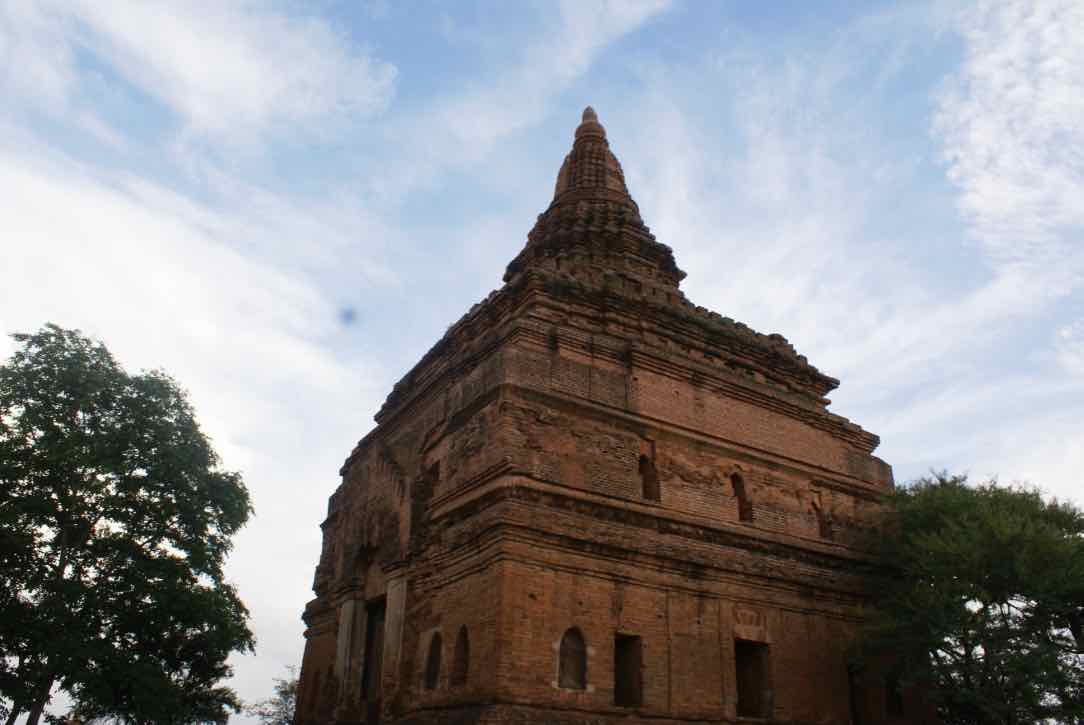
Nathlaung Kyaung Temple
According to legend, the builders had a plan for the local spirits. The nats, Myanmar's indigenous supernatural beings, were to be gathered up and locked inside the temple so that Buddhism could flourish in Bagan without their interference. The temple's very name, Nathlaung Kyaung, translates roughly to "the shrine that confines the spirits." It is a remarkable origin story for a building that is itself a Hindu temple dedicated to Vishnu, standing inside the ancient city walls of Bagan in a landscape of Buddhist pagodas. One religion's house of worship, built to imprison another tradition's spirits, so that a third faith could take root. The Nathlaung Kyaung has always been a place where neat religious categories break down.
Before the Buddhist Kings
Dating the Nathlaung Kyaung is a matter of scholarly debate. It may have been built during the reign of King Anawrahta in the eleventh century, the same monarch who conquered Thaton and brought Buddhism to the forefront of Bagan's religious life. But some evidence suggests an earlier origin, possibly the tenth century, during the reign of King Nyaung-u Sawrahan, also known as Taungthugyi. If the earlier dating is correct, the temple predates the Buddhist transformation of Bagan entirely. It would have served Hindu merchants and Brahmins who had settled in the city and were employed in the service of the Burmese kings, part of a community whose presence is confirmed by Tamil inscriptions found at nearby Myekapa recording donations of pavilions, lamps, and metal objects by South Indian donors.
Vishnu's Many Forms
The temple was built in a square layout with steep-rising terraces, a design that became a hallmark of early Bagan architecture and is thought to have influenced later Buddhist structures in the region. Indian artisans likely had a hand in its construction. Today, much of the original structure has been lost to time and earthquakes. The outer mandapa and entrance are gone, leaving only the central hall and upper superstructure. But in the surviving niches and porches, statues depicting the avatars of Vishnu remain: Matsya the fish, Kurma the tortoise, Varaha the boar, Narasimha the man-lion. Each incarnation represents a moment when Vishnu descended into the world in a different form to save humanity from crisis. Originally ten Vishnu idols stood in the temple. Seven remain in place; three were removed over the centuries, one of which made its way to the Dahlem Museum in Berlin.
The Cosmic Dream in Stone
Inside the inner sanctum, a corridor leads to the central hall, where arched niches once held an elaborate sculptural program. A seated figure of Shiva in padmasana occupies one niche. Standing images of Vishnu hold a conch shell, a mace, and other iconographic symbols. A partially preserved sculpture shows Vishnu mounted on the great bird Garuda. But the most significant carving is the most damaged. It once depicted the cosmic creation myth: Vishnu reclining on the serpent Shesha, floating on the ocean of eternity, a lotus emerging from his navel to give birth to Brahma. Only the serpent's curled tail survives. What remains, though, hints at what was once a full representation of the Trimurti, the Hindu trinity of Vishnu, Shiva, and Brahma, all present in a single chamber within the walls of what would become one of the most important Buddhist cities in Asia.
Where Faiths Borrowed Freely
The Nathlaung Kyaung is not simply an anomaly in a Buddhist landscape. It is evidence of how deeply Hindu traditions penetrated the culture of the Pagan Empire, even as Buddhism became the dominant religion. The rituals associated with Vishnu worship, coronation rites involving offerings of sugarcane, peacock feathers, sedges, and lamps, were adopted by the Buddhist kings of Bagan for royal ceremonies including the Thingyan water festival and royal anointings. The boundary between Hindu and Buddhist practice at Bagan was porous, with kings who proclaimed Buddhist devotion drawing freely on Brahmanical ritual for their most important state occasions. Add the indigenous nat spirits into the mix, and medieval Bagan emerges as a place of extraordinary religious complexity.
The Last Hindu Temple Standing
Of the Hindu temples that once stood in the Bagan region, only the Nathlaung Kyaung survives within the old city walls. Its isolation makes it both a monument and a question. How many similar temples once existed? The Tamil inscription at Myekapa confirms that the Vishnu sect had an active presence across the region. But the other Brahmanical temples are gone, absorbed back into the earth or dismantled for materials as Buddhism consolidated its hold on the landscape. The Nathlaung Kyaung endures, battered by earthquakes, stripped of its entrance and much of its sculpture, but still standing among the Buddhist pagodas that surrounded and eventually eclipsed it. It is the last physical evidence of a religious community that helped shape Bagan's early centuries before history moved on without them.
From the Air
Located at 21.169N, 94.863E within the ancient walled city of Bagan in central Myanmar. The temple sits west of the towering Thatbyinnyu Temple, the tallest structure in Bagan, and near the Ananda Temple, making it part of the densest cluster of monuments in the archaeological zone. Bagan Nyaung-U Airport (VYBG) is approximately 4 km to the northeast. From the air at 3,000-5,000 ft, the walled city is distinguishable within the broader plain of over 2,000 temples along the Irrawaddy River's east bank. Best visibility during the dry season (November-March).