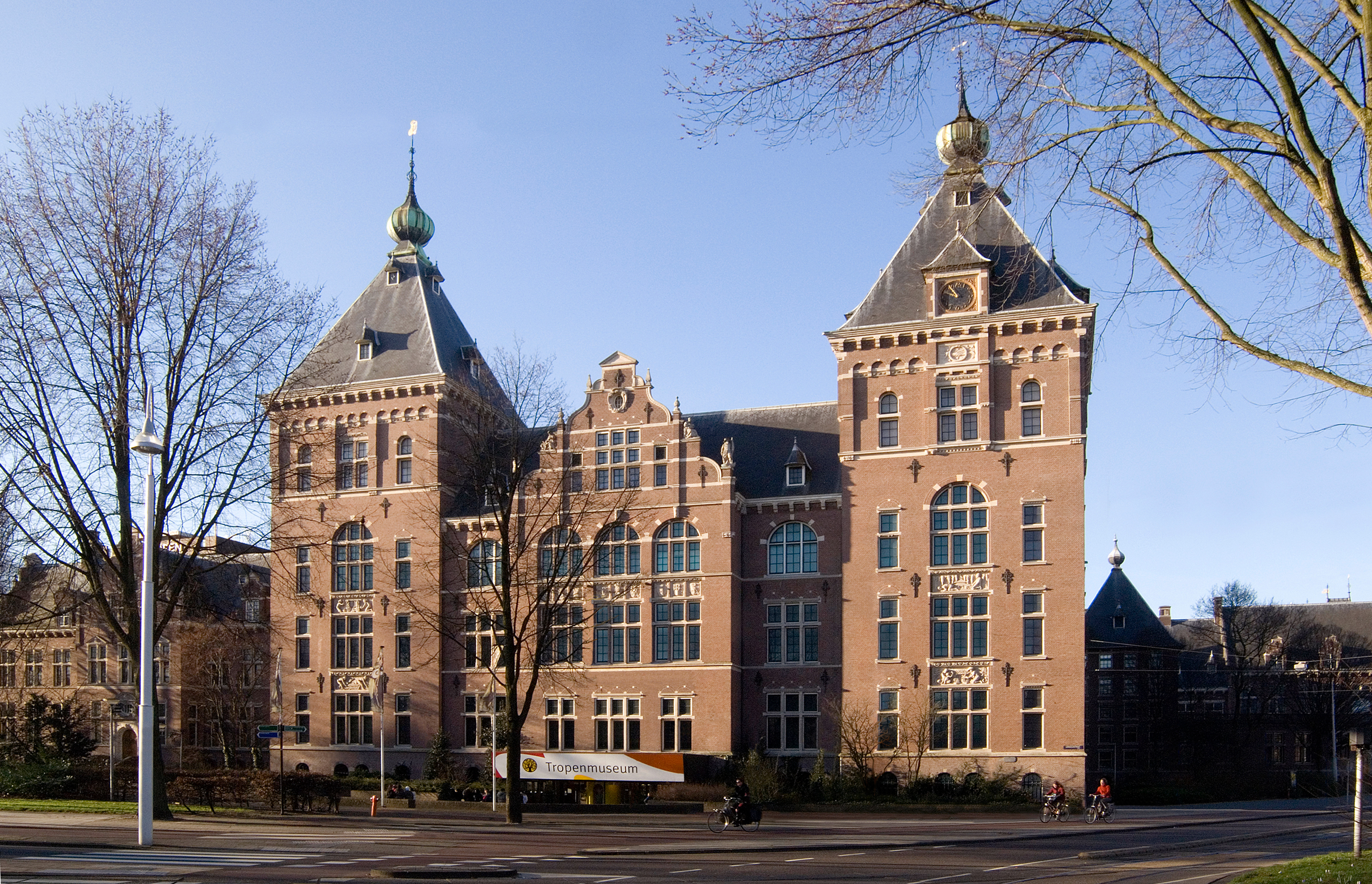
Nationaal Museum van Wereldculturen
Forty percent of the Dutch national ethnographic collection - somewhere around 180,000 objects - was acquired in colonial contexts. Some were bought, some were traded, some were taken at gunpoint during military expeditions that the army called pacification campaigns and the people on the receiving end called invasions. They sit now in four museums spread across the Netherlands, federated since 2014 under one administration called the Nationaal Museum van Wereldculturen, the National Museum of World Cultures. The collection's question is not what it once was - which is to say, what does Dutch culture have to show for its empire. The question now is how much of it should still be here at all.
Four Museums, One Name
The federation pulled together institutions that had grown up separately. The Tropenmuseum in Amsterdam started life in 1864 as the colonial museum at Haarlem, then moved into a vast purpose-built palace in the capital, all tropical hardwoods and stained glass and ethnographic dioramas. The Museum Volkenkunde in Leiden began earlier still - in 1837, in the same university town that nurtured the natural history and geology museums - and its specialty became Japan, the East Indies, and the Pacific. The Afrika Museum in Berg en Dal grew from a missionary collection and sits in a wooded park in Gelderland. The Wereldmuseum in Rotterdam owns its own collections - municipal rather than national - but works under the same federation umbrella. Together they hold roughly 450,000 objects and 260,000 photographic images, plus another 350,000 images of documentary value.
The Colonial Inheritance
The Dutch empire was smaller than the British and shorter-lived than the Portuguese, but it was efficient. The Dutch East India Company - the VOC, founded in 1602 - was the first multinational corporation, the first to issue stock, and for most of the seventeenth and eighteenth centuries it ran what is now Indonesia as a private operation. After the VOC went bankrupt in 1799 the Dutch state took over its colonies directly and ran them for another century and a half. The Dutch West India Company did the same work in the Atlantic, governing Suriname and the Caribbean islands. Objects flowed home to the Netherlands the entire time - some bought from traders, some donated by retired colonial officials, some confiscated as war booty during military expeditions like the Lombok intervention of 1894 or the campaigns in Aceh. The collections in the four museums became a kind of physical archive of the empire.
A Reckoning Begins
European museums spent the late twentieth century mostly avoiding the question of what to do with looted material. France's 2017 announcement that it would begin returning objects to West African nations changed the climate. The Netherlands followed close behind. The NMVW began work on its repatriation guidance in 2017. In March 2019 it published Return of Cultural Objects: Principles and Process - a document that committed the federation to transparently evaluate claims for the return of cultural objects according to standards of respect, cooperation, and timeliness. Director Stijn Schoonderwoerd described the work bluntly: it led us to question our colonial history, and we saw that we had the potential to ask a lot of questions about identity, control, power, inequality, and decolonization. Some returns had happened over previous decades, but they had been handled ad hoc, case by case, often only when a foreign government applied formal pressure. The 2019 framework changed the default position. The federation would now actively look at provenance.
Indonesia First
The repatriation work focuses first on Indonesia, the largest single source of colonial-era acquisitions. Dutch military expeditions to Sumatra, Sulawesi, Bali, Lombok, and beyond produced thousands of objects that ended up in Leiden, Amsterdam, and Rotterdam - regalia from local princely courts, religious objects from temples, weapons taken from defeated forces. Some of these objects are sacred in their countries of origin. Some are dynastic. Some are simply household items that document a vanished daily life. In 2023 the Dutch government formally returned 478 objects to Indonesia and Sri Lanka, including a hoard of jewels and weapons from Lombok and Hindu-Buddhist statues from Singhasari. More returns have followed. The Wereldmuseum group has, in the words of one repatriation researcher, become a working laboratory for what twenty-first-century European museum practice should look like.
What Stays, What Goes
Repatriation is not an emptying of museums. Most objects in the collection are not being claimed - either because their origins were uncontested or because the countries that might claim them have not done so. The four museums continue to mount exhibitions, conduct research, and welcome visitors. What has changed is the tone of the labels. A nineteenth-century mask is no longer just an artifact of native craftsmanship. It is a mask that arrived in Amsterdam through specific people on specific dates, often during military operations whose names appear on the wall card alongside the artist's. The collections still tell the story of cultures from every continent - that was always the point of an ethnographic museum. But they now also tell, more honestly, the story of how those cultures came to be represented by objects in display cases in the Netherlands. Both stories can be true at once. That is the project the federation is working on.
From the Air
The Nationaal Museum van Wereldculturen is a federation rather than a single building. The Museum Volkenkunde in Leiden sits at 52.163°N, 4.482°E, near the railway station and roughly 12 km north of The Hague. The Tropenmuseum in Amsterdam (52.362°N, 4.923°E) is in the Plantage district next to the Artis Zoo. The Afrika Museum lies in the wooded hills of Berg en Dal near Nijmegen (51.811°N, 5.879°E). All four cities are visible from 1,500-3,000 ft on Schiphol (EHAM) approaches; the Afrika Museum is closer to Düsseldorf (EDDL) and the Maas-Waal corridor.