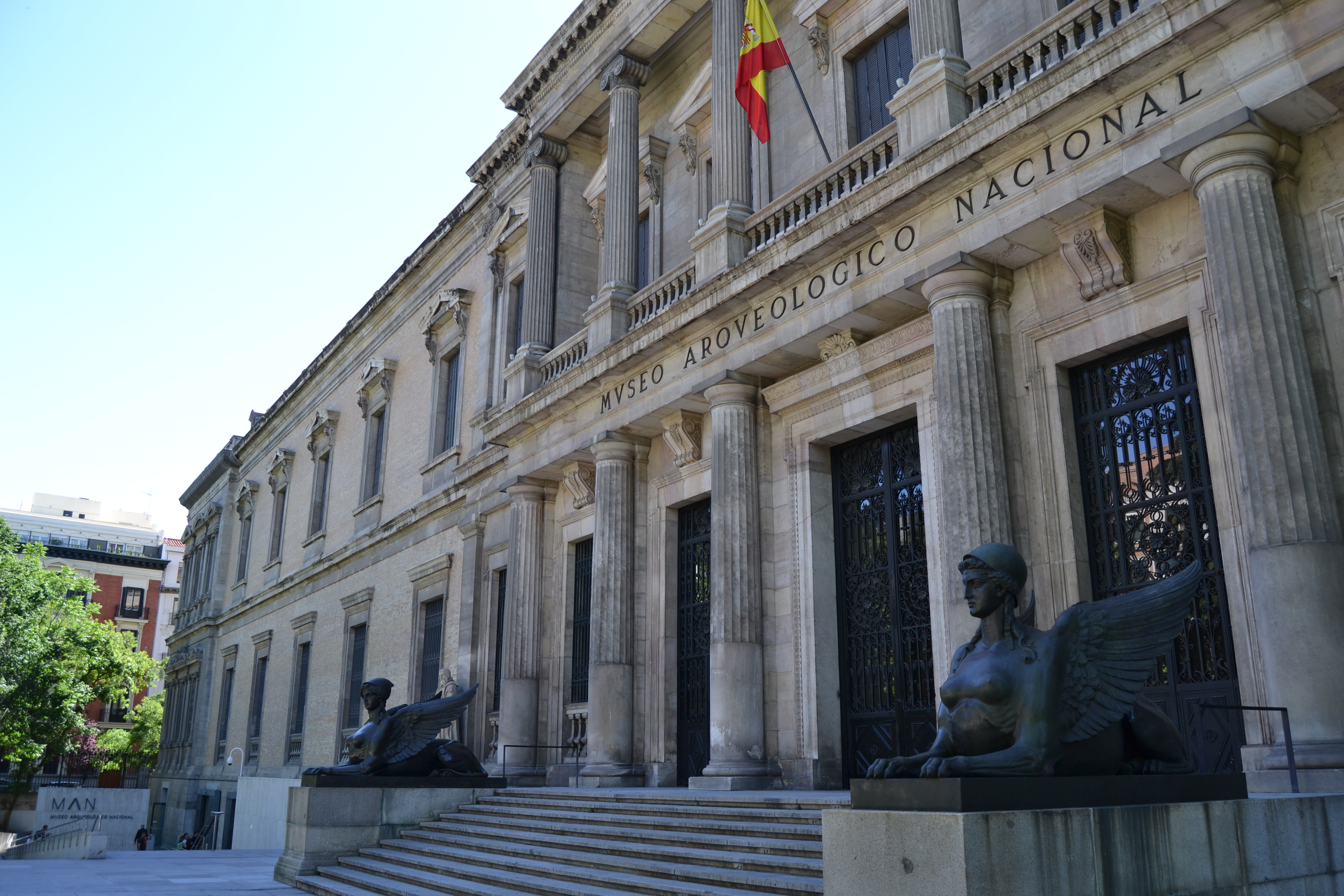
National Archaeological Museum of Spain
She has been staring out of the same stone face for over 2,400 years. The Lady of Elche, a painted limestone bust discovered in southeastern Spain in 1897, is the most famous object in the National Archaeological Museum of Madrid, and one of the most recognizable images from the ancient Iberian Peninsula. Her elaborate headdress, wide disc-shaped ear coverings, and serene expression have made her an icon of pre-Roman Spain. She shares the museum with Visigothic gold crowns, Roman mosaics, Egyptian mummies, and a full-scale replica of the Altamira cave paintings, all housed in a neoclassical building beside the Plaza de Colon that the museum has occupied since 1895.
A Queen's Decree
The museum was founded in 1867 by a Royal Decree of Queen Isabella II, created as a repository for the numismatic, archaeological, ethnographic, and decorative art collections accumulated by the Spanish monarchy over centuries. The idea was not new; the Royal Academy of History had proposed a museum of antiquities as early as 1830, but the plan never materialized. Isabella's decree gave the scattered royal collections a permanent home, initially in the Embajadores district. In 1895, the museum moved to a purpose-built neoclassical structure designed by architect Francisco Jareno, sharing the building with the National Library of Spain. The pairing seems odd until you remember that both institutions exist to house what a nation considers worth remembering.
The Ladies of Iberia
The museum's collection of Iberian sculpture from southern and southeastern Spain is unmatched anywhere in the world. Beyond the Lady of Elche, visitors encounter the Lady of Baza, a limestone figure seated on a throne with wings, discovered in a burial site in Granada in 1971. The Lady of Galera is a tiny alabaster goddess from the 7th century BC. The Bicha of Balazote, a stone bull with a human head, and the Sphinx of Agost add mythological strangeness to the collection. These are not Greek or Roman sculptures; they belong to the pre-Roman peoples of the Iberian Peninsula, cultures that developed their own artistic traditions before Mediterranean colonization transformed them. The reconstructed Mausoleum of Pozo Moro, a 6th-century-BC tower tomb decorated with relief carvings, occupies its own space as a monument to a civilization most visitors have never heard of.
Gold Crowns and Painted Caves
In the forecourt, visitors can step inside a 1960s replica of the Cave of Altamira, its famous ceiling paintings reproduced using photogrammetry. The replica gives a sense of the cramped, powerful intimacy of the original cave in Cantabria. Upstairs, the Late Antiquity halls display the Treasure of Guarrazar, a hoard of Visigothic votive gold crowns found near Toledo in the 19th century. The crown of King Recceswinth, studded with sapphires and pearls, hangs suspended in its case like a chandelier made for prayer. Nearby, the Pyxis of Zamora, an intricately carved ivory cylinder from Al-Andalus, and one of the famous Alhambra vases represent the Islamic artistic traditions that flourished on the peninsula for nearly eight centuries.
Beyond Iberia
Though the museum's core collection focuses on the Iberian Peninsula from prehistory through the early modern period, significant collections from other civilizations fill the upper floors. Egyptian and Nubian funerary objects, many acquired from the collection of Spanish Egyptologist Eduardo Toda y Guell, include amulets, mummies, steles, and ushabti figurines. A crocodile mummy, carefully wrapped, reminds visitors that Egyptian reverence for the sacred extended to the animal world. The Greek collection spans from the Mycenaean period to the Hellenistic age, with an archaic hoplite armor set, a crater depicting the madness of Heracles, and pottery from across Magna Graecia and Sicily. A diorite head from Mesopotamia, donated by the Mexican collector Marius de Zayas to the Prado Museum in the 1940s, eventually found its way here as well.
Renovated and Reopened
The museum closed for a comprehensive renovation in 2008 and reopened in April 2014, with modernized galleries that organize the collection chronologically from basement-level prehistory upward through the centuries. The renovation addressed decades of overcrowding and outdated displays, giving landmark objects the space and lighting they deserved. In the 1940s, the museum's American ethnography collection was transferred to the Museum of the Americas, while other international pieces went to the National Museum of Ethnography and the National Museum of Decorative Arts. What remains is sharply focused: the story of the peoples who lived on the Iberian Peninsula, told through the objects they made, wore, worshipped, and buried with their dead.
From the Air
Located at 40.4236N, 3.6894W on Calle de Serrano beside the Plaza de Colon in central Madrid, sharing its neoclassical building with the National Library. The building's columned facade faces the landscaped plaza with its large Spanish flag. Nearest airport: Madrid-Barajas Adolfo Suarez (LEMD), approximately 12 km northeast. Recommended viewing altitude: 2,000-3,000 feet AGL.