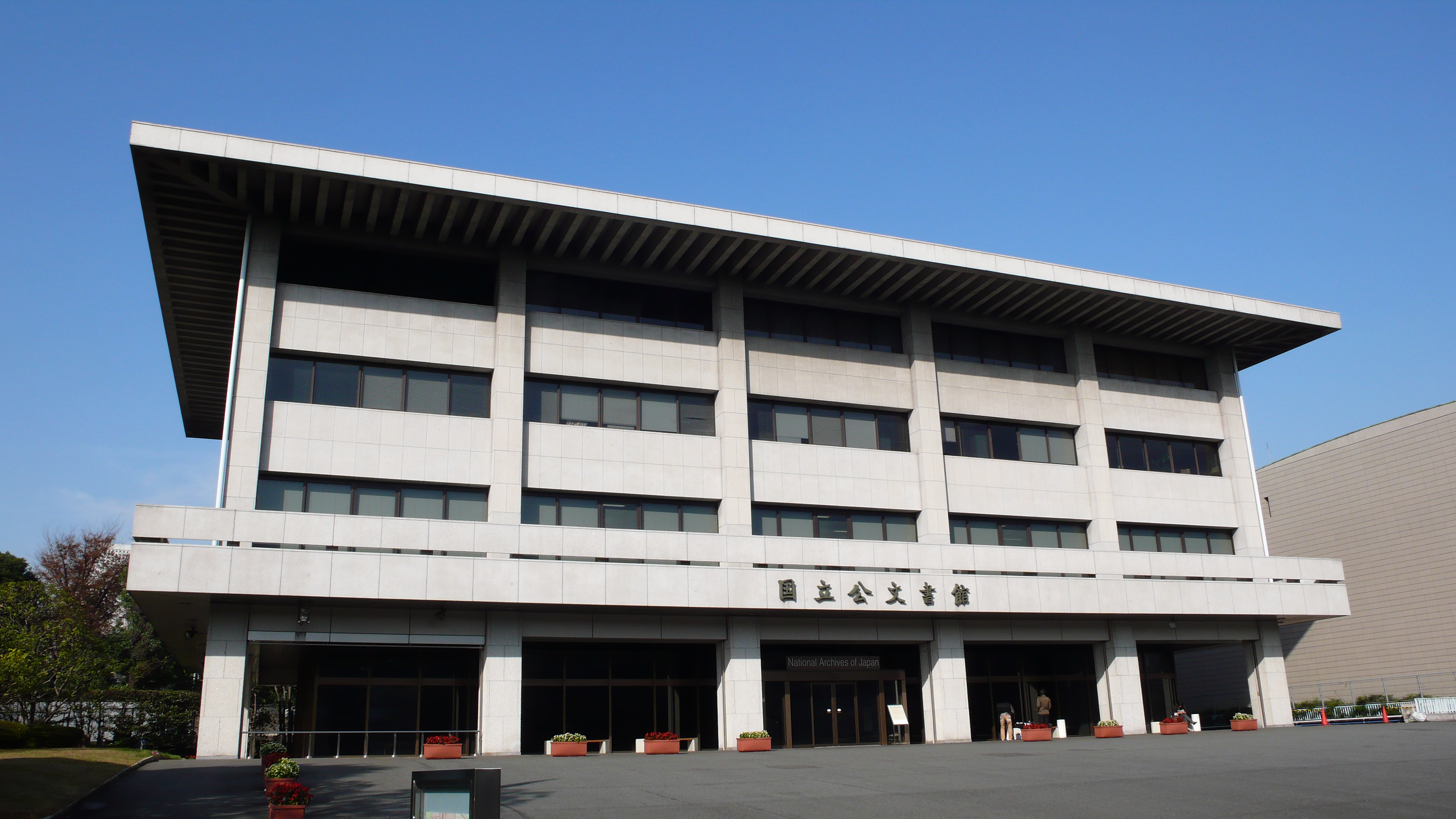
National Archives of Japan
Japan reveres its history. Its temples, scrolls, and sword-making traditions survive across centuries through meticulous care. Yet for most of the modern era, the country had almost no tradition of archiving government documents. Internal policy memos, committee proceedings, the bureaucratic paper trail that reveals how decisions actually get made -- these records were scattered across individual ministries or simply discarded. The National Archives of Japan, housed in a quiet building at the edge of Kitanomaru Park in Chiyoda-ku, was created to fill that gap. Established under the National Archives Law No. 79 of 1999, it preserves the paper memory of a nation that has always valued the past but only recently learned to organize it.
The Cabinet Library's Long Shadow
The roots of the archives reach back to 1873, when a library was established for the cabinet of the early Meiji government. In 1885, this became the Cabinet Library -- the Naikaku Bunko -- which grew into the nation's foremost collection of ancient Japanese and Chinese classical books and materials. The Cabinet Library's holdings included government records from the Edo period and the Tokugawa shogunate, spanning from 1603 to 1867. These documents form the historical bedrock of what the archives hold today: edicts, administrative records, and official communications from more than two and a half centuries of shogunal rule. But for most of the twentieth century, there was no centralized system to gather and preserve the government documents being produced by the modern Japanese state. Each ministry kept its own records, on its own terms, with its own standards for what to save and what to discard.
Building a Memory
The National Archives Law changed that. Under its framework, the archives are tasked with preserving all government documents and records deemed important as historical materials. This includes everything related to major policy decisions -- not just the final rulings, but the deliberation and consultation that preceded them, and the enforcement processes that followed. The Prime Minister oversees an annual Transfer Plan that governs when historically significant materials move from active ministries into the archives' permanent care. Preservation, restoration, cataloging, microfilming, and digitization all fall within the institution's mandate. The archives sit at the intersection of scholarship, politics, cultural practice, and technology, serving not merely as a warehouse for old paper but as an active participant in how Japan defines its institutional memory.
Scrolls on Screens
Since April 2005, the archives' Digital Gallery has made high-resolution images of its holdings available online. Visitors can browse digitized scrolls, maps, photographs, drawings, posters, and official documents, including materials designated as Important Cultural Properties of Japan. The website operates in both English and Japanese, though the holdings themselves are predominantly in Japanese. Among the more striking items available digitally are photographs from 1924 showing the stack room for official documents in Shiga Prefecture -- images appended to a prefectural governor's report to the chief of the cabinet secretariat, documenting early efforts to modernize how records were compiled and stored. It is a photograph of bureaucracy photographing itself, a moment of a nation learning to remember deliberately.
A Quiet Park, a Loud Mission
The archives building sits at 3-2 Kitanomaru Koen, a five-minute walk from Takebashi Station on the Tozai Subway Line. Kitanomaru Park, once part of the northern enclosure of Edo Castle, is one of central Tokyo's green sanctuaries -- home also to the Nippon Budokan and the Science Museum. The location is fitting. The archives preserve the administrative DNA of the same government that once ruled from the castle grounds next door. For a country that maintained one of the world's most sophisticated bureaucracies for centuries under the Tokugawa shoguns, the creation of a formal national archive in 1999 came remarkably late. But the collection it guards -- from shogunal edicts to postwar policy debates -- ensures that the processes behind Japan's governance are no longer left to the filing habits of individual ministries.
From the Air
Located at 35.690N, 139.754E in Kitanomaru Park, Chiyoda-ku, central Tokyo, immediately adjacent to the Imperial Palace grounds. From the air, the park is identifiable as a green rectangle north of the distinctive moat system surrounding the Imperial Palace. Nearest airports: Tokyo Haneda International (RJTT) approximately 10nm south, Chofu Airport (RJTF) approximately 14nm west. Narita International (RJAA) lies approximately 35nm east. Heavy airspace restrictions apply over central Tokyo and the Imperial Palace area. The nearby moats and stone walls of the former Edo Castle provide unmistakable visual reference points from altitude.