National Art Gallery of the Bahamas
Some wanted to tear Villa Doyle down. Built in the 1860s for Sir William Henry Doyle, one of the first Chief Justices of the Bahamas, the colonial mansion at the corner of West and West Hill Streets had been left to rot for decades. By the time the question of its future arose, the building had become a burden: crumbling, expensive to maintain, and - to some Bahamians - a symbol of the colonial era best forgotten. Demolition seemed efficient. Historian Dr. Gail Saunders disagreed. She saw in Villa Doyle not a monument to colonialism but a vessel for something the newly independent Bahamas desperately needed: a place to collect, preserve, and display its own artistic identity. Her argument won. Seven years of painstaking restoration followed, and in 2003 the National Art Gallery of the Bahamas opened its doors in the same building that had nearly become rubble. The colony's judge house had become the nation's gallery.
Saving the Walls
The restoration of Villa Doyle was neither quick nor simple. Architect Anthony Jervis, civil engineer George Cox, and committee chair Dr. Saunders led the effort, with consultation from art historian Dr. Petrine Archer-Straw. Work stretched through the entire decade of the 1990s, converting residential rooms into gallery spaces while preserving the building's architectural character. That character is worth preserving. Villa Doyle blends neoclassical elements - decorative columns, formal proportions - with distinctly Bahamian features: wraparound verandahs that catch the breeze off Nassau Harbour, louvered shutters that filter the Caribbean light. The mansion sits at a geographic and cultural seam, where Downtown Nassau to the north meets the residential neighborhood of Over-the-Hill to the south. The gallery's location bridges the two communities, a deliberate choice that reflects its mission to serve all Bahamians, not just the downtown elite.
The Collection Takes Shape
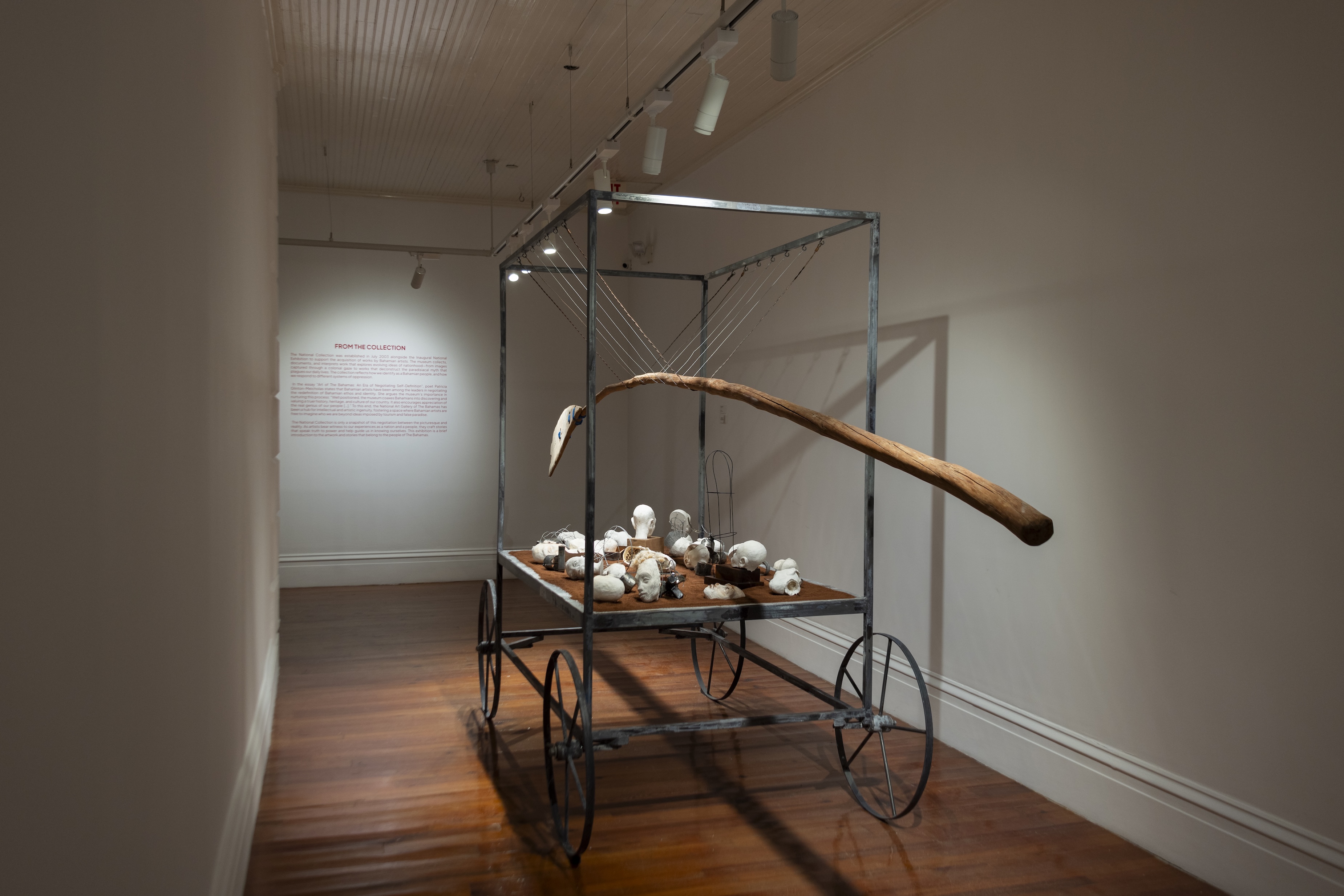
Prime Minister Hubert Ingraham announced the gallery's creation in 1996, and founding director Dr. Erica James set about building a permanent collection from scratch. Today the NAGB holds over 500 works spanning two centuries of Bahamian art, from the 1800s to the present. The range is striking: Amos Ferguson's intuitive paintings sit alongside Blue Curry's conceptual installations. Kendal Hanna's abstract compositions share space with Lavar Munroe's mixed-media explorations. John Beadle, Lillian Blades, Stanley Burnside, Kendra Frorup, Anina Major, R. Brent Malone, Maxwell Taylor, Antonius Roberts - the collection reads like a roll call of Bahamian creative life.
Photography, painting, sculpture, digital media: the NAGB refuses to privilege one form over another. The biennial National Exhibition, launched alongside the gallery's opening in 2003, has become the country's most important juried art event, with 13 works acquired from that first show alone. For a nation of 400,000 people spread across 700 islands, having a single institution that says this is who we are artistically carries enormous weight.
Beyond the Gallery Walls
The NAGB's most ambitious program may be its most logistically challenging. The Inter-Island Travelling Exhibition carries selections from the permanent collection to the Family Islands - the smaller, more remote communities scattered across the Bahamian archipelago. In a country where many islands lack even a library, bringing original art to Exuma or Eleuthera or the Abacos turns the gallery into a mobile institution rather than a static one.
Back in Nassau, the campus has grown beyond the gallery walls. An Art Park surrounds the building, and Fiona's Theatre - an open-air amphitheatre - hosts performances that draw audiences from both Downtown and Over-the-Hill. Free Sundays open the doors to anyone, removing the admission barrier that might keep local families away. The Double Dutch exhibition series, created during chief curator Holly Bynoe's tenure, expanded the gallery's reach into regional and cross-cultural collaboration, connecting Bahamian artists with counterparts across the Caribbean.
A Building Still Becoming
The NAGB operates as a quasi-governmental nonprofit, partially funded by the Bahamian government but independently overseen by a board of directors. This hybrid structure reflects the institution's balancing act: national in scope, independent in vision. Amanda Coulson, appointed executive director in 2011, served nearly a decade as the gallery's longest-tenured leader, professionalizing operations and expanding community engagement. After her departure in 2021, the institution continued evolving, with Maelynn Ford appointed executive director in January 2025.
Villa Doyle's four gallery spaces - the Permanent Exhibition Gallery and Project Space on the ground floor, two temporary exhibition halls upstairs - hold more art per square foot than the building's original architect could have imagined. The colonial mansion that once served a British judge now serves a sovereign nation's sense of itself. Dr. Saunders's bet paid off: the building that some wanted demolished has become irreplaceable, a place where Bahamians can see their own creativity reflected back at them in the rooms where colonial power once resided.
From the Air
Located at 25.08°N, 77.35°W in Downtown Nassau, New Providence island. The NAGB occupies Villa Doyle at the corner of West and West Hill Streets, near the junction of Downtown Nassau and the Over-the-Hill neighborhood. The colonial mansion is difficult to spot individually from altitude, but lies within the dense urban core visible on approach to Lynden Pindling International Airport (MYNN/NAS), approximately 10 nautical miles west. Government House on Mount Fitzwilliam is a nearby landmark. Paradise Island and the cruise ship terminals at Prince George Wharf provide strong visual references. Expect tropical conditions with warm temperatures year-round.