National Art Schools (Cuba)
It started with a drink after a round of golf. In January 1961, Fidel Castro and Che Guevara stood on the grounds of Havana's formerly exclusive Country Club Park and contemplated what to do with a country club whose members had all fled the country. Guevara proposed something audacious: a complex of tuition-free art schools for talented young people from across the Third World, buildings so experimental and conceptually advanced they would embody the "new culture" for the "new man." Three architects -- Ricardo Porro, Roberto Gottardi, and Vittorio Garatti -- designed five schools of astonishing organic beauty from locally produced brick and terracotta, using Catalan vaults because the US embargo made importing steel rebar and Portland cement prohibitively expensive. Castro praised the plans, declaring them "the most beautiful academy of arts in the whole world." By 1965, the revolution had turned against its own creation.
Architecture Against the Embargo
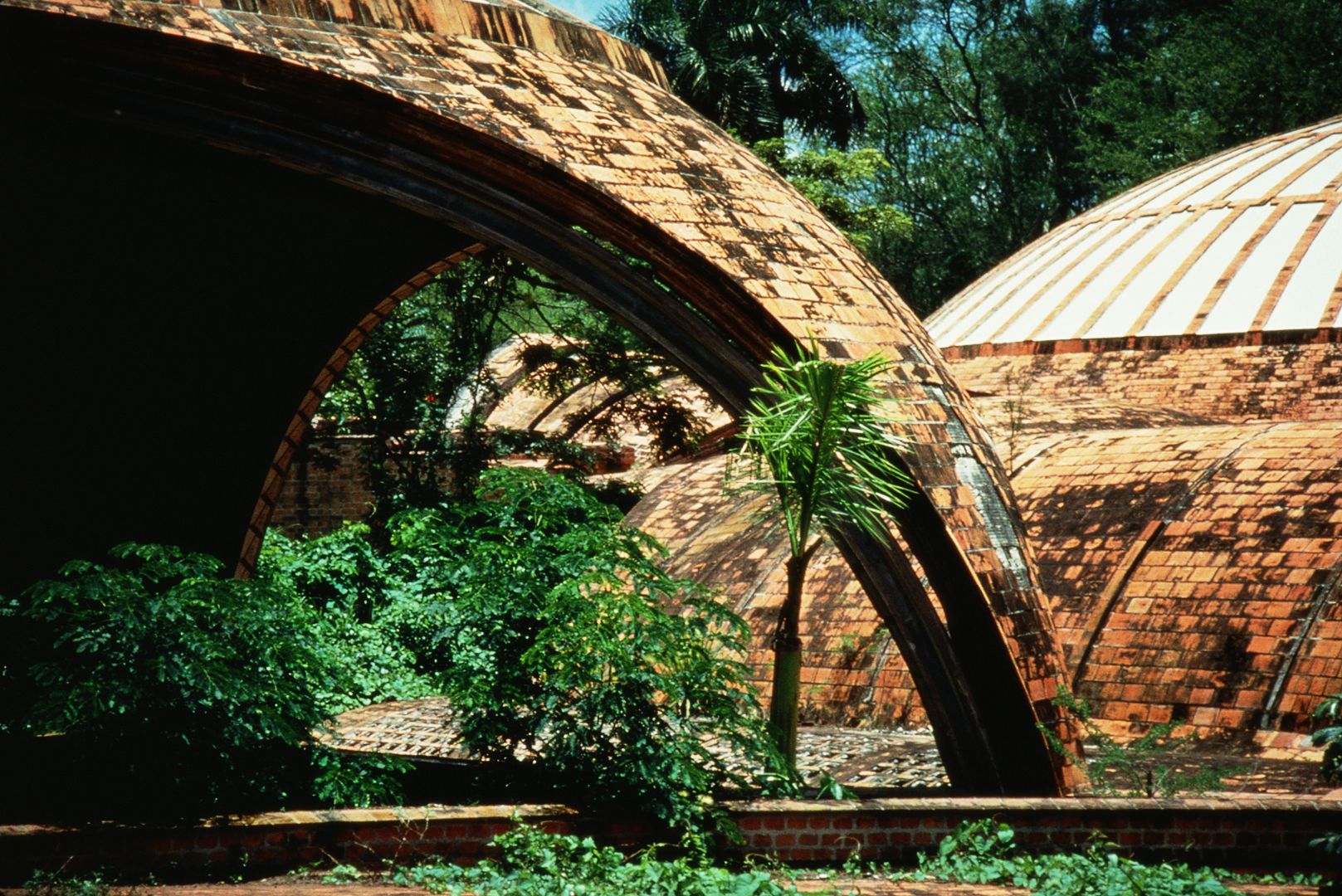
The three architects set up their studio on the abandoned golf course and established three guiding principles. First, the architecture would integrate with the unusual landscape -- the rolling greens, the ravines, the river. Second and third, they would work within the material constraints imposed by the US embargo: locally produced brick and terracotta tile instead of imported steel and cement, and Catalan vaults -- a centuries-old construction technique with the potential for organic, flowing forms -- as their structural system. The result was five schools, each radically different. The School of Modern Dance, designed by Porro, was conceived as a sheet of glass violently smashed into shifting shards, symbolizing the revolution's overthrow of the old order. The School of Plastic Arts, also by Porro, evoked an archetypal African village, its oval studios organized along curving colonnaded paths. Gottardi's School of Dramatic Arts was a compact, fortress-like complex organized around a central amphitheater. The schools rejected the International Style that dominated global architecture, seeking instead something rooted in Cuban, African, and Latin American identity.
A Serpent and a Ravine
Vittorio Garatti's two schools were the most extraordinary. The School of Music uncoils as a serpentine ribbon 330 meters long, embedded in and traversing the landscape's contours as it approaches the river. The path submerges below ground, rises through layered Catalan vaults, and presents an ever-changing contrast of dark subterranean passages and brilliant tropical light. The roofs step and terrace into planters for flowers, blurring the boundary between building and earth. The School of Ballet descends into a shady ravine, a cluster of terra cotta domes connected by organic vaulted pathways. Five different entrances lead into the complex. The most dramatic begins at the top of the ravine, where cupolas emerge floating over lush growth, and the path descends into a winding subterranean passage linking dance pavilions, classrooms, a library, and a Pantheon-like performance theater. The essence of the design lives not in its plan but in the choreographed spatial experience of moving through its volumes.
The Revolution Turns on Itself
The Cuban Missile Crisis of 1962 changed everything. Production and defense became the national priorities. The government declared the art schools extravagant and out of scale with reality. Ministry of Construction bureaucrats, who had envied the architects' privileged working conditions, found their moment. As Cuba's political environment shifted from utopian optimism to Soviet-inspired doctrine, the schools became targets of ideological attack. The architects were accused of being "elitists" and "cultural aristocrats" with bourgeois formations. The Catalan vault was denounced as a "primitive" technology representing "backward" capitalist values. The Afro-Cuban imagery of the School of Plastic Arts was attacked for referencing "hypothetical Afro-Cuban origins" supposedly "erased by slavery" -- irrelevant, the critics claimed, to a society advancing toward a culturally uniform socialist future. In October 1965, architect Hugo Consuegra published a courageous defense of the schools in Arquitectura Cuba. It was the last attempt to reconcile the buildings with revolutionary values. It failed.
Swallowed by the Jungle
The Schools of Modern Dance and Plastic Arts continued operating with minimal maintenance. The Schools of Dramatic Arts, Music, and Ballet were simply abandoned. The Ballet School, nestled in its shady ravine, became completely engulfed by tropical jungle. Ricardo Porro was compelled to leave Cuba; Vittorio Garatti followed. Only Roberto Gottardi remained in Havana, quietly advocating for restoration from within. In 1989, the American architect John Loomis met Gottardi at the Havana Biennial of Art and was given a tour of the decaying campus. Moved by what he saw, Loomis spent the next decade researching and writing Revolution of Forms: Cuba's Forgotten Art Schools, published in 1999. The book reunited the three architects for the first time since 1966, generated articles in the New York Times, and caught the attention of Cuban government officials -- one of whom had declared Loomis "an enemy of Cuba, being paid by the CIA."
Monument Rising
International attention transformed the schools' fate. In 2000, they were nominated for the World Monuments Fund Watch List. In 2003, the site was added to UNESCO's World Heritage Tentative List. In November 2010, the Cuban government officially declared the National Art Schools national monuments -- a reversal from decades of neglect and ideological rejection. The schools' story inspired a documentary film, Unfinished Spaces, by Alysa Nahmias and Ben Murray; an art installation series called Utopia Posible by Cuban artist Felipe Dulzaides; and an opera, Revolution of Forms, directed by Robert Wilson. The buildings remain only partially restored, their Catalan vaults still emerging from tropical vegetation in some places. They stand as a testament to what happens when revolutionary ambition meets revolutionary paranoia -- and as proof that great architecture, even when abandoned, can outlast the politics that tried to destroy it.
From the Air
The National Art Schools (23.09N, 82.45W) are located in the Cubanacan suburb of western Havana, on the grounds of a former country club golf course. The complex is spread across a varied landscape of rolling terrain and ravines, with organic brick and terracotta structures that blend into the vegetation. Jose Marti International Airport (MUHA/HAV) is approximately 12km to the southeast. Best viewed from 2,000-3,000 feet, where the serpentine forms of the School of Music and the domed clusters of the School of Ballet are most visible against the green landscape. The partially overgrown structures contrast dramatically with surrounding suburban development. Tropical climate; dry season November-April.