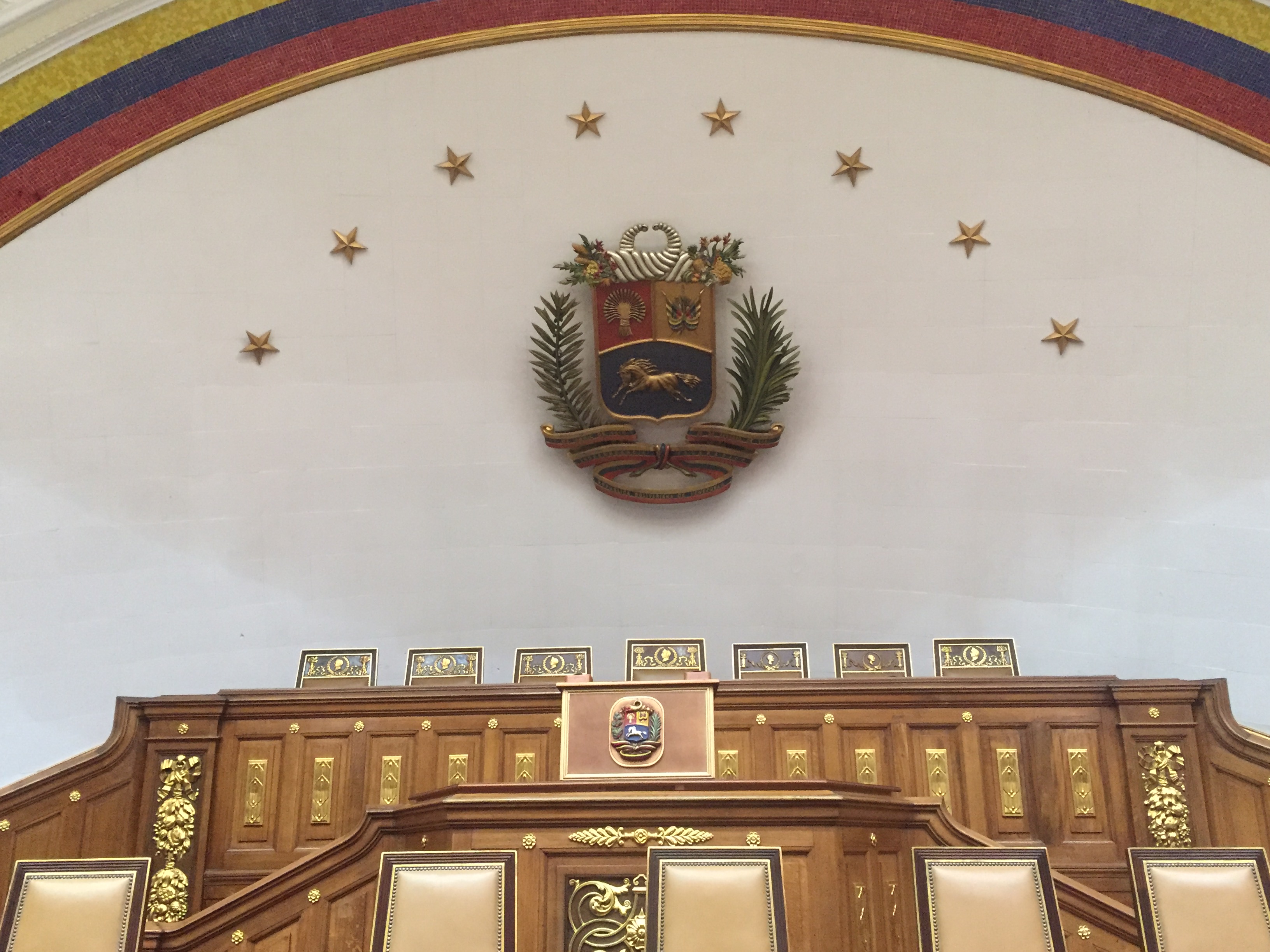
National Assembly of Venezuela
On January 7, 2020, Juan Guaido climbed over police barricades to reach the chamber of Venezuela's National Assembly. Inside, the lights went out. He was sworn in as president of the legislature in the dark, while a rival claimant held his own ceremony elsewhere in the building. The scene -- farcical and desperate in equal measure -- captured something essential about this institution: it has never stopped being contested, and the stakes of controlling it have never been small.
From Two Chambers to One
For nearly four decades under the 1961 Constitution, Venezuela's legislature operated as a bicameral Congress, with a Senate and a Chamber of Deputies. Former presidents received lifetime Senate seats, senators had to be over 30 and Venezuelan-born, and the president of the Senate served as constitutional successor to the president of the republic. That succession mechanism was invoked in 1993, when Senate President Octavio Lepage replaced the impeached Carlos Andres Perez. Hugo Chavez swept into the presidency in December 1998 on a promise to tear this system down, arguing it had become disconnected from ordinary Venezuelans. The Constituent Assembly elections of July 25, 1999, delivered him the mandate: all but six of the 131 seats went to Chavez allies. By December, voters approved a new constitution that replaced the Congress with a single-chamber National Assembly, fundamentally reshaping how legislative power would function.
The Pendulum Swings
The Assembly's early years tracked the consolidation of Chavez's movement. In the first election on July 30, 2000, his Fifth Republic Movement won 92 of the 165 seats. When the opposition boycotted the 2005 vote, the party claimed 114 seats with only 25 percent turnout -- a hollow victory that left the legislature without credible opposition. By 2007, the Fifth Republic Movement and several allied parties merged into the United Socialist Party of Venezuela. Then the pendulum reversed. In December 2015, the opposition coalition Democratic Unity Roundtable won 112 seats, including all three reserved for indigenous representatives, securing a two-thirds supermajority with 74 percent voter turnout. For the first time since the Assembly's creation, Chavismo had lost control of the legislature. The margin was so decisive that it gave the opposition the theoretical power to amend the constitution itself.
A Legislature Under Siege
The supermajority did not last. In January 2016, the Supreme Tribunal of Justice suspended four legislators from Amazonas state over allegations of voter fraud, stripping the opposition of its constitutional amendment power. The following March, the court went further, ruling the Assembly in contempt and transferring its legislative authority to the judiciary. International condemnation was swift -- the New York Times headline read "Venezuela Moves a Step Closer to One-Man Rule" -- but the ruling held. In August 2017, a newly convened Constituent Assembly, elected in a vote the opposition boycotted, assumed all legislative powers. The elected National Assembly continued to meet in the Federal Legislative Palace, passing laws that the executive branch simply ignored. It was governance as theater: two bodies claiming legitimacy, neither recognizing the other, and the country's institutions fracturing along the fault line between them.
Where Power Meets Architecture
The Assembly meets in the Federal Legislative Palace, known as the Capitolio, a neoclassical complex built between 1872 and 1877 by President Antonio Guzman Blanco just southwest of Plaza Bolivar. Inside, the Salon Eliptico features a gilded dome with a ceiling painting by Martin Tovar y Tovar depicting the Battle of Carabobo, the engagement that sealed Venezuelan independence in 1821. The building houses the handwritten Declaration of Independence. It is a place designed to project authority and permanence, which makes it all the more striking that the institution it shelters has been repeatedly undermined, sidelined, and reconstituted. The Assembly currently comprises 277 seats, with deputies elected to five-year terms through a mixed system of direct voting and party-list proportional representation. Three seats remain reserved for indigenous peoples, a provision unique among South American legislatures.
Democracy's Unfinished Business
The 2020 parliamentary election saw Maduro's PSUV claim 92 percent of seats with an official turnout of just 30.5 percent, results disputed by the European Union and the United States alike. Opposition leader Juan Guaido, who had declared himself interim president in 2019 with international backing, was effectively sidelined. The 2025 election brought record-low turnout and another opposition boycott from the Unitary Platform. Whether the National Assembly functions as a genuine legislature or a rubber stamp depends entirely on which era you examine. The institution's quarter-century of existence has been a compressed lesson in how constitutional design, political will, and raw power interact -- and how quickly democratic norms can erode when any one of those forces overwhelms the others.
From the Air
The National Assembly meets at the Federal Legislative Palace (Capitolio) at 10.506N, 66.916W, just southwest of Plaza Bolivar in central Caracas. From the air, look for the distinctive gilded dome of the Salon Eliptico within the dense colonial grid of the historic center. The Capitolio sits near other major landmarks including the National Pantheon and the Cathedral of Caracas. Nearest major airport: Simon Bolivar International Airport (SVMI/CCS), approximately 20km north across the Avila mountain range. Recommended viewing altitude: 2,000-4,000 feet for the best perspective on the historic center.