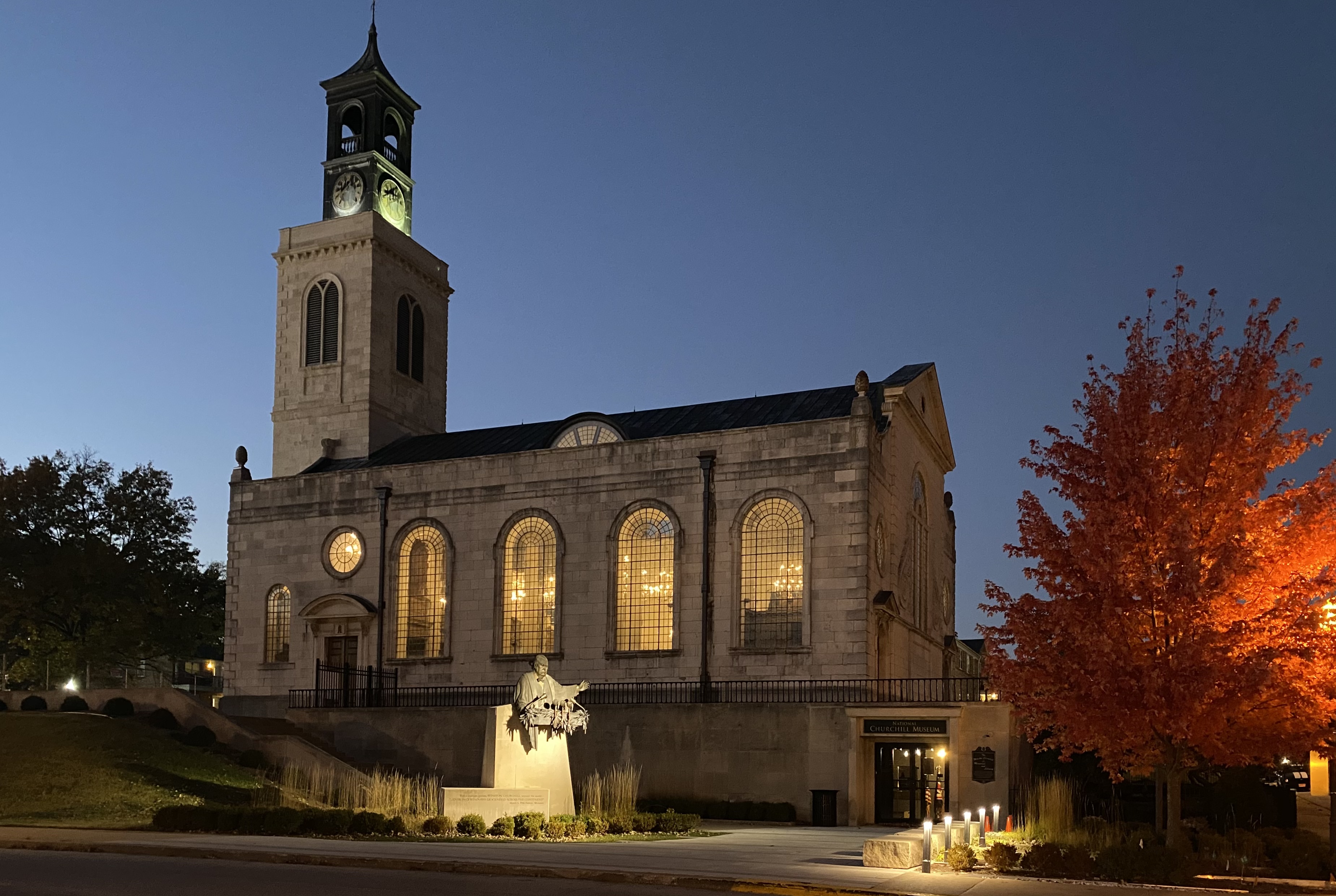
National Churchill Museum
A 17th-century London church stands in Fulton, Missouri, population 12,000, surrounded by the flat farmland of Callaway County. This is not a replica. Every stone of the Church of St. Mary the Virgin, Aldermanbury was numbered, crated, shipped across the Atlantic, and reassembled on the campus of Westminster College beginning in 1966. Outside its doors, eight slabs of the Berlin Wall form a sculpture called Breakthrough. The juxtaposition is deliberate and startling: a Christopher Wren church, a Cold War monument, and the echoes of the most consequential speech of the twentieth century, all on the grounds of a small liberal arts college in the American heartland.
The Speech That Named the Cold War
On March 5, 1946, Westminster College president Franc McCluer pulled off a remarkable coup. Through Major General Harry H. Vaughan, a Westminster alumnus serving in the Truman administration, McCluer arranged for President Harry S. Truman himself to introduce Winston Churchill at the college's John Findley Green Foundation Lecture series. Churchill, no longer prime minister but still commanding global attention, delivered his 'Sinews of Peace' address. The line that made history was blunt: 'From Stettin in the Baltic to Trieste in the Adriatic, an iron curtain has descended across the Continent.' The phrase 'iron curtain' entered the lexicon instantly, defining the geopolitical divide that would shape the next four decades. Today the lectern and chair Churchill used that day remain on display in the museum beneath the church, artifacts of a moment when words in a small Missouri auditorium redrew the map of the world.
A Church That Survived the Great Fire and the Blitz
The Church of St. Mary, Aldermanbury traces its origins to the late 12th century in London. It survived the English Reformation, the English Restoration, and numerous civil wars before the Great Fire of London destroyed it on September 2, 1666. Architect Christopher Wren rebuilt the church on part of the old foundation between 1672 and 1677, salvaging as many original stones as possible. A cupola crowned the tower by 1679. For over 260 years the Wren church served its London parish. Then, during the Blitz of World War II, German incendiary bombs gutted the interior, leaving only the walls and tower standing. The ruin sat untouched for two decades, slated for demolition, until a 1961 LIFE magazine feature on endangered Wren churches caught the attention of Westminster College President Robert L. D. Davidson. He saw the perfect memorial: a church with a nearly 1,000-year history, small enough to transport, and deeply connected to the war Churchill had led Britain through.
Stone by Stone Across the Atlantic
The logistics of moving a 17th-century church across an ocean were staggering. Each stone was catalogued and numbered before being carefully dismantled and shipped to Missouri. The rebuilding on the Westminster College campus faithfully followed Wren's original design. Beneath the reconstructed church, a museum was created to present the narrative of Churchill's life alongside the critical events of the 20th century. The exhibitions are immersive: visitors can stand inside a recreated World War I trench complete with barbed wire, sandbags, and the distant sounds of shellfire, experiencing what Churchill witnessed as a young officer. A Blitz simulation room replicates an air raid on London with flashing searchlights, detonating bombs, and sirens. A film narrated by Walter Cronkite examines Churchill's wartime leadership. The 'Winston's Wit and Wisdom' room seats visitors in a simulated British club, where they listen to recordings of Churchill's famous quips and search a database of his quotations.
Breakthrough: The Wall Comes to Missouri
On November 9, 1990, exactly one year after the fall of the Berlin Wall, 7,000 people gathered on the Westminster College campus to witness the unveiling of Breakthrough. The sculptor was Edwina Sandys, Churchill's granddaughter, and her medium was history itself: eight concrete sections of the Berlin Wall, each bearing traces of the graffiti that once marked the boundary between freedom and repression. The sculpture shows two human silhouettes walking through an opening in the wall, a visualization of the liberation Churchill had envisioned in his 1946 speech. The pairing of the Wren church and the Wall fragments creates a remarkable arc of meaning -- from the warning of an iron curtain to the physical evidence of its dismantling, all anchored in this unlikely Missouri setting. The museum continues to host distinguished lecture series established in 1936 and 1979, maintaining the tradition of global dialogue that Churchill inaugurated on this campus eight decades ago.
From the Air
Located at 38.85°N, 91.95°W on the Westminster College campus in Fulton, Missouri. The college campus is identifiable from the air by the church's distinctive tower and surrounding quadrangle in the center of the small city. Fulton Memorial Airport (KFTT) is approximately 2 nm south of town. Jefferson City Memorial Airport (KJEF) is about 25 nm southwest. The terrain is gently rolling central Missouri at approximately 800 feet MSL. The church and Breakthrough sculpture are best appreciated from lower altitudes in clear conditions, though the campus layout is visible from 3,000-5,000 feet.