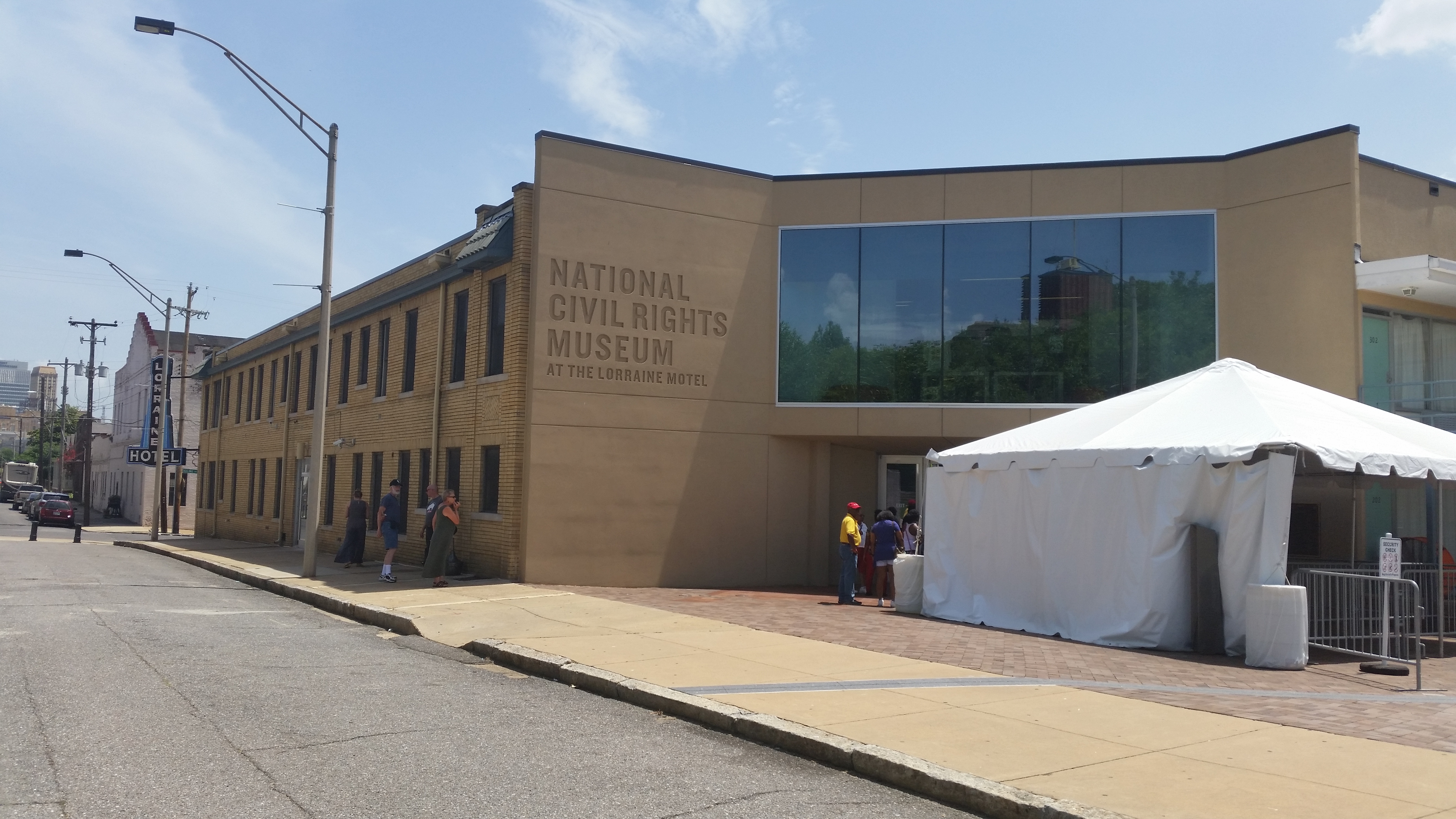
National Civil Rights Museum
A wreath hangs on the second-floor balcony railing of Room 306, marking the approximate spot where Martin Luther King Jr. stood on the evening of April 4, 1968, when a single bullet ended his life at the age of 39. The Lorraine Motel, once a favorite of musicians recording at nearby Stax Records -- Ray Charles, Aretha Franklin, Otis Redding all slept here -- became overnight the most charged address in the American civil rights movement. Today it is the centerpiece of the National Civil Rights Museum, a complex of buildings in Memphis's South Main Arts District that traces the long arc of that struggle from the 17th century to the present.
From the Windsor to the Lorraine
The site began its life modestly. It opened as the 16-room Windsor Hotel in 1924, later became the Marquette Hotel, and was purchased in 1945 by Walter Bailey, who renamed it for his wife Loree and the song "Sweet Lorraine." Bailey expanded it significantly, adding a second floor, a swimming pool, and drive-up access. He changed the name from the Lorraine Hotel to the Lorraine Motel. In the 1960s, it became a gathering place for Black musicians recording at Stax Records on McLemore Avenue -- Lionel Hampton, Ethel Waters, the Staple Singers, and Wilson Pickett all stayed there. It was a thriving, vibrant place, deeply embedded in the culture and music of Black Memphis.
The Evening of April 4
King came to Memphis in early April 1968 to organize protests around the ongoing sanitation workers' strike. He took Room 306 at the Lorraine. On the evening of April 4, while standing on the balcony, he was shot once through the neck and rushed to St. Joseph's Hospital, where he died an hour later. James Earl Ray, a 40-year-old resident of a rooming house across the street, was convicted of the murder in 1969 after pleading guilty on his 41st birthday. He later recanted his confession. The King family has long believed that Ray was not the sole culprit. Within days of the assassination, supporters began calling for a permanent memorial at the motel. By June 1968, Room 306 had been converted into a shrine open to the public.
Saving the Lorraine
In the years after the assassination, business at the motel declined. By 1980, approximately 15,000 people signed the guestbook annually, while an estimated 70,000 visited on commercial tours. But Bailey was deeply in debt. When foreclosure loomed, the newly formed Martin Luther King Memphis Memorial Foundation scrambled to save the building, holding fundraisers that included an exhibition basketball game featuring Magic Johnson, Isiah Thomas, George Gervin, and Marques Johnson. The effort raised only $96,568 of the needed $240,000 by the deadline. The foundation took out a $50,000 loan and won the auction with a bid of $144,000. The motel closed to customers on January 10, 1988, when the state took possession. Bailey, who had lived there for over 40 years, moved out that day. He died later that year.
The Vigil That Never Ended
When the motel closed, one resident refused to leave. Jacqueline Smith, a housekeeper who had lived at the Lorraine since 1973, was forcibly carried out by four sheriff's deputies on March 2, 1988. She shouted, "You people are making a mistake. If King were alive he wouldn't want this." True to her word, she pitched a tent on the sidewalk outside. She has been there ever since -- a round-the-clock vigil lasting more than 35 years. Smith argues that King would have objected to millions spent on a memorial when the surrounding neighborhood community, predominantly Black and lower-income, needed direct investment. She has called the museum the "James Earl Ray Memorial" for its focus on the moment of King's violent death, and has spoken to thousands of museum visitors from her post across the street.
A Living Archive
The museum opened to the public on September 28, 1991, designed by Nashville firm McKissack and McKissack with guidance from Smithsonian Institution curator Benjamin Lawless. In 1999, the foundation acquired the Young and Morrow Building across the street, where Ray had confessed, and built a tunnel connecting it to the motel. The museum now holds the police and evidence files from the assassination, including the rifle and fatal bullet. After a major renovation, it reopened in 2014 with interactive displays, a replica of the U.S. Supreme Court room where Brown v. Board of Education was argued, listening stations featuring Malcolm X, and more than 40 short films. In 2016, it became an affiliate of the Smithsonian Institution. Room 306 remains preserved as it was -- a frozen moment in a motel that once hummed with music and now carries the weight of history.
From the Air
The National Civil Rights Museum (Lorraine Motel) is located at 35.135N, 90.058W at 450 Mulberry Street in downtown Memphis. The site is about six blocks east of the Mississippi River in the South Main Arts District. Nearby airports include Memphis International (KMEM) about 8 miles south. Best viewed at 2,000-3,000 feet AGL. The museum complex includes the motel building with its distinctive signage and the Young and Morrow Building across Mulberry Street.