National Defence Academy (India)
Four hundred thousand applicants sit for the exam each year. Roughly three hundred will make it through. Those who do enter a world where army, navy, and air force cadets share barracks, classrooms, and the same unforgiving dawn reveille -- a concept so unusual that when the National Defence Academy was commissioned on 7 December 1954, no other country had attempted it. Located at Khadakwasla on the outskirts of Pune, with Sinhagad Fort as its backdrop and Khadakwasla Lake as its training ground, the NDA occupies a landscape that seems designed to test ambition against terrain.
Born from the Wreckage of War
The idea emerged from exhaustion. At the end of World War II, Field Marshal Claude Auchinleck, then Commander-in-Chief of the Indian Army, led a committee around the world studying military training and submitted a report to the Government of India in December 1946. His recommendation was simple and radical: a joint services academy, modeled partly on West Point, where the three branches would train as one. India's independence came eight months later, and the Chiefs of Staff Committee moved immediately to implement the plan. While they searched for a permanent site, an interim Joint Services Wing was commissioned on 1 January 1949 at the Armed Forces Academy in Dehradun. The state of Bombay ultimately won the competition for the permanent campus, offering the most generous land -- including a lake and surrounding hills -- in what would become one of the most significant military education experiments in modern history.
Where Three Services Share One Sky
What makes the NDA remarkable is not just that it trains officers, but how. A future tank commander and a future fighter pilot eat at the same mess, compete in the same inter-squadron championships, and push through the same grueling physical regimen before diverging toward their specialties. Air Force cadets learn to fly Super Dimona aircraft on a runway maintained within the campus itself -- a tradition that evolved from glider training that began in 1957, when five classes of gliders were first acquired. Naval cadets sail whalers on Camp Varuna expeditions and train in firefighting and damage control. Army cadets run field exercises at Camp Green Horn. But for the first four semesters, everyone studies the same compulsory curriculum: physics, chemistry, military history, geopolitics, and a foreign language chosen from Arabic, Chinese, French, or Russian. The academy's 18 squadrons, organized into five battalions, each carry their own mascot, nickname, and fiercely guarded identity.
The Weight of the Record
The numbers tell a story of consequence. Alumni of the NDA have earned 4 Param Vir Chakras -- India's highest wartime gallantry decoration -- along with 31 Maha Vir Chakras, 160 Vir Chakras, and 12 Ashok Chakras. The academy has produced 11 Chiefs of Army Staff, 10 Chiefs of Naval Staff, and 4 Chiefs of Air Staff. In 2019, when Lieutenant General Manoj Mukund Naravane was promoted to Chief of Army Staff, all three service chiefs simultaneously were NDA graduates from the same 61st course -- a coincidence that underlined just how thoroughly the institution had woven itself into the command structure of the Indian Armed Forces. In August 2021, the Supreme Court of India opened the NDA entrance examination to female candidates, beginning a new chapter for an institution built in the language of its own motto: Service Before Self.
A Campus Shaped by Landscape
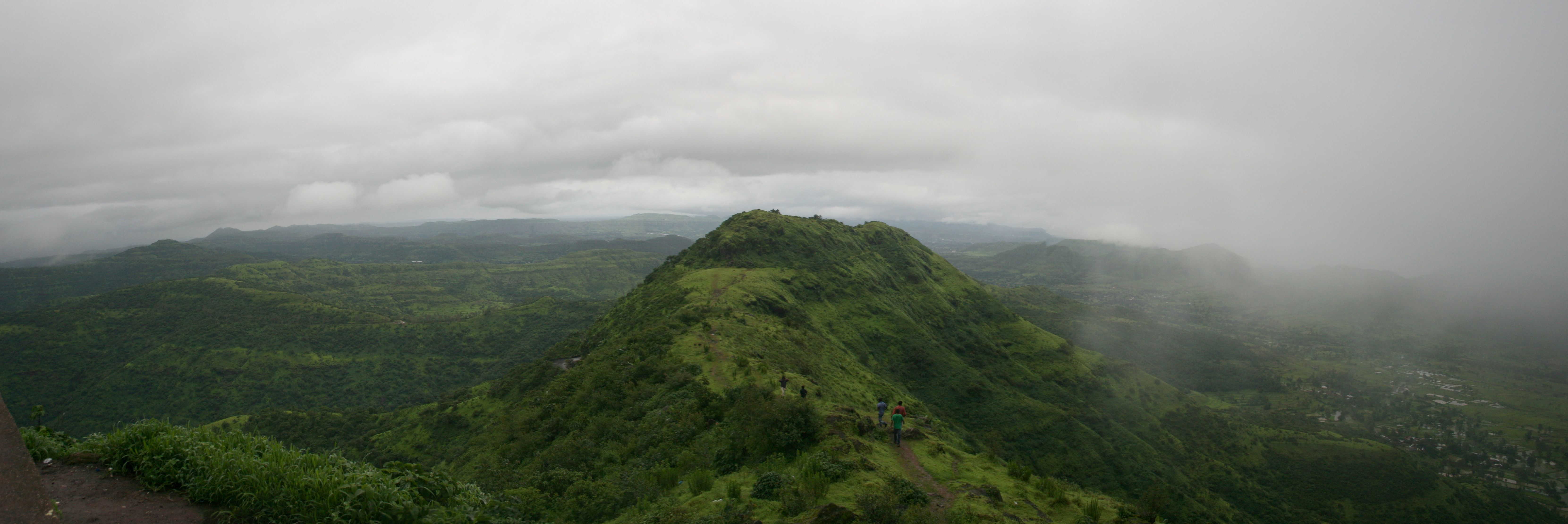
The setting is no accident. Situated about 17 kilometers southwest of Pune city, the campus spreads across donated land northwest of Khadakwasla Lake. Sinhagad Fort rises in the background, a reminder that military history in this region stretches back centuries before any modern academy existed. The site was chosen for practical reasons as well: proximity to the Arabian Sea for naval exercises, an operational air base at nearby Lohagaon, and the discovery of an old combined-forces training center complete with a disused mock landing ship, HMS Angostura, on the lake's north bank. The Sudan Block, the academy's most iconic building, anchors a campus that includes parade grounds, academic halls, and the kind of terrain -- hilly, monsoon-drenched, demanding -- that seems calculated to remind every cadet that comfort is not part of the curriculum.
From the Air
Located at 18.42N, 73.77E, about 17 km southwest of Pune. The NDA campus is visible as a large institutional complex northwest of Khadakwasla Lake, with Sinhagad Fort rising behind it. Recommended viewing at 3,000-5,000 ft AGL. Nearest airport: Lohagaon Air Force Station / Pune Airport (VAPO). The campus includes a visible runway used for cadet flight training.